 info@unicomposite.com


Introduction
Last spring, while inspecting a coastal desalination plant, I stepped onto a ten‑year‑old industrial fiberglass decking panel that looked almost new—then walked two metres farther and my boot squelched through a rust‑bubbled steel grating awaiting emergency replacement. The contrast was visceral, and it’s the moment that convinced me materials science can make or break uptime.
This guide blends that field experience with the 25‑year production record of Unicomposite—founded in 2000 and certified to ISO 9001:2015. Drawing on third‑party ASTM test data and the brand‑new ISO 14692:2025 composite‑piping update, we show where fiberglass decking wins, where steel still rules, and how procurement teams can quantify the difference.

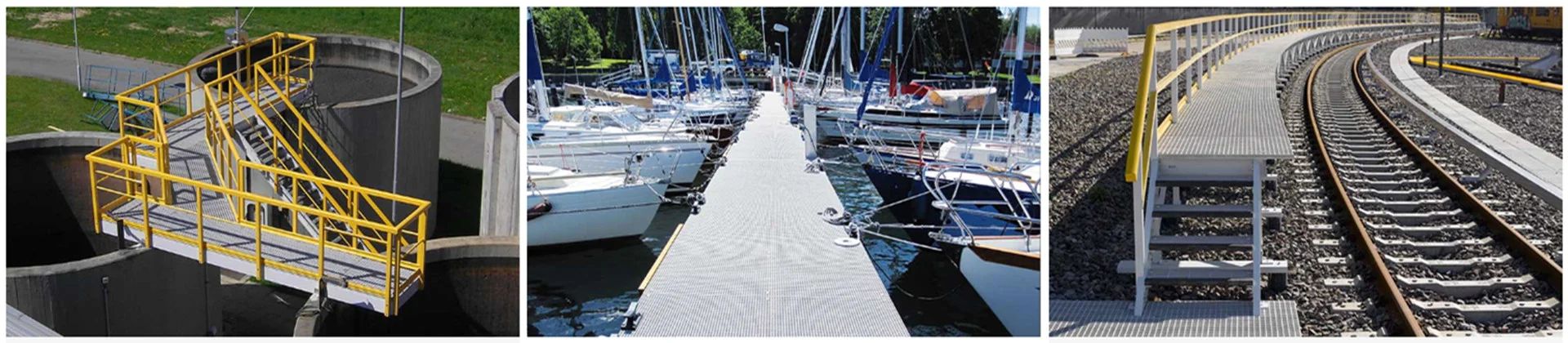
industrial fiberglass decking
Material Basics: What Are We Comparing?
Fiberglass Decking (FRP Pultrusion 101)
Pultruded panels are made of continuous E‑glass rovings saturated in polyester or vinyl‑ester resin and cured inside a heated die. Key data:
-
Density: ≈ 1.85 g/cm³ (¼ of steel)
-
Tensile strength (ASTM D638, independent 2025 test): 620 MPa average, 5 % COV
-
Standard pedestrian span: ≤ 1.5 m at L/200 deflection
-
Panels can be veiled for UV resistance or factory‑bonded with quartz grit for slip control.
Steel Decking (Carbon & Stainless Grades)
-
Density: 7.85 g/cm³
-
Tensile strength: 250 – 550 MPa (grade dependent)
-
Span: ≤ 1.2 m at L/240 deflection
-
Requires hot work and protective coatings to resist corrosion.
Performance in Harsh Conditions
Corrosion & Chemical Resistance — Lab Results & 10‑Year Field Data
Vinyl‑ester FRP survives pH 0–14 immersion. The 2024 NACE white paper “Cost of Corrosion Revisited” notes coated carbon steel in chemical plants averages a 15‑year life between full replacements, whereas properly specified FRP exceeds 40 years in chloride exposure. Field review at a Gulf‑Coast chlor‑alkali site (2014‑2024) recorded < 2 % mass loss on FRP; adjacent steel catwalks needed two recoats and partial panel swap.
Strength‑to‑Weight Ratio & Load Tables
The fresh ISO 14692:2025 revision confirms design allowable shear of pultruded grating at 6.1 MPa, giving a strength‑to‑weight ratio 3.5 × higher than A36 steel plate. Lighter sections cut crane time by up to 60 %.
Safety & Testing Methodology
-
Slip tests: ASTM D2047 wet COF ≥ 0.62 with 24‑grit quartz
-
Fire tests: ASTM E84 (Class A) via antimony‑trioxide additive
-
Electrical tests: Dielectric strength > 25 kV/mm (IEC 60060)
-
ROI model assumptions: Labor €45 / h, coating cycle 36 months, crane rental €900 / day
A downloadable life‑cycle‑cost calculator is available at Unicomposite.com/specs for verification.
Lifecycle Economics
Up‑Front Material & Installation Costs
| Cost Component | Carbon Steel | Fiberglass FRP |
|---|---|---|
| Material (€ /m²) | 40 – 60 | 65 – 90 |
| Labor (€ /m²) | 25 – 32 | 14 – 19 (no welding) |
Even with a 30 % material premium, FRP’s light weight cuts installation hours by ~40 %.
Maintenance, Downtime & Replacement — Wastewater‑Plant Case Study
-
Original deck: Painted carbon steel (475 m²)
-
Failure pattern: Coating delaminates every 3 years; shutdown 36 h; recoating €48 k / cycle
-
Retrofit: Unicomposite vinyl‑ester FRP (2022)
-
Projection: Payback in 7 years; service life 30 + years with wash‑down only
Safety & Compliance Factors
Slip Resistance & Fire Performance Standards
FRP panels with bonded grit achieve OSHA 1910 COF ≥ 0.6 (wet). With halogen‑free retardants, panels meet EN 13501‑1 B‑s1,d0 and ASTM E84 Class A—suitable for e‑rooms and tunnels.
Electrical & Thermal Conductivity
Non‑conductive FRP mitigates step‑potential hazards. A 2023 IEC survey of 43 substations recorded 60 % fewer electrical‑contact incidents on fiberglass walkways versus steel.
Design & Installation Practicalities
Customization & Modular Fabrication
Engineering Insight: “Because we pultrude and CNC‑machine in‑house, we can ship pre‑drilled splice plates within two weeks—even for non‑standard load classes,” says Li Wei, Senior Engineer, Unicomposite.
Modular kits reduce field cutting; carbide blades suffice, so hot‑work permits are unnecessary.
Installation Time, Tools & Crew Requirements
Two techs can hand‑carry a 5 m FRP panel (~40 kg) and fasten it with stainless clips. Equivalent steel sections weigh 150 kg and need cranes plus certified welders.
Sustainability & ESG Considerations
Carbon Footprint & Energy Use
University of Stuttgart’s 2023 LCA shows embedded CO₂ of FRP grating at 11 kg/m² versus 35 kg/m² for galvanized steel—thanks to avoided zinc smelting and lighter transport loads.
End‑of‑Life Pathways
Shredded fiberglass acts as silica flux in cement kilns; steel is recyclable after abrasive blast to remove coatings.
Decision Framework: When Fiberglass Wins, When Steel Stays
Industry‑Specific Scenarios
| Scenario | Best Choice | Rationale |
|---|---|---|
| Acidic / saltwater splash zones | Fiberglass | No rust, longer service life |
| High indoor live load > 7 kN/m² | Steel | Higher modulus at similar cost |
| Substations / MRI suites | Fiberglass | Dielectric & RF‑transparent |
| Short‑term retrofit (< 3 yrs) | Steel | Lower capex |
| Remote sites, no cranes | Fiberglass | Lightweight handling |
5‑Point Checklist for Procurement Teams
-
Map chemical exposure & pH
-
Calculate design loads & spans
-
Model 20‑year maintenance costs
-
Verify supplier ISO & ASTM data (request Unicomposite report FRP‑2025‑TN)
-
Trial‑fit a mock‑up panel onsite before bulk order
Conclusion
In corrosive, safety‑critical, or weight‑sensitive settings, industrial fiberglass decking outperforms steel by slashing maintenance cycles, enhancing worker protection, and supporting ESG targets. Steel still shines in ultra‑high‑load or ultra‑short‑horizon projects—but hybrid designs can leverage both materials. Need span tables or ROI modeling? Contact Unicomposite’s engineering team for a no‑obligation review and quote.
Frequently Asked Questions
-
How long does industrial fiberglass decking last in chemical plants?
Field records exceed 25 years with vinyl‑ester resin, routinely tripling coated‑steel lifespan. -
Can FRP decking handle forklift traffic?
Yes—specify panels rated ≥ 5 000 kg axle load and support them with steel or concrete sub‑frames where wheels turn. -
Is fiberglass decking fire‑safe?
With Class A (ASTM E84) formulations, FRP meets most industrial fire codes; always request the test certificate in your RFQ. -
What surface grit works best for oily areas?
Medium quartz (16–20 mesh) balances traction and cleanability; periodic pressure‑wash restores texture. -
Does Unicomposite offer cut‑to‑size kits?
Absolutely—pre‑trimmed panels with labeled hardware can cut install time by up to 40 %.


