 info@unicomposite.com


Introduction
Wet platforms, oily walkways, washdown areas, marine docks, and outdoor maintenance decks can become slip-risk zones when the walking surface is not matched to the environment. For engineers, procurement managers, and operations teams, decking is not only a floor surface. It is part of site access, worker safety, maintenance planning, and uptime control.
Non skid fiberglass decks offer an FRP decking option for industrial sites that need traction, corrosion resistance, lightweight handling, and custom panel specifications. This guide explains what these panels are, where they fit, how they compare with wood decking, and what buyers should confirm before requesting a quote.
The focus is practical B2B selection: FRP decking and planking, anti-slip surface options, resin systems, application matching, RFQ preparation, and custom supply.
non skid fiberglass decks for industrial safety
What Are Non Skid Fiberglass Decks?
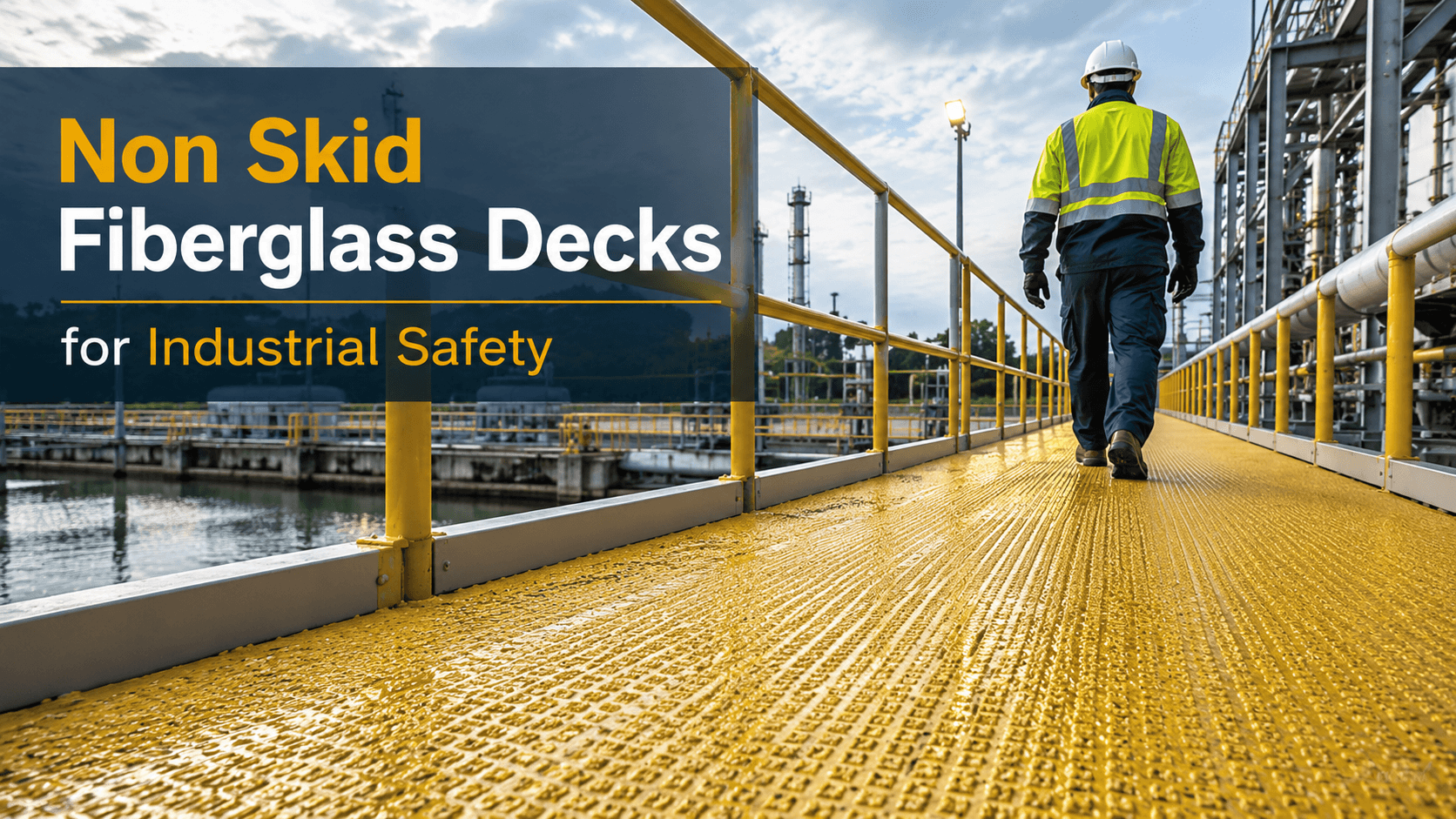
Non skid fiberglass decks are FRP decking panels, planks, or sheets with textured, gritted, molded, or coated surfaces designed to improve traction on platforms, walkways, docks, equipment access areas, and wet industrial floors. They combine fiberglass reinforcement with a resin matrix, then add a walking surface suited for site conditions.
Related terms include fiberglass deck, fiberglass decks, fiberglass decking panels, FRP decking, fiberglass planking, fiberglass non skid panels, and non skid fiberglass sheets. These terms may describe different shapes or applications, but the buyer intent is similar: a safer and more durable walking surface for demanding environments.
How They Differ from Standard Fiberglass Panels
Standard fiberglass panels may provide structural coverage, shielding, or enclosure support. Non skid decks must also address walking performance, so buyers should specify panel size, thickness, support span, load requirement, resin system, surface finish, and installation environment.
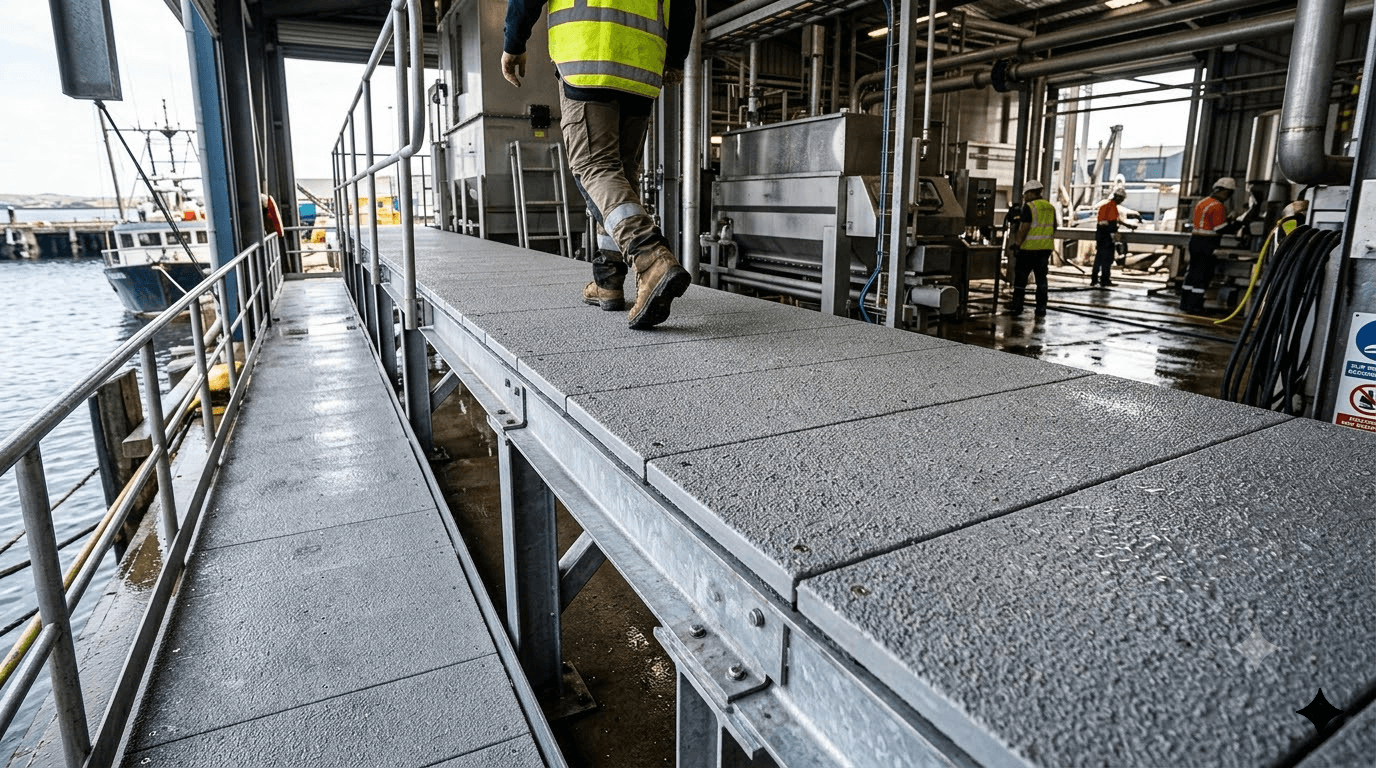
Anti-slip surfaces may be gritted for wet platforms, textured for regular foot traffic, molded into the panel surface, coated for specific grip needs, or covered when buyers need a more continuous walking surface. Surface choice affects traction, cleaning, drainage, wear behavior, and long-term maintenance.
What are non skid fiberglass decks used for?
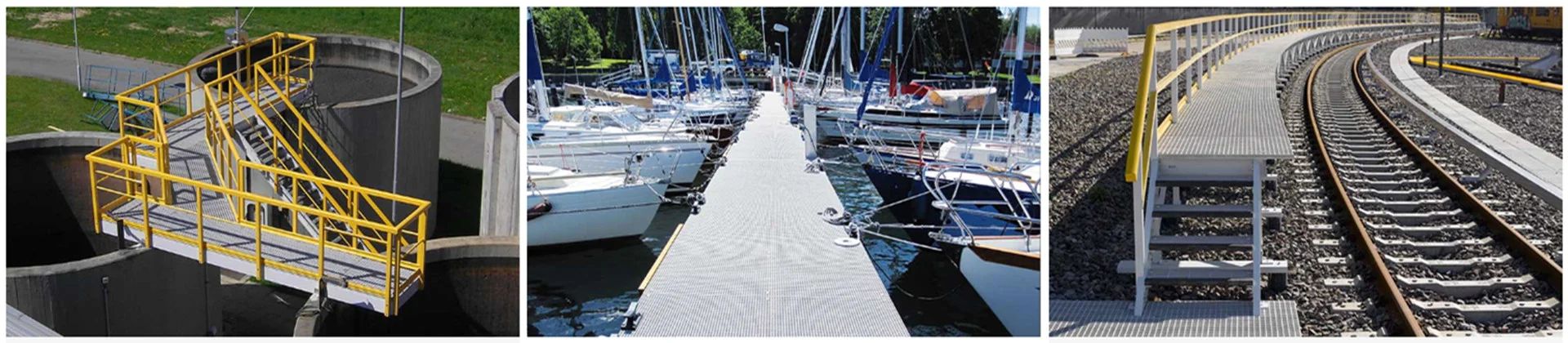
Non skid fiberglass decks are used for wet platforms, industrial walkways, marine docks, equipment access decks, utility areas, and maintenance routes where buyers need traction, corrosion resistance, lightweight handling, and custom FRP panel options. They are especially relevant in wastewater, marine, utility, food processing, and factory environments.
In field applications, engineers often specify these panels when water, oil, salt, cleaning chemicals, or outdoor exposure would make untreated wood or painted metal difficult to maintain.
Why Industrial Buyers Choose Non Skid Fiberglass Decking
Beyond the deck surface itself, industrial buyers look at how a panel behaves after repeated exposure to rain, cleaning, oil mist, salt air, chemical splash, foot traffic, and equipment access. Non skid fiberglass decking can support safer access when surface finish, resin, support span, fastening, cleaning, and inspection match the service environment.
Slip Resistance in Wet or Oily Areas
Textured or gritted FRP surfaces can improve footing in washdown areas, rain-exposed platforms, marine walkways, and areas exposed to oil or process fluids. Actual walking performance depends on surface profile, contaminant type, cleaning routine, footwear, panel slope, and inspection frequency.
For procurement, the practical step is clear: buyers should define whether the deck is used in wet walking, oily service, outdoor access, chemical washdown, or occasional maintenance traffic before selecting the surface finish.
Corrosion Resistance in Harsh Environments
FRP does not rot like wood or rust like steel. This makes it useful in wet, chemical, salt, and outdoor environments where moisture and corrosion can shorten service life.
Durability still depends on correct specification. Resin system, chemical concentration, UV exposure, operating temperature, cleaning method, fasteners, support design, installation quality, and inspection schedule all affect long-term results.
Lightweight Handling and Easier Installation
Fiberglass decking panels are often easier to handle than many metal deck systems. Lighter panels can reduce lifting complexity, field cutting difficulty, and installation fatigue.
In a maintenance deck retrofit, one buyer sent support-frame drawings, drilling positions, and walkway-zone references before production. The supplier delivered panels pre-cut, pre-drilled where required, labeled by zone, and packed with matching installation notes, reducing field cutting and sorting during installation.
Lower Maintenance Potential
Non skid fiberglass decking can reduce repainting, sealing, corrosion repair, rot-related replacement, and recurring surface treatment when properly specified. It should not be treated as maintenance-free.
Buyers should still plan inspections, cleaning, fastener checks, and surface review. Lower maintenance works best when resin, support design, surface finish, and site conditions align.
Why are non skid fiberglass decks suitable for industrial safety?
Non skid fiberglass decks support industrial safety because they combine anti-slip surface options, corrosion resistance, lightweight handling, and custom panel design for wet, outdoor, marine, utility, and industrial access areas. They help buyers specify walking surfaces around real site risks instead of relying on general-purpose decking.
For safety and operations teams, the value is not only the material. It is the ability to match surface texture, resin system, span, load requirement, fastening, and fabrication to the working environment.
Non Skid Fiberglass Decks vs Wood Decking
Wood decking can still work in low-cost, decorative, temporary, or low-exposure applications. Industrial environments, however, place different demands on a walking surface.
The table below compares non skid fiberglass decks with wood decking from an industrial buyer’s perspective:
| Comparison Item | Non Skid Fiberglass Decks | Wood Decking | Buyer Note |
|---|---|---|---|
| Wet surface traction | Can use gritted or textured surface | Can become slippery when wet | Match surface to washdown and exposure |
| Moisture resistance | Does not rot like wood | Can absorb moisture and rot | Useful in wet or outdoor areas |
| Chemical exposure | Resin can be selected by environment | Often vulnerable to chemicals | Confirm chemical type and concentration |
| Maintenance | Lower sealing or repainting needs | May need sealing, sanding, replacement | Avoid maintenance-free assumptions |
| Weight and handling | Lightweight FRP panels | Varies by species and moisture | Check handling and installation plan |
| Custom options | Size, surface, color, thickness, resin | Limited industrial customization | Useful for engineered projects |
| Long-term consistency | Repeatable panel specs and packaging | Natural material variation | Helpful for repeat orders |
Where Wood Decking May Still Fit
Wood may fit low-budget, temporary, decorative, or low-exposure applications. It can also be easier to source locally when the project does not require chemical resistance, custom surface finish, or repeatable industrial specifications.
The trade-off is upkeep. Wood may need sealing, inspection, repair, and replacement depending on moisture exposure, loading, and service environment.
Where FRP Decking Is Usually a Better Fit
FRP decking is usually a better fit for wet, corrosive, industrial, marine, utility, and washdown environments. These sites often need slip resistance, corrosion resistance, dimensional consistency, and reduced maintenance disruption.
For buyers managing multiple facilities or repeat orders, FRP also offers more control over panel dimensions, color, surface, packaging, and documentation.
Where Non Skid Fiberglass Decking Is Used
A wastewater platform, marine dock, and utility walkway may all use fiberglass decking, but each one requires different specification priorities. Buyers should match the deck to the work area before comparing price.
The table below summarizes common B2B applications:
| Application | Typical Buyer | Decking Requirement | Why FRP Decking Fits |
|---|---|---|---|
| Wastewater platforms | Municipal facilities | Moisture and corrosion resistance | Supports wet maintenance access |
| Chemical plants | Industrial operators | Resin matched to exposure | Useful near splash or process areas |
| Marine docks | Coastal facilities | Salt, moisture, UV, traction | Supports outdoor wet access |
| Utility walkways | Power and telecom buyers | Lightweight, non-conductive material | Helps access equipment areas |
| Equipment access decks | OEMs and factories | Custom panels and cutouts | Fits machinery or service platforms |
| Food processing areas | Plant operators | Washdown and slip-resistance needs | Supports cleaning and worker access |
| Outdoor industrial platforms | Contractors and facility owners | Weather-resistant walking surface | Reduces rot and rust concerns |
Wastewater and Chemical Facilities
Wastewater and chemical facilities use non skid fiberglass decking on maintenance platforms, access walkways, equipment decks, and trench-adjacent areas. Moisture, cleaning chemicals, and process exposure can create maintenance problems for wood or steel surfaces.
Buyers should match resin and surface finish to exposure conditions. Chemical type, concentration, temperature, cleaning frequency, and splash risk should be confirmed before final selection.
Marine Docks and Outdoor Walkways
Marine docks and outdoor walkways face salt air, moisture, UV exposure, rain, algae risk, and slip-resistance needs. FRP decking can help reduce rust and rot concerns while providing custom surface options.
Outdoor durability depends on resin, surface finish, fasteners, support design, installation quality, and inspection. Buyers should avoid relying on a generic “outdoor use” label without reviewing the specification.
Utility, Power, and Equipment Access Areas
Utility, power, and industrial equipment areas may require lightweight panels, dielectric properties, and reliable access for maintenance teams. Non-conductive FRP material can support these environments when the deck design fits the load and support layout.
Buyers should confirm load, span, fastening method, access frequency, and cleaning needs before ordering. These details prevent under-specification.
How to Specify Non Skid Fiberglass Decking
A clear RFQ helps suppliers recommend the right panel and prevents repeated quote revisions. Buyers should provide enough technical information to avoid guessing.
The table below can be used as a practical RFQ checklist:
| RFQ Item | What to Provide | Why It Matters |
|---|---|---|
| Application | Wastewater platform, dock, access deck | Defines environment and use |
| Panel size | Length and width | Supports sizing and layout |
| Thickness | Required or suggested thickness | Works with span and load |
| Support span | Frame spacing or support layout | Affects deflection and safety |
| Load requirement | Foot traffic, equipment, point load | Guides panel selection |
| Surface finish | Gritted, textured, molded, covered | Matches traction and cleaning needs |
| Resin system | Moisture, chemical, marine, UV, fire needs | Matches exposure conditions |
| Color | Standard or custom color | Supports safety zoning or branding |
| Fabrication | Cutting, drilling, edge finishing | Reduces jobsite work |
| Quantity | Panels, square meters, or project batch | Supports production planning |
| Packaging | Bundles, pallets, labels | Improves receiving and installation |
| Destination | Port, warehouse, or project site | Supports logistics and quoting |
| Drawings | Layout, frame, or installation sketch | Reduces specification errors |
Panel Size and Thickness
Buyers should provide length, width, thickness, support span, exposed area, and whether panels need to fit an existing frame. Thickness should be selected together with support spacing and load requirement.
A thicker panel does not automatically solve every issue. Load type, fastening, frame condition, and support layout all affect performance.
Surface Finish
Surface finish controls more than traction. It also affects cleaning, drainage, wear behavior, and maintenance routines.
Gritted surfaces often fit wet platforms, marine walkways, and washdown areas. Textured surfaces may suit regular foot traffic. Covered panels can help when buyers need a more continuous surface or want to reduce object fall-through.
Resin System
Resin choice should reflect moisture, chemicals, salt exposure, UV exposure, fire requirements, cleaning frequency, and operating temperature. Marine or outdoor use may require stronger attention to salt, UV, and fastener compatibility, while chemical areas require more detailed exposure information.
Buyers should describe the environment clearly. “Chemical area” is less useful than naming the exposure type, cleaning method, temperature, and whether contact is occasional splash or regular washdown.
non skid fiberglass decks
Cutting, Drilling, and Installation
Pre-cutting, drilling, edge finishing, and labeled panel groups can reduce site work. This is especially useful in retrofits where panels must match existing frames or bolt patterns.
When buyers provide drawings before production, suppliers can group panels by walkway section, mark packages by area, and reduce field measuring. This improves installation speed and limits avoidable cutting errors.
What should buyers send for a fiberglass decking quote?
Buyers should send application, panel size, thickness, support span, load requirement, surface finish, resin system, cutting or drilling needs, drawings, quantity, packaging, destination, and delivery expectations for an accurate fiberglass decking quote. These details help the supplier match the deck to the actual industrial environment.
For repeat orders, buyers should also include approved drawings, previous specifications, color requirements, packaging format, and labeling needs.
When Should Buyers Use FRP Grating Instead?
Fiberglass decking and fiberglass grating solve related but different problems. The fastest way to choose is to decide whether the site needs a more continuous surface or an open mesh structure.
Fiberglass Decking vs Fiberglass Grating
Fiberglass decking or planking is better when buyers need a more continuous walking surface, covered panel, or non skid sheet-style surface. Fiberglass grating is better when drainage, ventilation, and open mesh are more important.
The correct choice depends on water flow, debris, foot traffic, dropped-object risk, maintenance access, and cleaning requirements.
When Fiberglass Decking Makes More Sense
Fiberglass decking makes more sense for covered walkways, equipment decks, access floors, retrofit planks, non skid panels, and areas requiring a closed or semi-closed walking surface.
It also fits applications where buyers want custom sizes, colors, surface textures, or cut-to-fit panels for existing frames.
When Fiberglass Grating Makes More Sense
Fiberglass grating makes more sense for open platforms, trench covers, drainage areas, wastewater walkways, chemical splash zones, and marine docks that need open mesh.
Open grating can help with water drainage and ventilation. It may also reduce surface accumulation in certain environments.
How should buyers choose between fiberglass decking and grating?
Buyers should choose fiberglass decking when they need a more continuous non skid surface and choose fiberglass grating when drainage, ventilation, open mesh, and lighter panel openings matter more. The best choice depends on walking safety, cleaning needs, dropped-object risk, support span, and exposure conditions.
For complex projects, engineers may use both products in different areas of the same facility.
Source Custom Non Skid Fiberglass Decks from Unicomposite
For B2B buyers, custom supply helps turn project requirements into a repeatable decking specification. Unicomposite Technology Co., Ltd. is an ISO 9001 certified FRP and GRP composite manufacturer based in Nanjing, China, with an 18,000-square-meter facility.
The company supports pultrusion, pulwinding, SMC/BMC molding, hand lay-up, vacuum infusion, and custom composite fabrication. For fiberglass decking buyers, these capabilities map directly to procurement benefits: consistent profiles, cut-to-size panels, repeatable surface finish, labeled packaging, export-ready pallets, and sample review before bulk production.
Custom Manufacturing Capabilities
Unicomposite can support fiberglass decking and planking requirements such as panel size, thickness, resin system, surface finish, color, cutting, drilling, edge finishing, packaging, labeling, and bulk quantity.
This helps engineers, procurement managers, utilities, OEMs, marine buyers, and industrial contractors specify panels around actual site conditions rather than standard catalog assumptions.
Custom Options for B2B Buyers
Custom options may include gritted or textured walking surfaces, specific panel dimensions, safety colors, cut-to-size sections, drilled holes, export cartons, pallets, labels, and repeat-order packaging.
For distributors and project buyers, consistent packaging and documentation matter. A stable specification helps reduce confusion when the same deck is ordered again.
Procurement and Quality Checks Before Ordering
Before ordering, buyers should confirm the working environment, support span, load requirement, surface finish, resin, fabrication, packaging, lead time, sample needs, and destination.
Sample review, pre-shipment photos, packaging confirmation, and approved drawings can reduce risk before mass production. For repeat orders, buyers should keep the final specification file and packaging details.
Conclusion
Non skid fiberglass decks are useful in wet, industrial, marine, utility, and outdoor access areas where walking surfaces need traction, corrosion resistance, lightweight handling, and custom panel options. They can be a strong alternative to wood decking when the environment involves moisture, chemicals, salt exposure, washdown, or repeat maintenance needs.
Wood decking may still fit some low-cost or decorative applications, but industrial buyers should compare maintenance, moisture exposure, chemical exposure, load conditions, and long-term consistency before deciding.
For accurate quotes, buyers should prepare panel size, thickness, support span, load requirement, surface finish, resin system, drawings, fabrication needs, quantity, packaging, and destination.
[Contact Unicomposite for a custom non skid fiberglass decking quote →]


