 info@unicomposite.com


Introduction
A low rebar quote can look attractive until the supplier cannot confirm bar dimensions, testing records, packaging details, or delivery timing. For construction, infrastructure, marine, utility, and precast projects, that uncertainty can slow engineering review, disrupt site schedules, and increase long-term durability risk.
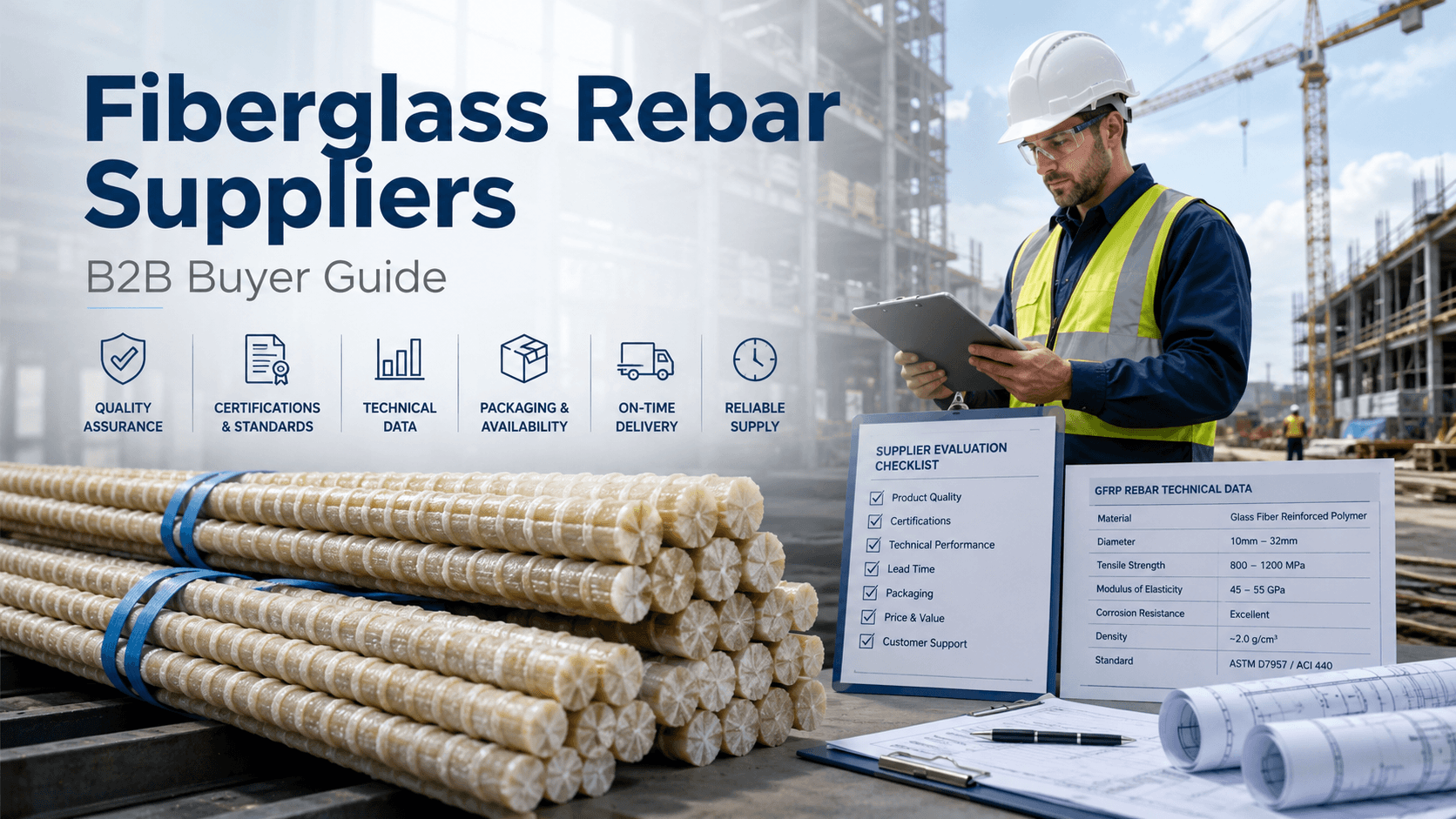
For B2B buyers, fiberglass rebar suppliers should be evaluated by more than price. Procurement managers, engineers, contractors, and operations teams need to confirm product specifications, documentation, production capability, packaging, lead time, and technical communication before placing a bulk order.
This guide explains how buyers can compare fiberglass rebar suppliers and manufacturers, what technical details to check, which documents to request, what red flags to avoid, and how to prepare a clear RFQ.
fiberglass rebar suppliers
What Makes a Reliable Fiberglass Rebar Supplier?
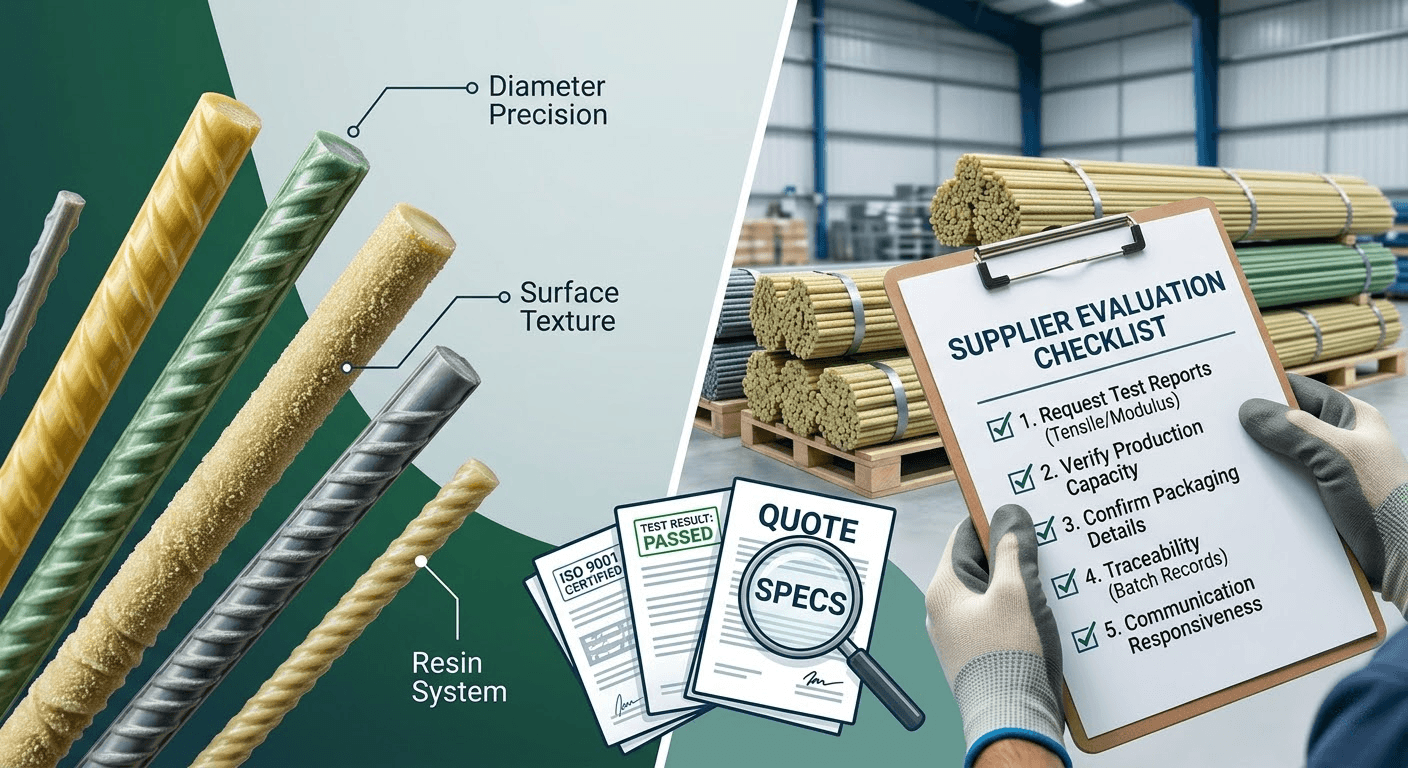
Before buyers compare quotes, they should confirm whether the supplier can define the product clearly. Fiberglass rebar, also called FRP rebar or GFRP rebar, is typically made with glass fiber reinforcement and resin. Its performance depends on bar diameter, surface profile, tensile properties, resin system, storage, handling, and project exposure.
A reliable supplier should provide clear specifications instead of broad claims such as “high strength” or “premium quality.” Buyers should request bar size options, length options, surface type, packaging details, and available quality documents before making a commercial decision.
The table below summarizes the first checkpoints buyers should review during supplier screening:
| Evaluation Item | What Buyers Should Check | Why It Matters |
|---|---|---|
| Product specification | Diameter, length, surface profile, resin system | Confirms project fit |
| Technical properties | Tensile performance, modulus, bond related data when available | Supports engineering review |
| Quality records | Test reports, batch records, QC documents | Reduces approval risk |
| Production capacity | Standard sizes, custom lengths, repeat supply | Supports project scheduling |
| Packaging plan | Bundles, labels, pallets, export packing | Protects bars during shipment |
How do buyers identify reliable fiberglass rebar suppliers?
Reliable fiberglass rebar suppliers provide clear product specifications, available testing information, production capacity details, lead time estimates, packaging plans, and technical support. Buyers should avoid suppliers that compete only on price without explaining material properties, bar size consistency, surface profile, project fit, and delivery conditions.
In field procurement, engineers often find that the cheapest quote creates the most follow-up work. Missing bar details, unclear packaging, and incomplete technical responses can delay submittals or force buyers to restart supplier evaluation.
Takeaway: a reliable supplier makes the product easy to verify before the purchase order is issued.
Supplier vs Manufacturer: Which Fits Your Project?
After confirming basic reliability, buyers should decide whether a local supplier, distributor, or direct manufacturer fits the project best. Each option can work, but the right choice depends on order size, timeline, customization needs, and technical complexity.
A local supplier may help with urgent small quantities or regional stock. A direct manufacturer may be better for bulk orders, custom cut lengths, repeat shipment programs, private labels, export packaging, and direct engineering communication.
The table below compares supplier types for common B2B purchasing situations:
| Buying Situation | Local Supplier or Distributor | Direct Manufacturer |
|---|---|---|
| Urgent small order | Often suitable | May be less efficient |
| Bulk project order | Depends on inventory | Usually stronger |
| Custom bar length | Limited options | Better fit |
| Repeat supply program | Depends on network | Better control |
| Technical questions | May relay information | Direct response possible |
| Export packaging | Variable | Easier to customize |
Should buyers choose a supplier or a direct manufacturer?
Buyers should choose a local supplier for urgent small orders and a direct manufacturer for bulk orders, custom sizes, repeat supply, and project-based technical support. Manufacturers often provide better control over specifications, custom cutting, packaging, production scheduling, and repeat shipment consistency.
A contractor needing a short replacement order may prioritize local availability. A precast producer or infrastructure buyer planning phased deliveries may need direct production communication, sample approval, and consistent batch quality.
Takeaway: supplier type should match the purchasing model, delivery risk, and technical requirements.
7 Checks Before Choosing Fiberglass Rebar Suppliers
Once buyers create a shortlist, the evaluation should become systematic. A strong supplier should pass practical checks before the buyer moves from inquiry to purchase order.
The table below turns supplier evaluation into a usable procurement checklist:
| Check | What Buyers Should Ask | Warning Sign |
|---|---|---|
| Specification clarity | Can they confirm diameter, length, surface profile, and resin details? | Generic descriptions only |
| Mechanical data | Can they share tensile, modulus, or bond related information when available? | No performance discussion |
| Bar schedule fit | Can they review required lengths, bundles, and project quantities? | No custom planning |
| Quality documents | Can they provide test or QC documents for review? | Missing documentation |
| Traceability | Can they discuss batch or lot identification? | No production record process |
| Logistics planning | Can they explain packing, labels, and lead time? | Unclear delivery schedule |
| Repeat order control | Can future orders match approved samples? | No consistency process |
A practical procurement process should not rely on one email quote. Buyers should request samples when possible, compare technical documents, confirm packaging, and test response quality before committing to a large order.
What documents should fiberglass rebar suppliers provide?
Fiberglass rebar suppliers should provide product specifications, available test reports, quality control documents, packing details, shipment information, and batch or lot details when available. Project-based orders may also require drawings, bar schedules, packaging plans, storage guidance, and documents requested by the engineer or buyer.
A common approval problem appears when a supplier can sell the product but cannot support the submittal process. In an anonymized bridge deck procurement case, a buyer faced schedule pressure because the supplier could not provide batch-level details or clear packing information before the engineering review deadline.
Required documents and standards vary by project location, design engineer, application, and buyer requirements. Buyers should confirm documentation needs before purchase, especially for infrastructure and regulated projects.
Takeaway: documentation helps buyers compare quality, approval readiness, and supply reliability.
What to Send Before Requesting a Quote
After buyers understand how to evaluate suppliers, they should prepare a complete RFQ. A vague inquiry such as “quote fiberglass rebar” usually leads to assumptions, delays, and inaccurate pricing.
A strong RFQ should include diameter, length, quantity, project type, destination, target schedule, packaging needs, and required documents. If buyers have drawings, bar schedules, standards, storage requirements, or special handling instructions, they should include them early.
The table below can be copied into a procurement email:
| RFQ Item | Example Detail |
|---|---|
| Product | Fiberglass rebar / GFRP rebar |
| Diameter | Required size or acceptable range |
| Length | Standard length or custom cut length |
| Quantity | Pieces, bundles, pallets, or container order |
| Project type | Bridge, slab, seawall, parking structure, precast |
| Destination | Port, warehouse, or jobsite |
| Documents | Specification sheet, test report, packing list |
| Quote request | Unit price, lead time, packing, freight terms |
What information is needed for a fiberglass rebar quote?
For a fiberglass rebar quote, buyers should send diameter, length, quantity, project type, destination, delivery schedule, required documents, packaging needs, and any drawings or standards. Complete RFQ information helps suppliers quote accurately and reduces back-and-forth communication.
For repeat buyers, it also helps to ask whether future shipments can match the approved sample. This matters when the project has multiple phases or when buyers need stable inventory for ongoing supply.
Takeaway: a complete RFQ makes supplier comparison faster and more accurate.
fiberglass rebar suppliers
Red Flags When Comparing Suppliers
After buyers receive quotes, they should look beyond price and check where risk may appear. Many supplier problems are visible before payment if buyers read the quote carefully.
Common red flags include vague specifications, missing documents, unrealistic lead times, unclear packaging, inconsistent answers, and weak communication after the first quote. Another warning sign is overpromising. If a supplier claims one product fits every project, buyers should pause and request project-specific clarification.
What are the biggest risks when choosing fiberglass rebar suppliers?
The biggest risks include unclear specifications, missing quality documents, weak traceability, poor packaging, unrealistic pricing, vague lead times, and limited technical support. These issues can cause approval delays, shipment problems, installation uncertainty, and inconsistent repeat orders.
Procurement teams should watch how suppliers answer technical questions. A supplier that cannot explain surface profile, bar schedule compatibility, packing format, storage needs, or document availability may not be ready for project-based supply.
Takeaway: supplier risk usually appears in the details missing from the quote.
Why Unicomposite Can Support FRP Rebar Buyers
For buyers who need direct manufacturing communication, Unicomposite can support standard and custom FRP rebar supply as part of a broader FRP/GRP manufacturing capability. Unicomposite is a Nanjing-based composite manufacturer with ISO 9001 certification and an 18,000 square meter factory.
Its manufacturing capabilities include pultrusion, pulwinding, SMC/BMC molding, hand lay-up, and vacuum infusion. For fiberglass rebar buyers, this manufacturing base can support sample approval, custom cutting discussions, diameter tolerance communication, batch traceability, export packing, and repeat order support.
Unicomposite also supplies related FRP products such as profiles, grating, handrail systems, cable trays, ladders, plant stakes, marker rods, and other composite components. This can help buyers sourcing multiple FRP product categories across infrastructure, utilities, agriculture, or industrial projects.
Takeaway: a capable FRP manufacturer should support product supply, technical communication, and the purchasing process behind the order.
Conclusion
Fiberglass rebar suppliers should be evaluated through a clear procurement path: define project requirements, compare supplier type, verify technical documents, and send a complete RFQ before shortlisting.
Four takeaways matter most. Confirm product specifications before pricing. Request documents that match the project’s approval process. Compare supplier communication and packaging quality. Choose a partner that can support repeat supply, not just a one-time shipment.
For contractors, engineers, distributors, precast producers, and infrastructure buyers, the best supplier helps reduce project risk while keeping specifications, documents, and delivery clear.
[Contact Unicomposite for a custom fiberglass rebar quote →]


