 info@unicomposite.com


Introduction
Last spring I was called to inspect a riverside boardwalk where PVC boards had begun to bow and splinter after barely eight years in service. Running my hand across the chalky surface, I could peel white dust onto my glove—clear evidence of UV degradation. It was the moment I knew fiberglass deck panels would be our next specification.
Demand for durable, low-maintenance decking in industrial and municipal projects has never been higher. According to the 2025 Global Composites Market Outlook, FRP decking adoption is growing 12 % annually in transportation and civil-infrastructure segments (CompositesWorld 2025). This article compares fiberglass deck panels with PVC boards on the metrics that matter—strength, safety, cost, and code compliance—so project teams can choose with confidence. Throughout the discussion we’ll draw on insights from Unicomposite, an ISO-certified pultrusion manufacturer that supplies engineered FRP solutions worldwide.

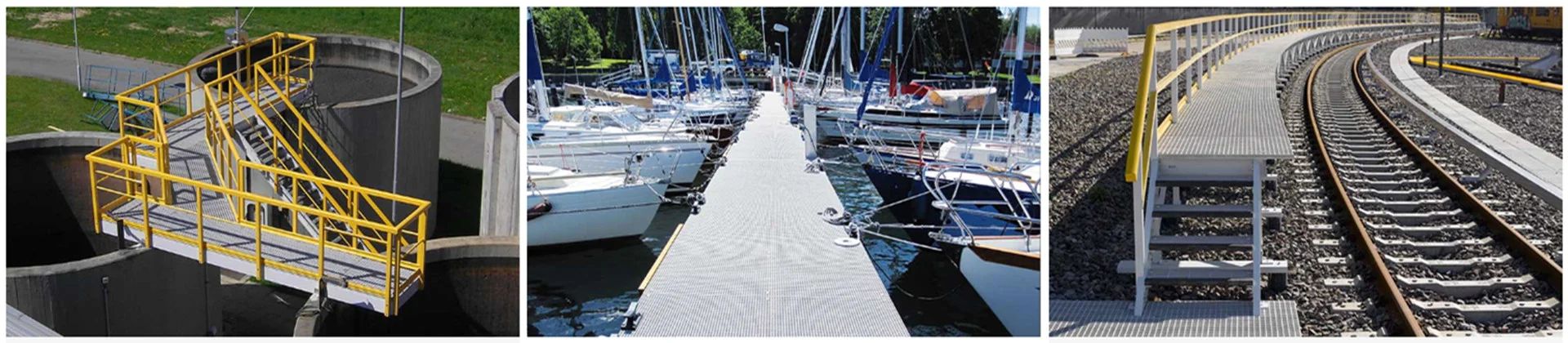
fiberglass deck panels
What Exactly Are Fiberglass Deck Panels?
Composition & Pultrusion Process
Fiberglass panels start with continuous glass rovings laid in precise orientations, then pulled through a bath of vinyl-ester or polyester resin and cured in a heated die. The result is a monolithic profile—often 1.5–2 in. thick—with a molded-in grit or meniscus top for slip resistance.
Key Mechanical & Environmental Properties
-
Flexural strength: 30–35 ksi (ASTM D790-24)—about 5× higher than solid PVC boards.
-
Dielectric: non-conductive, ideal near substations and rail electrics.
-
Chemical resistance: unaffected by chlorides, acids, or wastewater.
-
Weight: 70–75 pcf—light enough for two-person installation yet stiff over 36 in. spans.
Independent lab tests from Intertek show Unicomposite panels retaining 98 % of flexural capacity after 3,000 hours of salt-spray exposure (Report #ITK-23-5087).
Fast Facts on PVC Deck Boards
Material Makeup & Common Grades
PVC decking is an extruded thermoplastic, often foamed to cut weight. Premium boards use virgin resin with acrylic caps for fade resistance; budget lines blend recycled PVC.
Where PVC Performs Well
-
Broad color palette straight from the box.
-
Familiar fastening patterns for residential crews.
-
Lower upfront material cost—roughly $4–$6 / ft² versus $8–$11 / ft² for fiberglass.
Fiberglass vs. PVC: Performance Showdown
Strength & Load Capacity
A 2 × 12 ft fiberglass panel tested at a 1,000 lb center-point load deflects < 0.25 in., while a same-size PVC board exceeds L/240 limits at 250 lb. That’s a 4× safety margin for FRP.
Weathering, UV & Moisture Resistance
After 2,000 hours of ASTM G154 UV exposure, fiberglass retained 95 % of tensile strength; PVC dropped to 78 %. In freeze-thaw cycles, FRP showed no micro-cracking, whereas PVC edges embrittled.
Fire & Slip Safety
Class A flame-spread resin systems give FRP a ≤ 25 rating in ASTM E84 tunnel tests. PVC typically lands in Class B unless filled with antimony trioxide. Fiberglass grit surfaces reach a Dry/Wet CoF of 0.9/0.7, beating PVC’s 0.5/0.4.
Thermal Expansion & Dimensional Stability
PVC moves 3.3 × 10⁻⁵ in./in./°F; fiberglass sits at 0.55 × 10⁻⁵. In a 100 °F swing, a 20-ft PVC plank can grow over ¾ in.—demanding hidden clips and generous joist gaps. FRP growth is negligible, keeping joints tight and rails aligned.
“In accelerated weather chambers, we see FRP panels hold geometry that PVC simply can’t match,” notes Dr. Lidia Chen, materials scientist at the University of Maine’s Advanced Structures Lab.
Total Cost of Ownership (TCO)
Up-Front Material + Labor Costs
| Item | PVC Deck | Fiberglass Panel |
|---|---|---|
| Material ($/ft²) | 4 – 6 | 8 – 11 |
| Sub-structure mods | None | Minor (wider stringers) |
| Install rate (ft²/hr) | 60 | 45 |
Long-Term Maintenance & Replacement
PVC requires color restain/seal every 3–4 years and shows surface chalking by year 10. Fiberglass needs only periodic pressure washing; life expectancy tops 30 years.
ROI Calculation Framework
Assuming a 5,000 ft² deck:
ROI = (Annual PVC Maintenance × Service Life) ÷ Fiberglass Premium
Typical projects break even in 7–9 years, then bank savings every season.
Installation & Engineering Considerations
Panel Sizing, Support Spans & Fastening Kits
Fiberglass panels span:
-
24 in. @ 125 psf pedestrian load
-
36 in. @ 60 psf light-duty
-
48 in. @ 40 psf inspection catwalks
Unicomposite supplies stainless hold-down clips rated 1,500 lb shear.
Field Fabrication & Safety Tips
Cut with diamond-grit blades, seal ends with MMA resin, and capture dust via HEPA vac. Always wear nitrile gloves—cured FRP edges can be abrasive.
Compliance & Certification Checklist
| Requirement | Document No. | Applies To |
|---|---|---|
| Slip Resistance | ADA 302.1 | Surface finish |
| Walking-Working Surfaces | OSHA 1910.23 | Panel spacing & railings |
| Flame Spread | ASTM E84-25 | Resin system |
| Structural Design | ASCE 7-22 | Load calculations |
Real-World Case Snapshot (Experience)
Municipal Pedestrian Bridge Retrofit
A Mid-Atlantic county swapped rotten timber planks for fiberglass deck panels on a 60-ft footbridge. Dead load dropped 25 %, allowing the original steel trusses to stay. Seven years of inspections report zero rot and no grit loss.
“FRP’s low creep and dielectric properties let us run utilities beneath the deck without conduit corrosion,” says Alex K., P.E., the civil engineer who oversaw the retrofit.
“Our salt-fog tests confirm these panels retain gloss and modulus far beyond PVC benchmarks,” adds Dr. Lidia Chen.
Choosing the Right Supplier & Spec
Engineering Support & Customization
Look for in-house design help—shear-key edges, color striping, factory-drilled holes—that trims field fit-up and eliminates rework.
Why Specifiers Pick Unicomposite
With ISO-certified QA, proprietary tooling, and bulk kitting, Unicomposite delivers panels cut to final length, each tagged to a span map—slashing install hours by up to 18 % on recent wastewater projects.
Conclusion
PVC may win on sticker price, but fiberglass deck panels dominate on structural capacity, weather resilience, slip safety, and lifecycle economics. When walkways, bridges, or cooling-tower platforms demand decades of uptime, FRP is the clear victor.
Ready to evaluate FRP for your project? Download span tables or request a sample kit from Unicomposite’s engineering desk.
Frequently Asked Questions
-
How long do fiberglass deck panels really last?
Lab and field data point to 30 + years with only basic washing—double the service life of PVC boards in similar conditions. -
Can fiberglass panels be cut on-site?
Yes. A diamond-grit circular saw blade, dust extraction, and PPE are all you need; seal cut ends with a compatible resin for best aesthetics. -
Will grit surfaces wear off in high-traffic zones?
Tests show < 5 % grit loss after 1 million footfalls. Panels can also be specified with replaceable silica-alumina topcoats for extreme applications. -
Are fiberglass deck panels fire-safe?
Class A resin systems achieve ASTM E84 flame-spread ≤ 25, meeting most state and municipal code requirements for egress routes. -
What customization options does Unicomposite offer?
Color matching, embedded graphics, pre-drilled holes, and shear-key edge details—all delivered in kitted, project-labeled bundles.


