 info@unicomposite.com


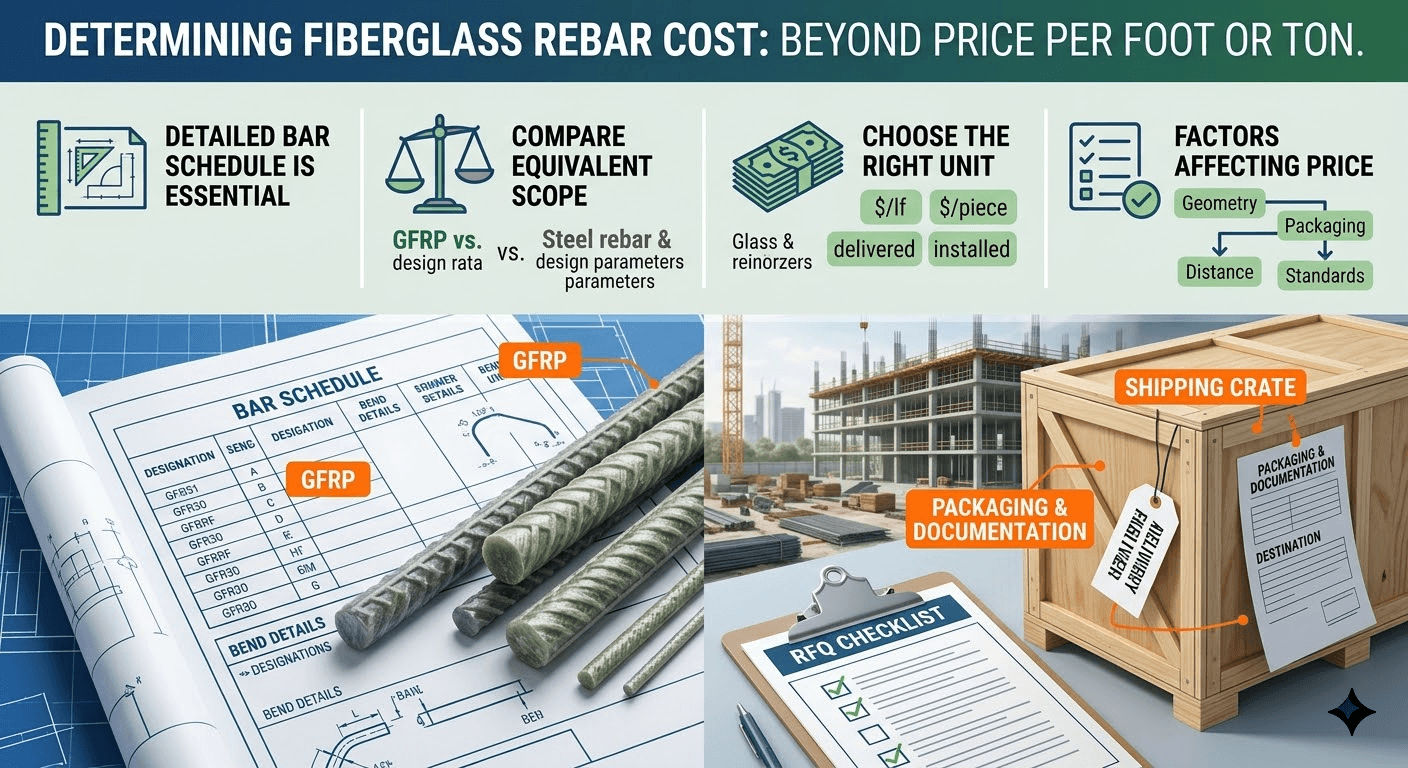
There is no reliable universal fiberglass rebar price per foot or per ton. A usable project price depends on the bar schedule, required shapes and lengths, quantity by line item, project specifications, documentation, packaging, destination, and requested delivery basis. The fastest way to obtain a comparable quote is to issue the same scope and acceptance requirements to every bidder.
A cost comparison also needs the right unit. Price per linear foot can compare matching bar designations, but price per ton is usually a poor basis for comparing GFRP and steel because the materials differ in density and are not selected by weight alone. For budgeting or material selection, compare alternatives that satisfy the same project design and acceptance criteria.

fiberglass rebar cost
What Determines Fiberglass Rebar Cost?
Fiberglass rebar cost begins with the bar schedule, not with a generic market price. Each missing input forces a supplier either to exclude part of the scope or to make an assumption that may not match the project.
| Quote input | Why it affects the price | What to provide |
|---|---|---|
| Bar designation and diameter | Bar size changes material quantity, packaging, and the number of pieces required | Approved bar schedule with the designation system and units clearly identified |
| Straight or bent bar geometry | Cut lengths and bent shapes are different line items with different fabrication and packing requirements | Shape codes or dimensioned drawings, bend dimensions, and quantities by shape |
| Length and quantity | Piece length, total footage, and quantity per line item determine production and packing scope | Length, piece count, and total quantity for every bar mark |
| Surface and product definition | Surface enhancement and bar geometry can be part of the material specification and acceptance scope | The required bar description and referenced project specification |
| Required standards and documents | Qualification, lot acceptance, traceability, and submittal requirements affect the document package and testing scope | Governing standard and edition, project specification, submittal list, and acceptance criteria |
| Packaging and identification | Bundle size, tags, bar-mark separation, and protection affect handling and shipment preparation | Packaging limits, labeling format, unloading constraints, and any jobsite sequencing needs |
| Destination and commercial basis | Freight, route, customs responsibilities, and delivery point change the landed-cost boundary | Full destination, requested delivery basis, and any site access restrictions |
| Required schedule | The requested delivery sequence affects planning and whether split shipments are needed | Required-on-site dates, release sequence, and whether partial delivery is acceptable |
This table is an RFQ framework, not a statement that every diameter, shape, standard, document, or delivery arrangement is available from every supplier. Product scope and commercial terms must be confirmed in the quotation.
Use the Right Cost Unit
Fiberglass rebar cost can refer to four different boundaries: material price, delivered cost, installed cost, and life-cycle cost. Identify the boundary before comparing any two numbers.
The same project can produce very different-looking price comparisons depending on the unit used. Select the unit that matches the decision being made.
Price per linear foot or meter
Use a length-based comparison when the alternatives have the same bar designation, length, quantity, and scope. Check whether cutting, bent shapes, packaging, documents, and freight are included. A low unit price is not comparable if the quote excludes required line items.
Price per piece
Piece pricing is useful for cut-to-length bars and bar marks. It also makes quantity discrepancies easier to find. Verify the length, shape, and identification attached to each line item before comparing totals.
Price per ton
Price per ton can be useful for comparing offers for the same material and the same product scope. It is misleading when used as the main GFRP-versus-steel comparison because equal weights do not represent equal bar schedules or equivalent structural designs. Convert both alternatives to the engineer-approved project quantity before comparing cost.
Delivered and installed cost
Delivered cost adds packaging and transportation to the material scope. Installed cost may also include unloading, storage, cutting, placement, supports, waste, labor, equipment, inspection, and schedule effects. State which of these items are included so the comparison does not mix supplier price with contractor cost.
Compare GFRP and Steel on an Equivalent Project Scope
The question “Is fiberglass rebar cheaper than steel?” cannot be answered from one commodity price. The comparison becomes useful only after the project team defines functionally equivalent alternatives and a common cost boundary.
Start with the engineer-approved reinforcement schedules for each alternative. GFRP and steel are different materials governed by different design provisions, so replacing a steel schedule with the same number or weight of GFRP bars is not a valid estimating shortcut. For the broader material-selection differences, see Fiberglass (GFRP) Rebar vs Steel Rebar: Differences & Cost.
Then normalize the comparison:
- Use the approved quantity for each alternative. Record bar marks, sizes, lengths, shapes, and total pieces.
- Set the same supply boundary. Identify whether fabrication, packaging, documents, freight, taxes, and site delivery are included.
- Estimate installation separately. Use the contractor’s planned crew, equipment, waste allowance, handling method, and schedule—not an unsupported generic labor-saving percentage.
- Document future-cost assumptions. If maintenance, rehabilitation, traffic control, downtime, or replacement is included, record the event, timing, cost basis, and responsible estimator.
- Convert future costs consistently. Use the same analysis period, price basis, and discounting method for every alternative.
The Federal Highway Administration describes life-cycle cost analysis as a comparison of initial and discounted future costs, including maintenance, rehabilitation, reconstruction, and user costs. Its method begins by defining comparable alternatives, activity timing, agency costs, and user costs before calculating life-cycle cost.[3] This is a sound evaluation framework, but it does not establish a universal cost advantage for any rebar material.
Cost boundary worksheet
| Cost category | Supplier quote | Contractor estimate | Owner life-cycle model | Verification output |
|---|---|---|---|---|
| Bars by approved schedule | Yes | — | — | Priced bar schedule |
| Cut lengths and bent shapes | If included | — | — | Line-item scope and drawings |
| Packaging, labels, and documents | If included | — | — | Quote inclusions list |
| Freight and delivery | If included | Sometimes | — | Named delivery point and commercial basis |
| Unloading, storage, and placement | — | Yes | — | Installation work breakdown |
| Supports, ties, tools, and waste | — | Yes | — | Quantity and labor estimate |
| Inspection and acceptance | Sometimes | Sometimes | — | Inspection and submittal plan |
| Maintenance and rehabilitation | — | — | Yes | Activity schedule and cost basis |
| Work-zone or downtime effects | — | — | If applicable | User-cost assumptions |
| End-of-analysis residual value | — | — | If applicable | Stated analysis convention |
How Specifications and Documentation Affect a Quote
Standards are not interchangeable labels. The project specification must identify the required document, edition, product scope, submittals, tests, and acceptance criteria.
ASTM D7957/D7957M-25 covers solid round GFRP bars in cut lengths and bent shapes with an external surface enhancement for concrete reinforcement. Its scope includes geometric, material, mechanical, physical, qualification, quality-control, acceptance, marking, and traceability requirements.[1] A project that cites this standard may therefore require more than a diameter and quantity in the RFQ.
ACI CODE-440.11-22 addresses structural concrete reinforced with GFRP bars and includes design, material, construction-document, testing, inspection, detailing, and serviceability provisions.[2] ACI SPEC-440.5-22 covers construction with GFRP reinforcing bars and includes submittals, delivery, storage, handling, quality assurance, acceptance, offsite fabrication, and installation.[4]
Referencing these documents in an RFQ does not prove that a quoted product complies with them. Ask the supplier to state compliance, exceptions, document availability, and acceptance scope explicitly. The licensed design professional and project authority determine the governing requirements.
determining fiberglass rebar cost
Copy-and-Paste Fiberglass Rebar RFQ Checklist
Use this checklist to request a project-specific fiberglass rebar price. Remove fields that do not apply, but do not omit the bar schedule or delivery destination.
Project and contact
- Project name and location
- Buyer, technical contact, and delivery contact
- Bid date and required quotation validity period
- Governing project specification and drawing revision
Reinforcement schedule
- Bar designation system and units
- Diameter or bar size for each line item
- Straight length or dimensioned shape drawing
- Quantity by bar mark, length, and shape
- Required surface or product description
- Any approved alternates and how they must be identified
Technical and quality requirements
- Required standard and edition
- Project-specific material requirements
- Required qualification or product data
- Lot acceptance and test requirements
- Certificate, traceability, labeling, and submittal requirements
- Inspection or witness points, if specified by the project
Packaging and delivery
- Packaging, bundle-weight, and labeling limits
- Required separation by bar mark or placement sequence
- Full delivery address and access restrictions
- Requested delivery basis
- Required-on-site date and shipment sequence
- Unloading limitations and receiving hours
Commercial clarification
- Currency and tax or duty treatment requested
- Items that must be included or priced separately
- Requested payment basis
- Procedure for quantity or drawing revisions
- Contact for technical and commercial exceptions
How to Evaluate Competing Quotations
A comparable GFRP rebar quotation requires the same bar schedule, specification, document scope, delivery boundary, and commercial assumptions.
A bid tab should expose differences rather than hide them in a single total. Create one row for each bar mark and separate columns for material, fabrication, packaging, documents, freight, and exclusions.
Check these items before selecting an offer:
- Schedule match: Do all bar marks, lengths, shapes, and quantities match the issued RFQ revision?
- Specification response: Does the quotation state compliance, deviations, and exceptions rather than simply repeating a standard number?
- Document scope: Are required submittals, test records, certificates, and traceability documents included or excluded?
- Delivery boundary: Is the named destination and commercial basis the same across all bids?
- Timing: Are the quotation validity, production assumptions, shipment sequence, and required-on-site dates clear?
- Change control: Does the quotation explain how drawing or quantity changes will be repriced?
- Acceptance: Are inspection responsibilities and the treatment of nonconforming items defined?
If one quote is materially lower, first look for a scope difference. Missing bent shapes, shorter lengths, omitted tests, limited documentation, or an ex-works freight boundary can create a lower total without creating a lower project cost.
Common Fiberglass Rebar Pricing Mistakes
Asking for a price without a bar schedule
A diameter range and total tonnage do not define a reinforcement package. Issue quantities by bar mark so the supplier can price the actual scope.
Comparing equal weight instead of equivalent design
GFRP and steel are not selected by equal mass. Use the design professional’s approved schedules for both alternatives.
Treating a dated web price as a quotation
Online prices may omit fabrication, documents, packaging, freight, taxes, or project-specific acceptance. Use them only as unverified screening inputs, not as a procurement commitment.
Leaving standards and tests until after award
Adding qualification, acceptance testing, or documentation after pricing can change scope and schedule. Put these requirements in the RFQ.
Mixing material price with life-cycle value
Material price, installed cost, and life-cycle cost answer different questions. Keep the cost boundaries separate, then combine them only in a documented model.
Frequently Asked Questions
How much does fiberglass rebar cost per foot?
The price per foot depends on bar designation, length, shape, quantity, specification, documentation, packaging, destination, and delivery basis. A bar schedule is required for a comparable project quote.
Can fiberglass rebar be quoted by the ton?
It can be expressed by weight for a defined product, but price per ton is not a sound basis for comparing GFRP with steel. Compare engineer-approved bar schedules and the same supply boundary.
Is GFRP rebar cheaper than steel rebar?
Neither material is universally cheaper. Compare the initial delivered and installed costs for equivalent designs. If the owner evaluates future maintenance or disruption, use the same analysis period, activity schedule, cost basis, and discount method for both alternatives.
What is the minimum information needed for an RFQ?
Provide the project location, drawing and specification revision, bar schedule, sizes, lengths, shapes, quantities, required standards and documents, packaging requirements, destination, and requested delivery dates. Missing information can be listed as an explicit assumption, but it must be resolved before order confirmation.
Prepare a Project-Specific Quote
Review our FRP rebar for concrete reinforcement page, then send us your approved bar schedule or drawings, bar sizes, lengths and shapes, quantities, governing specifications, document requirements, packaging instructions, destination, and required-on-site dates for a project quotation. Available product scope, documentation, lead time, delivery basis, and commercial terms will be confirmed during quotation.
References
- ASTM International, ASTM D7957/D7957M-25: Standard Specification for Solid Round Glass Fiber Reinforced Polymer Bars for Concrete Reinforcement.
- American Concrete Institute, ACI CODE-440.11-22: Building Code Requirements for Structural Concrete Reinforced with GFRP Bars.
- Federal Highway Administration, Improving Transportation Investment Decisions Through Life-Cycle Cost Analysis.
- American Concrete Institute, ACI SPEC-440.5-22: Construction with Glass Fiber-Reinforced Polymer Reinforcing Bars.


