 info@unicomposite.com


Introduction
Fiberglass Reinforced Concrete Panel systems sit between conventional steel-reinforced precast and all-FRP panels. They are concrete elements strengthened with fiberglass reinforcement, designed to deliver better durability, lighter units and more predictable performance in aggressive environments. For owners and engineers responsible for plants, façades or modular equipment rooms, the real question is not “what is it?” but “how will this panel perform over 20–30 years, and where does it create the most value?”
Panel performance translates directly into lifecycle cost, downtime risk and safety. A system that resists corrosion, controls cracking and stays dimensionally stable can mean fewer shutdowns and fewer unplanned repairs. This article is written from the perspective of a specialist FRP supplier: Unicomposite, an ISO-certified pultrusion manufacturer in China that produces fiberglass profiles and custom composite parts used alongside concrete panels in corrosive, electrically sensitive or weight-critical applications.

Fiberglass Reinforced Concrete Panel
Understanding Fiberglass Reinforced Concrete Panels
What Is a Fiberglass Reinforced Concrete Panel?
A Fiberglass Reinforced Concrete Panel is a concrete element that uses glass-fiber reinforcement instead of, or in combination with, traditional steel. The fiberglass can appear as:
-
meshes and mats,
-
bars or grids, or
-
pultruded profiles and stiffeners
embedded in the concrete matrix. The fiberglass carries tensile forces and controls cracking, while the concrete provides compressive strength, stiffness and mass.
The term often overlaps with GRC or GFRC (glass fiber reinforced concrete) used for thin cladding skins, but in many industrial applications it refers to thicker panels where fiberglass bars or profiles replace steel in all or part of the section. From a buyer’s point of view, the key difference is reduced corrosion risk and the opportunity to optimize thickness and weight.
Typical fiberglass reinforced concrete cladding panels might be 60–100 mm thick with a surface weight in the range of 80–140 kg/m², depending on geometry and insulation build-up. These are indicative values only; your engineer and supplier should verify all dimensions for each project.
How Fiberglass Reinforcement Changes Panel Performance
Replacing steel with fiberglass changes how the panel behaves throughout its life:
-
Corrosion resistance: fiberglass does not rust, so cover depth can be optimized and rust-driven cracking is removed from the equation.
-
Crack control: well-designed fiberglass reinforcement helps keep crack widths tight, which protects finishes, sealants and embedded items.
-
Weight reduction: in many non-primary applications, designers can achieve similar flexural performance with thinner sections, often yielding panels that are roughly 20–30% lighter than comparable steel-reinforced units.
For contractors, lighter units mean smaller cranes, simpler logistics and easier installation on constrained sites. For owners, more stable cracking behavior supports better long-term stiffness and fewer cosmetic and durability issues.
Key Performance Benefits for Industrial & Commercial Buyers
Structural Performance & Service Life
From a structural standpoint, a Fiberglass Reinforced Concrete Panel helps balance strength, stiffness and crack control for elements such as:
-
façades and rainscreens
-
equipment enclosures
-
modular plant rooms and OEM skids
Panels are often designed for service lives in the 25–50 year range, depending on exposure and code requirements. Because fiberglass avoids rust expansion, the panel is less likely to suffer the classic cycle of corrosion, cracking and spalling that shortens the life of conventional steel-reinforced concrete in harsh environments.
Field tip: ask your engineer to summarize not just the ultimate capacity of the panel, but also the target deflection limits and crack-width criteria. Those serviceability limits are what keep façades looking good and enclosures tight over time.
Durability in Harsh Environments
Durability is often the main reason teams consider fiberglass reinforcement. In wastewater, coastal or chemical plants, steel at edges, anchors and penetrations tends to corrode first, leading to leaks and broken corners. Fiberglass reinforcement paired with a suitable resin system is inherently corrosion-resistant in most of these conditions.
In cold climates, freeze–thaw cycles and de-icing salts can accelerate damage in conventional panels. Glass-reinforced systems that are properly detailed for drainage and joints show less scaling and edge spalling because there is no expanding rust product behind the surface. That combination of corrosion resistance and controlled crack widths gives asset owners a realistic path to fewer unplanned interventions.
Where projects require testing, panels may be evaluated to structural and durability methods (for example, flexural tests, freeze–thaw or chloride exposure regimes) and fire performance classifications according to regional standards. Your local engineer and supplier should confirm which standards apply in your jurisdiction.
Safety, Aesthetics & Occupant Comfort
Panels contribute to more than strength:
-
Safety: concrete mass supports robust fire resistance, while fiberglass reinforcement is non-sparking and non-conductive—an advantage around live equipment or in hazardous zones.
-
Aesthetics: consistent geometry and better crack control help façades age gracefully instead of showing rust streaks and local spalls.
-
Comfort: concrete’s thermal mass and acoustic performance, combined with appropriate insulation and detailing, can help meet increasingly strict envelopes for temperature and noise.
These factors are often written into project briefs as performance criteria—so the panel specification needs to align with the wider building physics and safety strategy.
Typical Uses & Sectors That Benefit Most
Building Envelopes, Façades & Cladding
Fiberglass reinforced concrete panels are widely used in:
-
mid- to high-rise façades
-
stair and lift-core cladding
-
plant room and rooftop screens
-
refurbishment of aging envelopes
Because panels can be lighter than conventional units, they are especially attractive for refurbishments where existing frames or foundations have limited reserve capacity. Reducing mass per square metre can unlock additional cladding options without wholesale strengthening of the structure.
Field tip: on refurb projects, involve the panel manufacturer early to explore standard module sizes and fixing patterns that minimize cutting and on-site adaptation.
Water, Wastewater & Industrial Facilities
Process industries are an excellent fit. In wastewater treatment, cooling tower enclosures and power plants, the internal atmosphere is often warm, wet and chemically aggressive. Conventional reinforcement struggles here, leading to repairs long before the nominal design life.
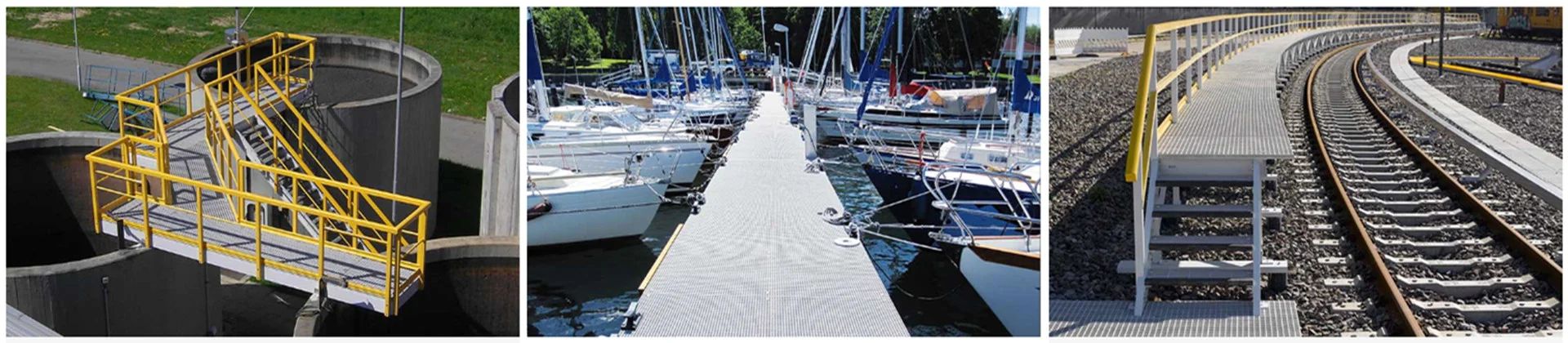
Fiberglass reinforced concrete panels, combined with FRP gratings, handrails and profiles from suppliers like Unicomposite, create a coherent corrosion-resistant system. Panels form walls, roofs or equipment screens around pumps and tanks, while pultruded FRP shapes provide frames, walkways and access platforms. This reduces the number of weak links where dissimilar materials fail at different rates.
Marine, Agriculture & OEM / Modular Construction
Other sectors that benefit include:
-
Marine and coastal: shelters, equipment rooms, docks and control buildings in splash and spray zones.
-
Agriculture and aquaculture: enclosures and processing buildings exposed to moisture, fertilizers and cleaning chemicals.
-
OEM and modular construction: packaged plant rooms, skid units and prefabricated enclosures where predictable weight, corrosion resistance and fast installation are essential.
In many of these cases, fiberglass reinforced panels are one part of a broader composite strategy using FRP beams, plates and accessories.
Design & Specification Checklist for Buyers
Performance Requirements & Loading Conditions
Good projects start with a clear definition of:
-
design loads (wind, equipment, impact, seismic if relevant)
-
spans, support conditions and fixings
-
deflection and crack-width criteria
-
required service life and exposure class
Work with a licensed structural engineer to translate these into a design brief the panel and FRP suppliers can work from. This avoids redesign loops later in the project.
Material, Finish & Hardware Selection
Key choices include:
-
type and configuration of fiberglass reinforcement
-
concrete mix and cover depth
-
surface finish, color and texture
-
fastener and anchor materials
-
interface details with steel, FRP and insulation
In corrosive or electrically sensitive environments, pairing fiberglass reinforcement with pultruded FRP edge profiles can reduce thermal bridging and avoid metallic cold paths. Unicomposite, for example, can supply pultruded edge beams, connection plates and frames tailored to your panel supplier’s molds and reinforcement layouts.
Standards, Testing & Documentation
A robust specification should ask for:
-
drawings and calculation summaries signed by a qualified engineer
-
structural and durability test data appropriate to the region
-
fire classification reports where required by code
-
QA certificates (e.g., ISO-based quality systems, material traceability)
-
clear handling and installation guides
Design & compliance note: performance examples in this article are typical ranges based on industry practice, not project-specific guarantees. Final design, detailing and code compliance must always be signed off by a licensed engineer familiar with local regulations.
How a Specialist Manufacturer Like Unicomposite Adds Value
Integrating Pultruded FRP Profiles with Concrete Panels
Specialist FRP manufacturers extend what is possible with Fiberglass Reinforced Concrete Panels by supplying complementary pultruded elements. Examples include:
-
edge stiffeners and perimeter frames cast into or bolted onto panels
-
FRP connection plates to isolate steel from corrosive atmospheres
-
integrated FRP ribs to increase out-of-plane stiffness without large thickness increases
Unicomposite focuses on these pultruded fiberglass profiles and custom composite parts, produced in its own ISO-certified factory. By tailoring resin systems, fiber architectures and profile geometries, the company helps engineers balance strength, weight and corrosion resistance when integrating FRP components with concrete panels.
Engineering Support, Customization & Quality Control
Beyond production, Unicomposite supports projects with:
-
technical review of drawings and load cases for FRP parts
-
advice on profile shapes, wall thicknesses and resin choices
-
customization for OEMs and modular builders, including repeatable, high-volume runs
-
quality-control systems built around ISO certification and material traceability
For buyers, this means fewer unknowns at interfaces between concrete panels and FRP components, and a manufacturing partner that understands how the whole system behaves rather than just one product in isolation.
Case Snapshot: Upgrading to Fiberglass Reinforced Concrete Solutions
The Problem: Corroding Panels & Costly Shutdowns
A municipal wastewater facility used conventional steel-reinforced concrete panels for an equipment enclosure near a chlorine contact tank. After several years, inspectors saw rust staining around fixings, hairline cracks spreading from corners and small spalls near penetrations. Each patch repair required partial shutdowns and additional safety measures, and the maintenance team worried about loose concrete above walkways and valves.
The Solution & Outcomes
During a planned upgrade, the owner’s engineering team specified Fiberglass Reinforced Concrete Panels with integrated FRP edge profiles and non-corroding hardware for the most exposed faces. A precast supplier worked with an FRP manufacturer to coordinate panel geometry, reinforcement layouts and pultruded profile details.
After installation and several inspection cycles, the new enclosure showed no progression of cracking or spalling at previous trouble spots. The corrosion-resistant panel system allowed the facility to move from frequent patch repairs to a more predictable inspection and cleaning routine. Although the initial material cost was higher than a like-for-like replacement, the projected lifecycle cost favored the fiberglass-reinforced solution within the first major maintenance interval.
A similar approach has been used on façade refurbishment projects, where lighter, fiberglass-reinforced panels with FRP edge frames have allowed owners to upgrade cladding systems without major strengthening of existing structures.
Conclusion
Fiberglass Reinforced Concrete Panel systems give owners, engineers and OEMs a practical way to improve durability and constructability while keeping the familiar benefits of concrete. By pairing a concrete matrix with corrosion-resistant fiberglass reinforcement and, where appropriate, pultruded FRP profiles, projects can unlock lighter units, more stable cracking behavior and better performance in aggressive environments.
Success depends on thoughtful design and the right partners. Clear performance briefs, careful materials selection, suitable testing and collaboration between panel producers and FRP specialists help ensure the final system delivers on its promises. For teams looking to integrate fiberglass reinforcement and pultruded profiles into their next project, working with an experienced manufacturer such as Unicomposite offers a straightforward route to engineered, repeatable and long-lasting solutions.
Frequently Asked Questions
1. How long does a Fiberglass Reinforced Concrete Panel typically last?
In many building and industrial applications, panels are designed for a 25–50 year service life, depending on exposure, detailing and local codes. Fiberglass reinforcement helps by removing rust expansion as a failure mechanism, but the actual life will depend on engineering, installation quality and maintenance practices.
2. Are fiberglass reinforced panels more expensive than conventional panels?
Upfront material costs are often higher than conventional steel-reinforced panels, especially where custom reinforcement or FRP profiles are used. However, many owners find that reduced corrosion, fewer repairs and shorter shutdowns can offset the premium over the first major maintenance cycle.
3. Can Fiberglass Reinforced Concrete Panels meet fire code requirements?
Concrete has inherently good fire performance, and fiberglass reinforcement is typically embedded within the concrete cover. Panels are usually tested and classified according to regional fire standards, so your supplier should provide relevant documentation and coordinate with the project’s fire engineer.
4. Where does it make the most sense to use fiberglass reinforcement instead of steel?
Fiberglass reinforcement delivers the most value in corrosive, electrically sensitive or weight-critical environments—such as wastewater facilities, coastal structures, cooling towers, modular plants and façade refurbishments where corrosion risk or structural capacity is a concern.
5. How can a manufacturer like Unicomposite support my project?
Unicomposite can supply pultruded FRP profiles, joint plates and custom shapes that integrate with your panel system, along with engineering input on material choices and geometries. This helps align panel design with practical manufacturing limits and long-term performance targets.


