 info@unicomposite.com


Introduction
A custom FRP part can fail before it reaches the job site. The problem often starts during supplier selection: the mold is not reviewed carefully, the resin system does not match the working environment, the tolerance is unclear, or the production process cannot support repeatable batches.
For engineers, procurement managers, OEM buyers, and industrial project teams, choosing a molded fiberglass company is a technical sourcing decision. Buyers are selecting a manufacturing partner that must interpret drawings, recommend materials, control tooling, approve samples, and deliver parts that fit the real application.
This guide explains how to evaluate a molded fiberglass company for custom FRP parts. It covers process selection, tooling capability, resin and reinforcement review, quality control, quote preparation, sample approval, and supplier questions for industrial buyers who need corrosion resistant, lightweight, application specific composite components.
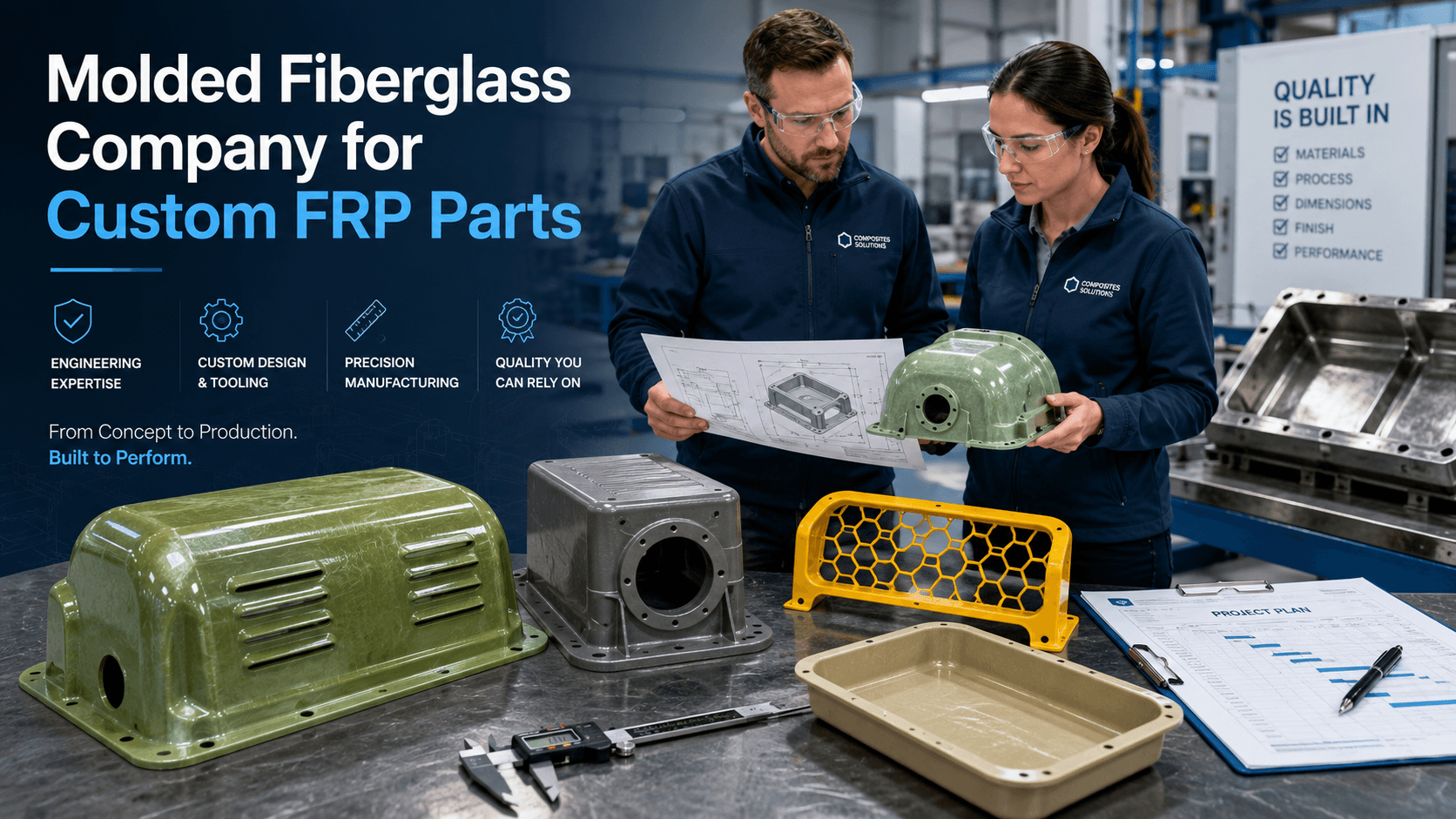
molded fiberglass company for custom frp parts
Why Choosing the Right Molded Fiberglass Company Matters
Choosing a molded fiberglass supplier affects the full project cycle: design review, mold development, sample approval, production consistency, delivery schedule, and installed performance. A low quote can become expensive if the part needs rework, does not fit the assembly, or fails because the material was specified poorly.
In field projects, unclear specifications often create the highest cost. For example, a fiberglass cover for an outdoor utility enclosure may look acceptable in photos, yet fail the requirement if wall thickness, insert layout, bolt hole position, UV exposure, or surface finish was not confirmed before production.
A capable supplier should ask about the application, exposure environment, quantity, tolerance, installation method, and required documentation. That early review helps reduce mold changes, sample rejection, and production delays.
What should buyers confirm before choosing a molded fiberglass company?
Buyers should confirm the company’s molding process, tooling capability, resin options, reinforcement type, drawing review process, tolerance control, sample approval workflow, inspection method, production capacity, and packaging plan. These factors reduce the risk of poor fit, inconsistent batches, delayed delivery, and unsuitable material selection.
For custom FRP parts, a supplier should do more than accept a drawing and quote a price. The company should review how the part will be used, how it will be installed, and what conditions it must withstand.
The strongest sourcing decisions start with technical fit, then move to price and delivery.
What Is Molded Fiberglass?
Molded fiberglass is a composite material made by forming glass fiber reinforcement and resin in a mold. The result can be a panel, cover, housing, enclosure, tray, shell, guard, equipment part, or custom industrial component.
Unlike pultruded fiberglass, which produces continuous profiles with fixed cross sections, molded fiberglass can form more complex shapes. It can support curves, flanges, ribs, bosses, surface texture, embedded hardware, and non linear geometry.
Molded fiberglass parts are used in electrical enclosures, equipment covers, transportation panels, marine components, wastewater facilities, agricultural equipment, construction parts, and OEM assemblies. They can be specified for moisture, weathering, selected chemicals, and repeated handling when resin, reinforcement, wall thickness, and surface finish are matched to the application.
The table below summarizes common molded fiberglass part types and the checks buyers should make before quotation:
| Part Type | Common Application | Key Buyer Check |
|---|---|---|
| Covers and housings | Equipment protection, utility systems, outdoor enclosures | Resin, UV resistance, dimensions, mounting points |
| Panels and shells | Transportation, machinery, architectural use | Surface finish, thickness, stiffness, color |
| Trays and basins | Chemical handling, wastewater, agriculture | Resin compatibility, drainage, edge design |
| Custom guards | Industrial machinery, access protection | Impact needs, attachment method, repeatability |
| OEM components | Assemblies, branded equipment, export products | Tolerance, batch consistency, packaging |
When is molded fiberglass a better fit than metal or plastic?
Molded fiberglass is often a better fit when buyers need corrosion resistance, lower weight, electrical insulation, design flexibility, or moderate strength in a shaped part. Metal may suit high impact or high heat applications, while plastic may suit simpler parts with lower performance requirements.
For industrial buyers, FRP is often selected when steel corrosion, aluminum denting, or plastic deformation creates maintenance problems. Molded fiberglass can combine shape flexibility with material durability, especially in wet, corrosive, outdoor, or electrically sensitive environments.
The part performs best when the resin system, reinforcement, wall thickness, surface finish, inserts, and mounting design match the working conditions.
Molded Fiberglass vs Other FRP Manufacturing Methods
After identifying the part function, buyers should confirm whether molded fiberglass is the right manufacturing route. FRP products can be made through several processes, including molding, pultrusion, hand lay up, vacuum infusion, SMC, and BMC.
Each method supports different geometry, volume, tolerance, and cost requirements. A capable supplier should explain which process fits the part instead of forcing every project into one production method.
The table below compares common FRP manufacturing methods for custom parts:
| Process | Best Fit | Buyer Consideration |
|---|---|---|
| Molded fiberglass | Covers, panels, housings, shaped parts | Good for complex geometry and custom molds |
| Pultrusion | Rods, tubes, beams, channels, fixed profiles | Best for continuous cross sections |
| Hand lay up | Large or low volume custom parts | Flexible, but labor dependent |
| Vacuum infusion | Larger composite structures needing better resin control | Useful for stronger resin distribution |
| SMC/BMC molding | Higher volume molded parts with repeatable shape | Requires tooling and process planning |
What is the difference between molded fiberglass and pultruded fiberglass?
Molded fiberglass is formed in a mold to create shaped parts such as covers, panels, housings, and custom components. Pultruded fiberglass is produced continuously through a die to create fixed cross section profiles such as rods, tubes, channels, beams, and structural shapes.
If the part needs curves, flanges, mounting areas, or a formed shape, molded fiberglass may be the better route. If the part needs a consistent profile across a long length, pultrusion usually fits better.
This distinction matters during supplier selection. A company with multiple FRP processes can guide buyers toward the right method instead of quoting a product that is difficult to manufacture efficiently.
How to Evaluate a Molded Fiberglass Company
Once buyers confirm that molded fiberglass fits the project, the next step is supplier evaluation. A reliable molded fiberglass company should show capability in engineering communication, mold development, material selection, sample approval, quality control, and production planning.
A qualified FRP manufacturer reviews geometry, draft angle, mold feasibility, resin exposure, reinforcement layout, wall thickness, critical dimensions, production volume, tolerance needs, and application environment before quoting. This review helps buyers avoid a part that is moldable in theory but inefficient or risky in production.
Unicomposite is a China based FRP and GRP composite manufacturer with ISO 9001 certification and an 18,000 square meter facility. Its manufacturing capabilities include pultrusion, pulwinding, SMC and BMC molding, hand lay up, and vacuum infusion. For custom FRP parts, this process range helps buyers compare molding options and related composite solutions.
The table below provides a practical supplier evaluation checklist:
| Evaluation Area | What to Ask | Strong Supplier Signal |
|---|---|---|
| Process capability | Which molding methods can you support? | Can recommend a suitable process for the part |
| Tooling support | Can you develop or modify molds? | Reviews mold design, draft angle, release, and surface |
| Material selection | Which resin and reinforcement options are available? | Matches material to chemical, UV, heat, or electrical needs |
| Drawing review | Can engineers review drawings or 3D files? | Identifies risks before quotation |
| Sample approval | Can you provide samples before bulk production? | Supports fit and quality confirmation |
| Quality control | What checks are done before shipment? | Can provide photos, inspection records, or agreed checks |
| Batch consistency | How are repeat orders controlled? | Uses documented process control and production records |
| Export support | How are parts packed and shipped? | Plans packaging around part shape and fragility |
How can buyers identify a capable custom fiberglass fabrication supplier?
Buyers can identify a capable custom fiberglass fabrication supplier by checking whether the company reviews drawings, recommends suitable resin and reinforcement systems, supports tooling, provides samples, controls critical dimensions, manages production batches, and understands packaging for export or project delivery.
A weak supplier may focus only on price and quantity. A stronger manufacturer asks how the part is used, what loads it sees, what environment it enters, and how it connects to other components.
That difference protects buyers from expensive late stage corrections.
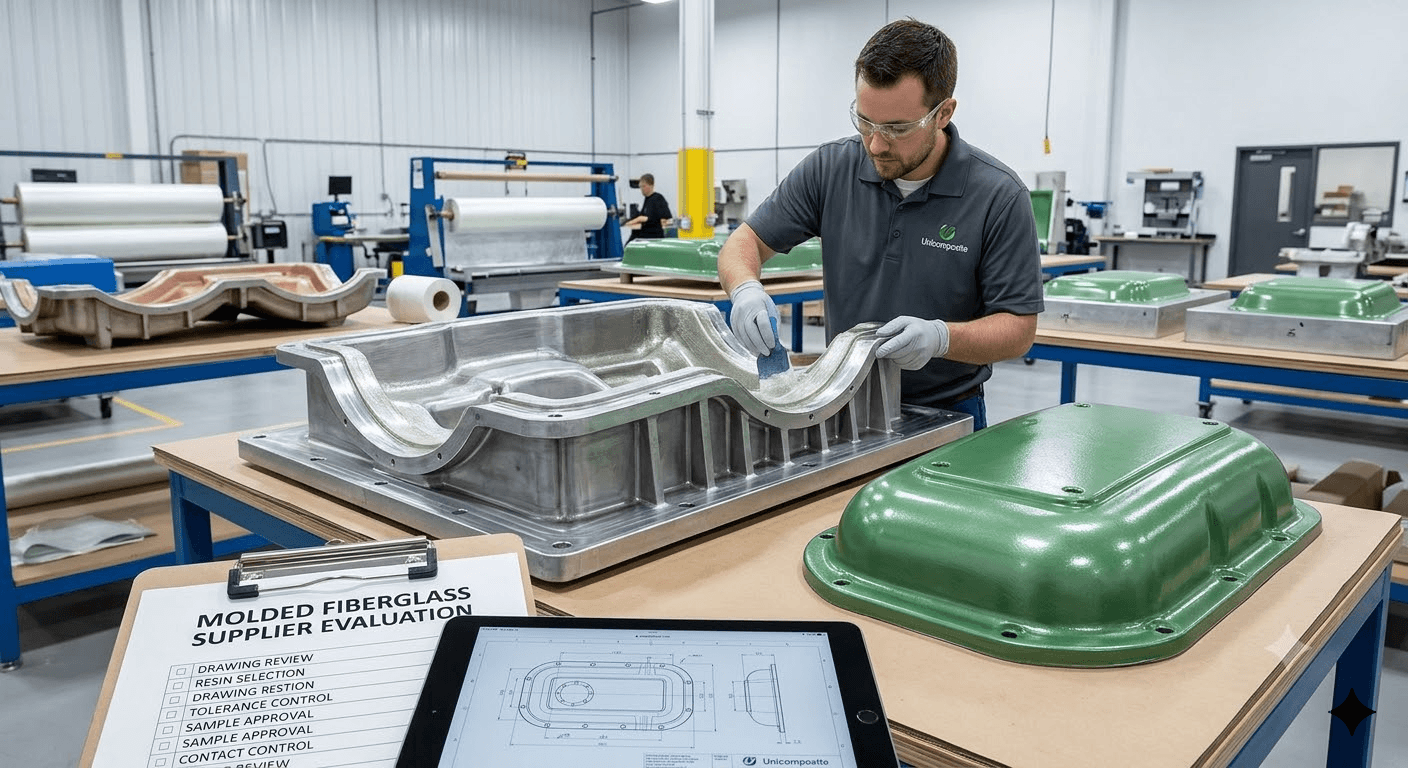
molded fiberglass company
Molded Fiberglass Company Evaluation Checklist
Beyond the first conversation, buyers should verify the supplier’s ability to support production from prototype to repeat order. Custom molded parts often involve more risk than standard catalog products because the mold, resin, geometry, tolerance, inserts, and surface quality all interact.
Consider an anonymized industrial equipment project. The buyer needed a custom FRP cover for outdoor machinery, with bolt holes, a smooth outer surface, UV exposure, and repeat batches for OEM assembly. During prototype review, the team found that two holes needed alignment correction, the outer surface required a smoother finish, and the packaging needed added corner protection. Because those issues were corrected before bulk production, the buyer avoided assembly delays across the full order.
The table below lists technical items buyers should confirm before approving production:
| Technical Confirmation | What to Verify | Why It Matters |
|---|---|---|
| Resin system | Chemical, UV, moisture, heat, or fire requirement | Helps match material to working environment |
| Reinforcement type | Glass fiber format, orientation, and layup method | Affects strength, stiffness, and part behavior |
| Wall thickness | Nominal and critical thickness zones | Controls stiffness, weight, and fit |
| Critical dimensions | Holes, inserts, edges, mating points | Reduces assembly problems |
| Insert bonding | Metal inserts, fasteners, or embedded hardware | Affects installation and service reliability |
| Surface finish | Smooth, textured, gel coat, color, coating | Supports appearance, safety, and cleaning |
| Mold condition | New mold, existing mold, or mold modification | Influences repeatability and lead time |
| Inspection method | Dimensional checks, photos, sample approval | Confirms quality before shipment |
Buyers can reduce risk by requesting documents and samples before mass production. Useful checks include drawing confirmation, material recommendation, sample or prototype, tolerance agreement, mold plan, inspection photos, packaging plan, and batch record.
Molded fiberglass can be specified for corrosive environments when resin and reinforcement are selected correctly. It should not be treated as a generic material. The supplier must match the part design to the exposure conditions and installation method.
Information Needed for a Custom Fiberglass Quote
After shortlisting suppliers, buyers can speed up the RFQ process by sending complete project information. A clear inquiry helps the manufacturer assess feasibility, tooling needs, production method, and cost.
The most useful information includes drawings, samples, 3D files, part dimensions, material requirements, surface finish, color, tolerance, quantity, application environment, packaging, destination, and delivery timeline. If the buyer is unsure about the process, they should describe the part function and operating conditions.
The table below shows what to include in a custom molded fiberglass RFQ:
| RFQ Item | Example Detail |
|---|---|
| Part description | Cover, housing, panel, tray, guard, enclosure |
| Drawing or sample | 2D drawing, 3D file, photo, existing part |
| Dimensions | Length, width, height, thickness, hole positions |
| Material needs | Resin type, UV resistance, chemical resistance, electrical insulation |
| Surface finish | Smooth, textured, colored, painted, gel coat |
| Quantity | Prototype, trial batch, annual volume |
| Tolerance | Critical dimensions and assembly points |
| Application | Outdoor, chemical, marine, utility, equipment, OEM assembly |
| Packaging | Cartons, pallets, protective wrapping, labels |
| Delivery | Destination, timeline, shipping method |
Procurement teams can separate fixed requirements from flexible options. Mounting hole positions may be fixed, while color or surface texture may allow adjustment. That gives the factory room to recommend a practical solution.
Before bulk production, buyers should verify the sample, final drawing, mold plan, tolerance standard, material selection, inspection method, packaging design, and delivery schedule.
Why Work with Unicomposite for Molded Fiberglass Parts
For custom FRP projects, buyers often need both manufacturing capability and engineering communication. The supplier may need to review drawings, recommend a process, support tooling, produce samples, and coordinate repeat production.
Unicomposite manufactures standard and custom FRP/GRP products for industrial, infrastructure, utility, marine, agricultural, and OEM applications. Its broader product range includes FRP structural profiles, grating, handrail systems, cable trays, ladders, platforms, rebar, rods, molds and tools, and custom composite components.
This range can help buyers who need more than one FRP product type. A utility project may need molded covers, pultruded profiles, cable trays, and insulating parts. An OEM project may need custom molded housings, rods, handles, and repeatable packaging.
Buyers can contact Unicomposite with drawings, samples, or project requirements to discuss suitable FRP manufacturing options.
Conclusion
Choosing a molded fiberglass company should follow a clear sourcing framework. Define the part first, including function, geometry, environment, and assembly requirements. Confirm the process next, because molded fiberglass, pultrusion, hand lay up, vacuum infusion, SMC, and BMC serve different production needs.
Then verify the supplier. Review tooling support, resin and reinforcement selection, drawing review, sample approval, quality control, production capacity, and packaging. Approve the sample before scaling production, especially for OEM parts, industrial covers, enclosures, housings, and repeat batch orders.
The practical takeaways are clear:
- Match the FRP process to the part geometry and production volume.
- Confirm resin, reinforcement, wall thickness, critical dimensions, inserts, and surface finish before production.
- Request samples, drawings, tolerances, material records, inspection photos, and packaging approval.
- Work with a manufacturer that can support custom fabrication, technical communication, and repeatable production.
[Contact Unicomposite for a custom molded fiberglass part quote →]


