 info@unicomposite.com


Byline: Composite Applications Engineer
Peer review: Manufacturing QA Lead
Last updated: September 18, 2025
Introduction
Industrial buyers are replacing aging timber decks and planks with composites for one reason: predictable performance in punishing environments. This article compares fiberglass decking profiles (pultruded and molded FRP) with pressure-treated wood and hardwoods on cost, maintenance, lifespan, and safety—using a practical B2B lens.
Context: Unicomposite is an ISO-certificated pultrusion manufacturer in China with in-house lines for standard and custom FRP profiles. We’ll use factory and field experience to frame spec choices and lifecycle costs—no hard sell, just engineering-grade guidance.

fiberglass decking profiles
1) What Are Fiberglass Decking Profiles?
1.1 Pultruded profile basics
Pultruded decks combine continuous glass reinforcements with thermoset resin (polyester or vinyl ester) and a corrosion-resistant surfacing veil. Top surfaces are commonly gritted or mini-mesh for traction, available as I-deck, T-deck, or plank geometries for long, stiff spans.
Typical property ranges (illustrative): density 1.7–1.9 g/cm³, flexural modulus 20–28 GPa, flexural strength 240–480 MPa, Barcol hardness 35–50. Always confirm current supplier datasheets.
1.2 Where they’re used
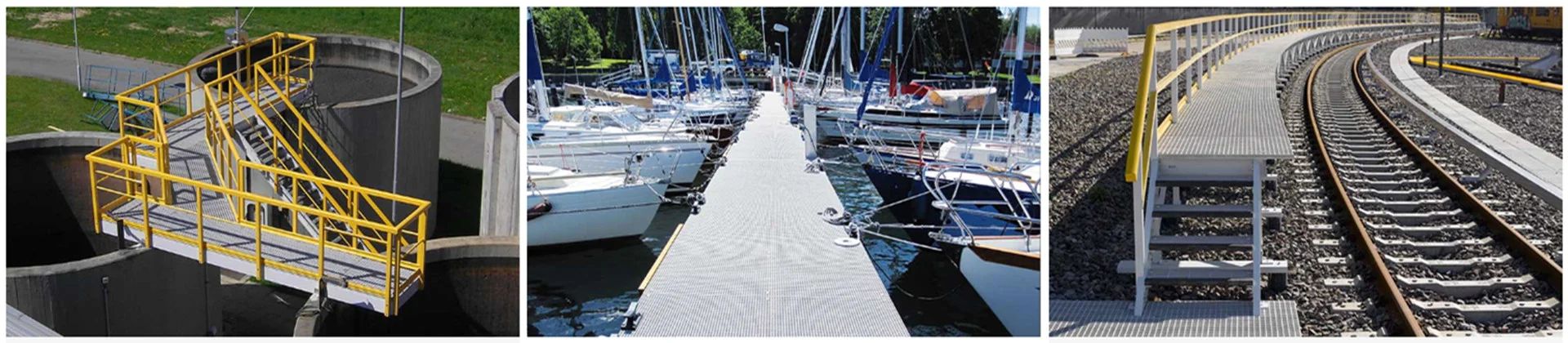
Cooling towers, wastewater plants, chemical walkways, food & beverage platforms, marinas, and waterfront infrastructure—anywhere moisture, chemicals, or sanitation cycles punish wood.
1.3 How profiles are made (experience)
Fibers are drawn through a resin bath, formed in a heated die, then pulled to length with QC checks for fiber volume, Barcol hardness, and tolerances.
Engineer note: “Controlled fiber orientation and continuous processing are why pultruded planks deliver repeatable spans that wood can’t match.”
2) Head-to-Head: Fiberglass vs Wood (Cost & Lifespan)
2.1 10-year TCO snapshot (illustrative, per 100 m² deck)
Model: Materials + Labor + Coatings + Repairs/Replacement + Downtime (soft costs).
| Cost driver | Wood (treated) | FRP plank |
|---|---|---|
| Day-one materials + install | $38,000 | $58,000 |
| Coating cycles (yrs 3,6,9) | $12,000 | $0 |
| Partial replacements (yrs 4–7) | $10,000 | $2,500 |
| Downtime & access (soft costs) | $6,000 | $1,500 |
| 10-yr total | $66,000 | $62,000 |
| Delta vs wood | — | –$4,000 (–6%) |
Assumptions: moderate chemical splash, quarterly cleaning, FRP topcoat touch-ups only. Replace with your numbers; request a supplier TCO calculator.
2.2 Maintenance burden and unplanned downtime
Timber swells, checks, and sheds coatings in wet/chemical service. FRP eliminates rot and routine repainting, and factory grit maintains traction. In utility programs, deck-related work orders commonly drop 30–50% after standardizing on FRP.
2.3 Service life & warranty norms
Well-specified composite planks regularly reach 15–25+ years in corrosive service. UV topcoat refreshes extend aesthetics without structural replacement.
Planner quote: “We stopped budgeting for mid-cycle plank swaps once we standardized on FRP at the aeration basins.”
3) Performance Criteria That Move the Needle
3.1 Strength-to-weight and deflection
High stiffness at a fraction of wood’s weight simplifies installation and reduces substructure mass. For walkways, target deflection limits around L/200 to L/240 unless your authority dictates otherwise.
Span table excerpt (illustrative only; verify with supplier):
| Plank | Uniform load | Limit | Allowable clear span |
|---|---|---|---|
| 38 mm I-deck | 2.4 kN/m² | L/240 | 950–1,050 mm |
| 50 mm I-deck | 4.8 kN/m² | L/240 | 900–1,000 mm |
| 38 mm plank | 2.4 kN/m² | L/200 | 1,050–1,150 mm |
3.2 Corrosion, moisture, and chemicals
Vinyl ester systems resist acids/alkalis and chlorides. Non-absorptive FRP avoids swelling and microbial decay, and its dielectric properties are an advantage near electrics and VFDs.
3.3 Safety & traction targets
Specify wet-traction surfaces and published static coefficient of friction (COF). Many operators set internal targets of COF ≥ 0.6 (wet) for pedestrian walkways; calibrate to your footwear and cleaning regimen.
Safety lead quote: “Match grit to the task—too coarse is hard to sanitize, too fine is slippery with oils.”
3.4 Fire behavior and code notes
Request material fire test data (e.g., ASTM E84 flame spread/ smoke) and ignition info (e.g., ASTM D635). Fire ratings are material ratings; assemblies and local codes may require additional evaluation. Confirm with your AHJ.
4) Specifying Fiberglass Decking Profiles for OEMs & Facilities
4.1 Selection framework
Map traffic class + clear span + environment + cleaning to plank geometry and thickness. Start with longest spans/harshest zones; they drive deck type.
4.2 Resin & finish matrix (quick chooser)
| Environment / Cleaning | Resin | Top surface | Notes |
|---|---|---|---|
| Benign outdoor, light wash | Polyester | Grit (medium) | Cost-efficient, UV veil recommended |
| Chemical splash/immersion | Vinyl ester | Grit (coarse) or mini-mesh | Superior chemical resistance |
| Food & beverage, hygiene | Vinyl ester | Fine grit or mini-mesh | Easier sanitation; verify COF |
| Marine/chlorides + UV | Vinyl ester | Medium grit | Add colorfast gelcoat/veil |
| High-temp washdowns | Vinyl ester (HT) | Grit matched to footwear | Check Tg and edge-seal guidance |
4.3 Fasteners and connections
Use stainless clips and isolation pads on steel. Pre-plan expansion gaps; FRP’s thermal movement is lower along the pultrusion axis than across it. Avoid point loads near edges.
4.4 Documentation package (E-A-T)
Request: drawings, ASTM D790/D695 mechanicals, corrosion datasheets, tolerances, E84 fire report, QA certificates (e.g., ISO 9001), and span tables.
Unicomposite capability note: in-house pultrusion and fabrication enables custom plank geometries, rapid samples, and sector-specific data packs for utilities, marine, and cooling towers.
5) Installation & Maintenance Best Practices
5.1 Substructure and spans
Verify beam spacing vs supplier span tables. Use clip spacing as specified; maintain uniform bearing to avoid local overstress.
5.2 On-site handling & safety (field toolkit)
-
PPE: safety glasses, gloves, dust mask/respirator.
-
Cutting: carbide/diamond blades; capture dust; deburr edges.
-
Drilling/fastening: stainless hardware; torque to spec; isolation pads.
-
Finishing: seal cut edges if required by the resin system and environment.
5.3 Cleaning and lifecycle care
Use non-abrasive cleaners; schedule quick traction checks in wet/oily areas. Plan a light re-topcoat when measured traction drops below your internal threshold.
5.4 First-person field note (experience)
On a basin deck retrofit, our crew pre-kitted clip sets per span bay and pre-cut edge strips. Install hours fell ~25% versus a similar timber project, and QA punch-list items dropped because there were no warped boards to chase.
6) Mini Case Study (Anonymized)
6.1 Context
A municipal wastewater plant replaced 1,200 m² of aging timber on aeration basins with pultruded FRP planks (mini-mesh, gritted top).
6.2 Results
Install time fell by 28%, slip incidents dropped from 5 to 1 in the first year, and coating spend went to near-zero. The 10-year TCO model showed a 34% cost reduction vs wood (labor + coatings + replacement downtime).
6.3 Lessons learned
Use vinyl ester in chemical-mist zones, standardize grit, and pre-kit clips by span bay to speed install.
7) Procurement & QA Checklist
7.1 Pre-RFQ info to collect
-
Span map and live loads (uniform + point).
-
Environment: UV, chlorides, chemicals, temperature range.
-
Traffic patterns: pedestrian, carts, occasional equipment.
7.2 What to ask suppliers
-
Test methods and values (D790 flexural, E84 class).
-
Color stability data and grit spec.
-
Tolerances, sample lead time, replacement policy, packaging.
7.3 Logistics for bulk buys
Confirm MOQs, palletization, Incoterms. Inspect on receipt: grit coverage, color uniformity, straightness before acceptance.
Unicomposite note: ISO-certificated QA and traceable batches simplify incoming inspection for OEMs and utilities.
8) Risks, Myths & How to Mitigate
8.1 “FRP is too expensive upfront”
Use the TCO worksheet; avoided coatings and unplanned shutdowns typically yield 3–5-year payback in wet/chemical service.
8.2 UV chalking & color fade
Specify UV veil/gelcoat and set a visual standard; plan quick touch-ups instead of full recoats.
8.3 Fire & smoke misconceptions
Material ratings ≠ assembly approvals. Coordinate with your AHJ and ventilation conditions; request smoke/toxicity notes where relevant.
9) Sustainability & Compliance Notes
9.1 Longevity vs replacement waste
Eliminating two or more timber replacement cycles over 15–20 years reduces waste and truck rolls—often the largest carbon contributor on small projects.
9.2 Worker safety and hygiene
Non-conductive, corrosion-free surfaces support lock-out/tag-out near electrics and easier sanitation in food/chem plants. Programs report near-zero rot-related hazards with FRP compared to wood.
Conclusion
For industrial walkways, platforms, and waterfront decks, fiberglass decking profiles outperform wood when moisture, chemicals, or frequent cleaning are realities. The business case rests on lower maintenance, longer service life, and safer traction—not just materials cost. If you’re planning a retrofit or OEM platform, request the spec pack, span tables, and a 10-year TCO calculator. Unicomposite’s engineering team can translate your span map and load cases into the right profile, resin, and finish—then prototype fast for field validation.
Sources & standards (non-exhaustive): ASTM E84 (surface burning characteristics); ASTM D635 (rate of burning/ignition); ASTM D790/D695 (flexural/compressive properties). Verify local code requirements with your authority having jurisdiction.
Frequently Asked Questions
Q1: How do I choose between gritted and mini-mesh tops?
Pick gritted for general pedestrian traction; mini-mesh reduces small-object drops and can aid hygiene. Confirm COF targets against your cleaning regimen and footwear.
Q2: When is vinyl ester mandatory?
Use vinyl ester in chemical splash, immersion, or high-temperature washdown zones. Polyester can be suitable for benign outdoor exposure with UV protection.
Q3: Can FRP planks be cut and drilled on site?
Yes. Use carbide/diamond tools, capture dust, deburr edges, and seal cuts if the environment or resin system requires it. Follow supplier PPE guidance.
Q4: What’s a reasonable service-life expectation?
With correct resin/finish and proper supports, 15–25+ years is common in utilities and marine-adjacent environments. Aesthetic topcoat touch-ups extend appearance without structural replacement.
Q5: Does FRP meet fire code?
Ask for material fire tests (e.g., ASTM E84 class) and consult your AHJ for assembly-level acceptance. Ventilation and occupancy class affect requirements.


