 info@unicomposite.com


Introduction
FRP nuts are small components that quietly carry a lot of responsibility. As part of composite fastening systems, they combine glass fibers and resin to deliver strength, corrosion resistance, and electrical insulation that traditional metal hardware struggles to match. For engineers, buyers, and OEMs working in aggressive or energized environments, the choice between steel and FRP nuts directly affects maintenance frequency, safety, and lifecycle cost.
This guide is written for technical and purchasing teams who need more than marketing claims. You’ll see how FRP nuts are made, what performance you can realistically expect, where they are used, and how to specify them with confidence. Along the way, we’ll touch on practical installation tips, limitations, and what to look for in a supplier.
Manufacturers such as Unicomposite—an ISO-certificated pultrusion specialist in China with its own factory—illustrate the level of capability available in the market. By producing standard FRP profiles and custom composite parts for electricity, landscaping, wastewater treatment, cooling tower construction, agriculture, aquaculture, marine and more, companies like this can also support engineered FRP nut and fastener solutions as part of a complete system.

FRP Nuts
What Are FRP Nuts and How They’re Made
1.1 FRP Nut Materials, Structure and Basic Terminology
FRP nuts are made from fiberglass-reinforced plastic: continuous or chopped glass fibers embedded in a thermoset resin such as polyester, vinyl ester, or epoxy. The fibers provide tensile and flexural strength, while the resin protects them from moisture and chemicals and transfers loads between fibers.
In fasteners, tensile strengths for FRP bolts and similar components can sit in the 400–800 MPa range, depending on fiber type and layup, which is competitive with many structural steels on a strength-per-weight basis. Internal threads are machined or molded to standard metric or imperial forms, so FRP nuts can be paired with FRP bolts or threaded rods without changing your basic design rules.
1.2 Manufacturing Processes: Pultrusion, Molding and Custom Fabrication
Two main routes are used:
-
Pultrusion + secondary machining
Continuous profiles—rods, slabs or blocks—are pulled through a heated die, curing the resin and locking fiber alignment. Nuts are then cut, drilled and tapped from these profiles. This is ideal for standard sizes with consistent properties along the bar length. -
Molded FRP nuts (SMC/BMC, compression molding)
Sheet molding compound (SMC) or bulk molding compound (BMC) is pressed into nut shapes, allowing efficient production of more complex geometries and higher volumes.
Unicomposite, for example, combines pultrusion, Pulwound, SMC/BMC, and hand lay-up processes, then finishes parts with drilling and machining to meet dimensional tolerances. Quality checks typically include visual inspection, dimensional gauging, thread gauges, and mechanical tests like torque-to-failure or pull-out tests.
1.3 Key Specifications and Relevant Standards
On a data sheet, you can expect to see:
-
Tensile, compressive and flexural strength
-
Modulus of elasticity
-
Glass content and resin system
-
Temperature range and flammability rating
-
Chemical resistance notes for common media
Fastener standards are still largely written around metals, so many FRP suppliers use adapted test procedures and internal standards that mirror these norms. As a specifier, insist on repeatable test data, clear allowable loads and stated safety factors, plus evidence of a quality system such as ISO 9001.
Key Performance Advantages of FRP Nuts
2.1 Corrosion Resistance, Chemical Stability and Long Service Life
Corrosion resistance is usually the first reason FRP nuts appear on a spec. In wastewater, coastal, chemical, or cooling-tower environments, even stainless steel fasteners can start to pit, seize or crack. Composite fasteners, by contrast, resist many chemicals and don’t rust, which can extend service life dramatically.
Industry case studies on FRP fasteners in marine conditions report conventional steel hardware needing replacement after 2–3 years, while composite fasteners often run 10–20 years before showing comparable degradation, slashing maintenance and downtime. When you’re bolting down gratings, handrails, or platforms in hard-to-reach places, fewer change-outs translate directly into lower lifecycle cost.
2.2 Electrical Insulation, Non-Magnetic and Thermal Properties
FRP is inherently non-conductive, with fiberglass threaded assemblies often showing dielectric strength ratings around 1.0 kV/mm in product literature. That makes FRP nuts attractive in substations, switchgear structures, rail power systems, and any installation where stray currents, touch potential or flashover are concerns.
They are also non-magnetic, which benefits installations around sensitive instruments or MRI equipment. Temperature performance depends on the resin—typically, FRP nuts work best within a defined medium-temperature band. Above that, mechanical properties and creep resistance can drop, so you should always match the chosen product’s rating to your design envelope rather than assume “steel-like” high-temperature behavior.
2.3 Lightweight Design, Installation Ease and Safety
On a density basis, fiberglass composites are roughly a quarter of the weight of steel yet can deliver comparable tensile strength in many applications. In practice, this means FRP fasteners and associated hardware can be 60–75% lighter than equivalent steel components.
For field crews, that weight reduction means:
-
Less fatigue when installing hardware at height
-
Easier manual handling and fewer lifts with heavy tools or hoists
-
Lower transport weight and simpler logistics on remote projects
A common “field tip” from installers is to standardize on composite nuts and bolts for walkways and handrails on tall structures. Crews often report faster progress simply because every bucket of fasteners is lighter.
Where FRP Nuts Are Used in Industry
3.1 Power, Electrical and Utility Infrastructure
Utilities deploy FRP nuts wherever insulation and corrosion resistance are both important, including:
-
Busbar and equipment frames in outdoor switchyards
-
Cable ladders and tray supports around energized equipment
-
Structural frames in and around switchgear rooms
In one anonymized project, a utility retrofitted corroding metallic nuts on outdoor bus support structures with FRP hardware. The change simplified the insulation design, reduced the number of flashover incidents during storms, and cut back on hot-work maintenance visits around energized gear.
3.2 Water, Wastewater, Cooling Towers and Marine Structures
FRP nuts are widely used to fasten:
-
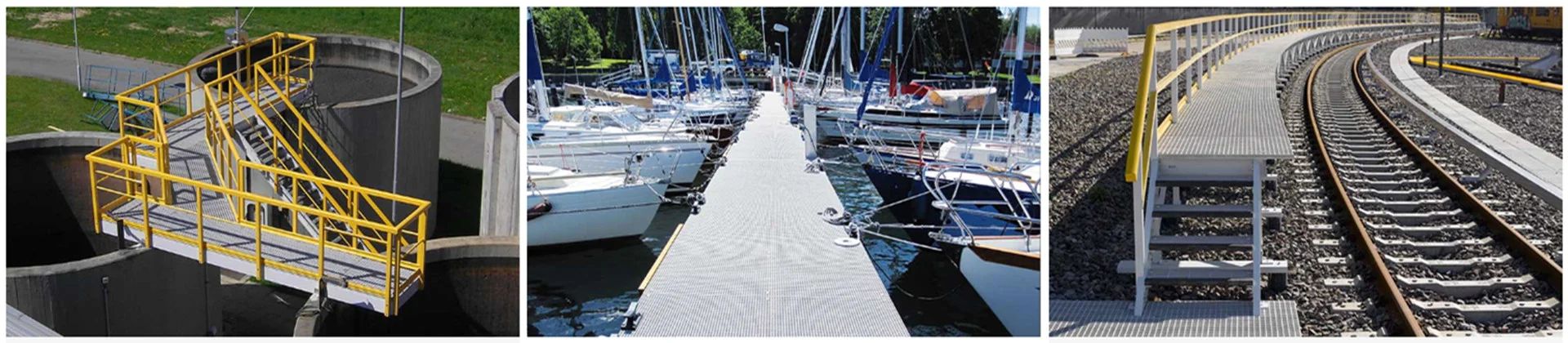
FRP gratings, ladders and handrails in clarifiers and treatment basins
-
Structural framing and drift eliminator supports in cooling towers
-
Walkways and service platforms on marine or coastal structures
Suppliers like Unicomposite that already produce FRP grating, beams and handrails can provide compatible FRP nuts and bolts, creating a full composite system from structure to fastener for truly corrosion-resistant installations.
3.3 Agriculture, Aquaculture and General Industrial OEMs
In agriculture and aquaculture, FRP nuts show up in:
-
Greenhouse structures and irrigation systems exposed to fertilizers
-
Aquaculture cages and feeding platforms in brackish or seawater
-
Equipment where wash-down chemicals attack metal hardware
Industrial OEMs also use FRP nuts on composite machinery frames or enclosures to avoid galvanic corrosion between metals and FRP and to meet insulation requirements around drives, controls and sensors.
How to Select the Right FRP Nuts for Your Project
4.1 Engineering Criteria: Loads, Environment and Safety Factors
Start selection the same way you would for metal fasteners:
-
Define loads – tension, shear, bending, combined loading and vibration.
-
Map the environment – chemicals, salt spray, humidity, UV exposure, and temperature.
-
Set safety factors – aligned with your local design codes and risk tolerance.
Share these inputs with your FRP supplier. Engineering teams at manufacturers such as Unicomposite can help match nut type, resin system and layup to your design envelope rather than simply guessing from a catalog.
4.2 Sizing, Thread Matching and System Compatibility
Practical sizing steps:
-
Choose the correct diameter and thread form to match FRP bolts or threaded rods.
-
Check that the nut’s allowable load exceeds the maximum design load with margin.
-
Ensure compatibility between the nut, the mating fastener, and the clamped materials.
If you’re joining FRP profiles to metal plates, confirm that the joint design accounts for different stiffness and thermal expansion. In many cases, using FRP nuts with FRP beams and plates creates a more uniform, predictable connection over time.
4.3 Cost, Lifecycle Value and Procurement Considerations
FRP nuts may cost more per piece than commodity steel nuts, but the lifecycle picture is usually more favorable in harsh environments:
-
Fewer replacements thanks to corrosion resistance
-
Less downtime and fewer confined-space entries to change hardware
-
Lower transport and installation costs due to weight savings
For bulk buyers and OEMs, partnering directly with a manufacturer allows you to standardize dimensions, colors and packaging. Unicomposite, for example, can coordinate project supply of structural profiles, gratings and matched FRP fasteners, simplifying procurement and logistics for multi-site programs.
Installation, Maintenance and Safety Considerations
5.1 Best Practices for Installing FRP Nuts
Installation is familiar, but the “feel” is slightly different from steel:
-
Use torque levels recommended by the supplier; avoid simply copying steel torque tables.
-
Stop tightening once the joint is snug and specified torque is reached—over-tightening can crush laminates or damage threads.
-
Drill and machine holes with sharp bits and correct speeds to avoid delamination.
A real-world lesson from one contractor: their crew initially used steel fastener torque settings and stripped a handful of FRP nuts. After recalibrating torque wrenches to supplier values and training installers to feel for the right “snug,” installation proceeded smoothly for the rest of the project.
5.2 Inspection, Maintenance and Replacement Intervals
FRP nuts should appear in your regular inspection plans:
-
Look for discoloration, chalking, surface cracking or signs of impact damage.
-
Inspect high-vibration locations for thread wear or loosening.
-
Pay attention to components that are frequently disassembled for maintenance.
In many corrosive applications, you’ll find that FRP nuts outlast nearby metallic hardware. That doesn’t eliminate inspection—especially on safety-critical access structures—but it does shift more of your maintenance budget away from corrosion-driven replacements.
5.3 Safety, Limitations and Documentation
To use FRP nuts safely and transparently:
-
Confirm temperature limits, UV resistance and chemical compatibility from the data sheet.
-
Treat supplier mechanical values as input to engineering design—not a substitute for a qualified engineer’s calculations.
-
Keep test reports, certificates of conformity and batch traceability on file for audits and incident reviews.
A short conversation between your design engineer and the FRP manufacturer’s technical team early in the project typically prevents most misuse scenarios.
Working with an Experienced FRP Nut Manufacturer
6.1 Why Supplier Capabilities Matter
For fasteners used in large substations, multi-cell cooling towers or long coastal walkways, supplier capability is not a minor detail. Look for manufacturers that:
-
Operate under ISO-certificated quality systems
-
Run multiple composite processes (pultrusion, molding, hand lay-up) in-house
-
Have proven experience in power utilities, water and wastewater, cooling towers, marine and industrial OEM work
Unicomposite’s combination of pultrusion lines, Pulwound, SMC/BMC and hand lay-up production, plus custom fabrication, is the kind of footprint that supports both standard product lines and engineered, project-specific FRP nuts and assemblies.
6.2 Questions to Ask Potential FRP Nut Suppliers
Before you place a significant order, ask:
-
Which resin systems and fiber types do you use for this nut range?
-
What mechanical and electrical test data can you share for this exact product?
-
Can you customize sizes, colors, threads or packaging for my project?
-
How do you control quality consistency from batch to batch?
-
Do you offer engineering or joint-design support, and what does that look like in practice?
The answers will quickly reveal whether you are dealing with a trading company or a solution-oriented manufacturing partner.
6.3 Example of a Solution-Oriented FRP Nut Project
Consider an anonymized coastal wastewater plant that struggled with seized and rusted steel nuts on FRP walkways. After a joint review with an FRP manufacturer, the owner switched to a fully composite system: pultruded beams, gratings, and FRP nuts and bolts. Within a few years, inspection reports showed almost no hardware replacements, maintenance crews spent less time cutting out corroded fasteners, and access to critical equipment became safer and more predictable.
Conclusion
FRP nuts bring together corrosion resistance, electrical insulation, and high strength-to-weight performance in a single component. For utilities, water and wastewater operators, industrial OEMs, and infrastructure owners, they provide a credible path to reduce maintenance, improve safety and increase reliability—especially when paired with matching FRP beams, gratings and profiles.
If you define your loads and environment clearly, follow good installation and inspection practice, and work with an experienced FRP manufacturer such as Unicomposite, you can treat your fastening system as an engineered asset rather than a consumable. For many projects, that shift is where the real value of FRP nuts is unlocked.
Frequently Asked Questions
Q1. Are FRP nuts as strong as metal nuts?
In pure tensile strength, FRP fasteners can reach ranges that overlap with many structural steels, especially when loads are aligned with the fiber direction. They are not a one-for-one replacement for every steel nut, but when you design around their properties and follow supplier load limits, they can deliver comparable performance with far better corrosion resistance.
Q2. How much lighter are FRP nuts compared with steel?
Fiberglass-based composites are roughly a quarter of the density of steel, and FRP fastener systems are often 60–75% lighter than equivalent steel assemblies. This weight reduction improves handling, reduces lifting effort and can cut freight costs on large or remote projects.
Q3. Can FRP nuts be used in high-temperature applications?
FRP nuts handle typical outdoor and many industrial temperatures well, but they have defined upper limits set by the resin system. Above those limits, strength and stiffness fall off more quickly than with steels, so it’s important to confirm the product’s rating and avoid applying FRP nuts where very high temperatures or fire exposure dominate the design.
Q4. Are FRP nuts suitable for chemical or marine environments?
Yes—corrosion resistance in chemical plants, wastewater facilities and marine atmospheres is one of the main reasons they are specified. The exact performance depends on the resin and fiber system, so you should always cross-check the chemical exposure against the supplier’s resistance tables or request specific test data.
Q5. Can I order custom sizes or colors for FRP nuts?
Most manufacturers can provide a standard range off the shelf and offer custom options for diameter, thread, nut height, color and even surface finish. For OEMs and large infrastructure owners, agreeing on a standardized custom range with the manufacturer can simplify maintenance and spare-parts management across multiple sites.


