 info@unicomposite.com


Short answer: Pultruded fiberglass grating does not have one universal service-life number. Its remaining service depends on the identified product, environmental exposure, structural duty, installation history, and inspection evidence.
A published number of years is not a substitute for product-specific evidence and a defined acceptance basis. The useful question is therefore not simply, “How old is the grating?” It is, “Does this identified grating still satisfy the structural requirements, walking-surface requirements, environmental limits, and other project-specific acceptance criteria for its present use?”

how long does pultruded fiberglass grating last
What Does “Service Life” Mean for Pultruded FRP Grating?
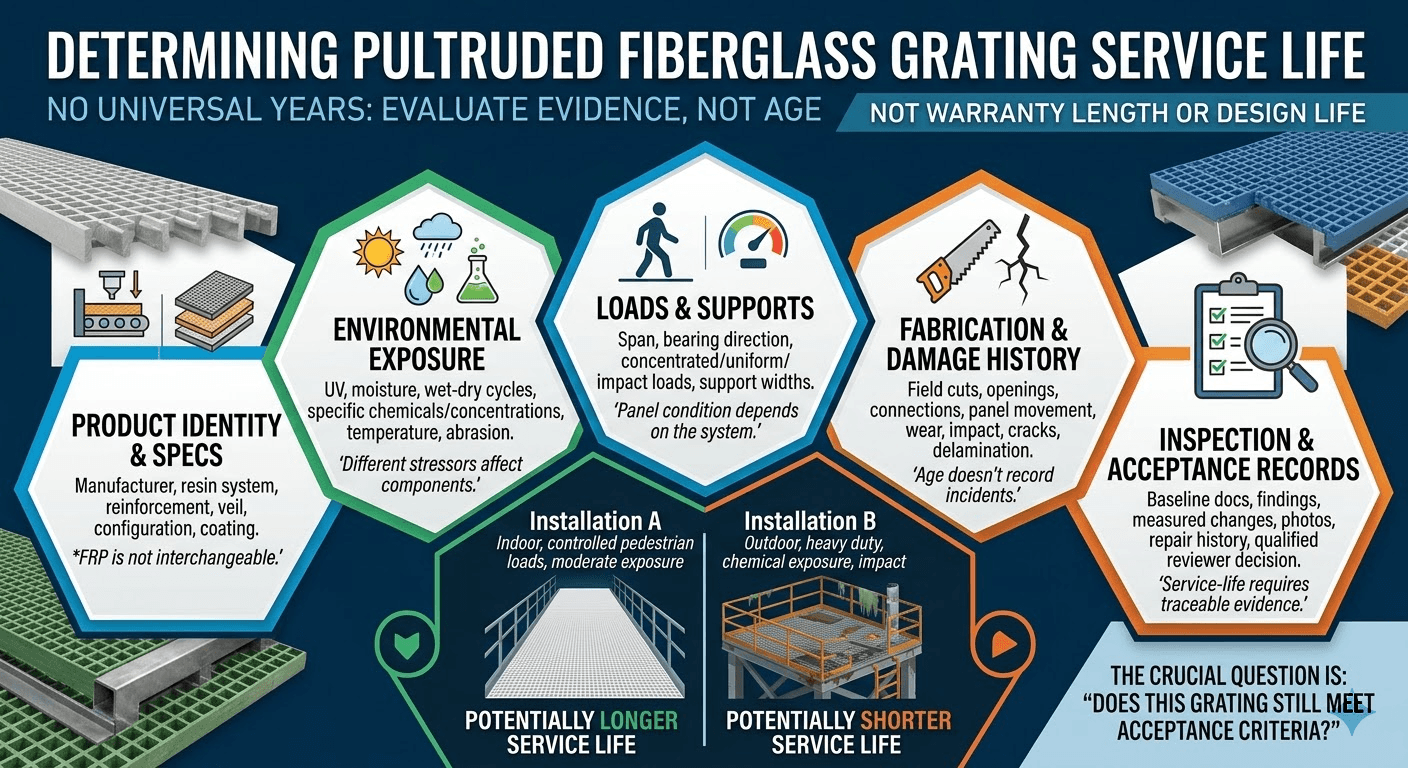
Service life is the period during which an installed system continues to meet its required function and acceptance criteria under the conditions actually experienced. It is not the same as warranty length, design life, exposure-test duration, or the age printed in an asset register.
In procurement and asset management, service life should be evaluated against documented requirements rather than calendar age alone.
For a walkway or platform, the acceptance basis may include loads, deflection, supports, connections, walking-surface condition, environmental resistance, and any project-specific fire, electrical, or other requirements. These criteria must be identified before age or visible appearance can be interpreted.
This distinction matters because two installations of the same age can have different histories. One may have controlled pedestrian loads and moderate indoor exposure. Another may experience outdoor weathering, wet-dry cycles, chemical splash, abrasion, impact, modified supports, or unrecorded field cuts. Their remaining service cannot be inferred from age alone.
Why a Fixed Year Count Is Misleading
Long-term research on pultruded glass-fiber-reinforced polymer does not establish one service-life number for every grating product and environment. A ten-year outdoor exposure study evaluated three pultruded GFRP laminate systems, including coated variants, and examined how different layers contributed to changes in mechanical properties.[1] A separate Public Works Research Institute study examined pultruded GFRP specimens exposed outdoors for about 14 years while carrying sustained bending loads; it reported that surface changes and mechanical-property responses did not follow one simple pattern.[2]
Laboratory studies also show that moisture, temperature, resin system, exposure mode, and loading conditions affect results. Research on pultruded GFRP in water and moist environments found changes that depended on the exposure conditions and temperature.[3] More recent hygrothermal work compared polyester- and vinyl-ester-based pultruded profiles under several water, temperature, and condensation conditions rather than treating all pultruded GFRP as one material.[4]
These studies are valuable evidence about degradation mechanisms and test methods. They are not service-life certificates for an unrelated commercial grating. Exposure duration in a study should never be copied into a product lifespan claim without matching the material, geometry, surface system, loads, environment, failure criteria, and validation method.
NIST research on polymer service-life prediction makes the broader methodological point: lifetime prediction requires degradation mechanisms, realistic combinations of stressors, field validation, and suitable models. A qualification test may detect premature failure without predicting a product’s actual service life.[5]
What If a Project Requires a Service-Life Number?
If a project requires a stated service period, define that requirement in the design or procurement specification first. Then ask each supplier to provide product-specific evidence, applicable exposure limits, inspection assumptions, and acceptance criteria for the proposed grating.
The submitted evidence should identify the product, test or field basis, environmental and loading conditions, limitations, and the person responsible for technical acceptance. Until those items are reviewed and accepted, any generic online lifespan range should be treated as an early screening assumption—not a design value, remaining-life assessment, or product warranty.
The Main Factors That Control Service Life
| Factor | Information needed | Why it changes the assessment |
|---|---|---|
| Product identity | Manufacturer, product series, bar and panel configuration, production revision, resin and reinforcement system, surfacing or coating | “Pultruded FRP” describes a process family, not one interchangeable material or construction. |
| Environment | Indoor or outdoor exposure, UV, moisture, immersion, wet-dry cycles, temperature range, chemicals and concentrations, cleaning agents, abrasion and contamination | Different stressors may affect the resin, fiber-matrix interface, surface, connections, or walking condition in different ways. |
| Loads and supports | Intended pedestrian, uniform, concentrated, wheel, impact, fatigue, and sustained loads; clear spans; support widths; bearing direction; cutouts and joints | A panel’s condition cannot be separated from the load path and the support arrangement in which it is used. |
| Fabrication and installation | Cut edges, openings, unsupported edges, fasteners, bearing, panel movement, field modifications, and installation records | Changes to the panel or support system can create conditions that were not part of the original selection. |
| Surface and damage history | Wear, impact events, cracking, exposed fibers, delamination, coating loss, heat or fire exposure, chemical incidents, and previous repairs | Calendar age does not record abnormal events or localized damage. |
| Inspection and acceptance records | Baseline documentation, inspection findings, measured changes, photographs, repair history, and the responsible review decision | A service-life decision needs traceable evidence and stated acceptance criteria, not appearance alone. |
No single row can establish remaining life. The factors must be reviewed together for the identified installation.
How Environment and Material System Affect Durability
Pultruded profiles combine fibers, a polymer matrix, and other layers or surface treatments. Environmental exposure can act on these constituents and their interfaces. Moisture, temperature, UV, chemical contact, and mechanical loading may also act simultaneously rather than one at a time.
For that reason, a statement such as “FRP is corrosion resistant” is not a chemical-compatibility decision. The actual chemical, concentration, temperature, exposure mode, duration, cleaning process, and specific material system must be matched. Data for one resin or coupon cannot automatically be applied to another grating product.
Likewise, visible fading or surface change is not by itself a remaining-strength measurement, while a visually acceptable surface does not prove that every structural and connection requirement is satisfied. Visual inspection is one input to a broader condition assessment.
How Loads, Supports, and Modifications Affect the Answer
The maximum intended load, span, support width, bearing direction, panel joints, cutouts, and edge support all belong in the service-life review. A change in equipment, traffic, maintenance access, or platform layout may alter the duty even when the panel itself has not changed.
Do not combine a load table from one product with a panel of unknown identity. Do not infer capacity from age, color, bar depth, or a similar-looking installation. Where structural integrity is in question, the current configuration and evidence should be reviewed by a qualified person against the governing project requirements.
ASTM F3059-24 illustrates why scope matters. It is a marine-specific specification for FRP gratings used in marine construction and shipbuilding and addresses testing and performance topics including durability and ultraviolet resistance within that stated application.[6] It does not establish universal compliance or a lifespan for every FRP grating, and its applicability must be determined for the project.
determining pultruded fiberglass grating service life
What Should Be Reviewed on Existing Grating?
A condition review should start with records and the current installation, not with a generic replacement age.
- Confirm identity and duty. Locate the product data, drawings, panel schedule, load basis, supports, environmental requirements, and acceptance criteria. Record unknowns rather than filling them with assumptions.
- Compare the installation with the records. Note changed supports, added openings, field cuts, loose or missing connections, panel movement, local damage, surface wear, and changes in traffic or equipment.
- Document environmental history. Include chemical or heat incidents, prolonged wetting, UV exposure, cleaning practices, abrasion, impact, and any change in process conditions.
- Record condition consistently. Use dated photographs, locations, measurements where specified, previous findings, repairs, and the person responsible for disposition.
- Escalate hazards and structural questions. OSHA requires walking-working surfaces to be inspected regularly and as necessary, maintained in a safe condition, and kept capable of supporting their maximum intended load. Hazardous conditions must be corrected or guarded, and work involving structural integrity must be performed or supervised by a qualified person.[7]
This is a review framework, not a pass/fail inspection procedure. Inspection frequency, methods, acceptance limits, testing, repair, and return-to-service decisions must come from the owner, governing requirements, product documentation, and qualified technical review.
When Should Pultruded Fiberglass Grating Be Repaired or Replaced?
Replacement should be triggered by failure to meet an applicable acceptance requirement, an unresolved hazardous condition, or a qualified determination that repair cannot restore the required service—not by an unsupported universal age.
Possible reasons for technical escalation include:
- uncertain product identity or missing load documentation;
- changed supports, spans, cutouts, traffic, or intended loads;
- panel movement, connection problems, or excessive deflection relative to the governing criterion;
- cracking, delamination, exposed fibers, impact damage, heat damage, or significant surface deterioration;
- chemical or temperature exposure outside the documented material limits; and
- recurring defects or repairs without a verified disposition.
These observations do not establish capacity by themselves. If a walking surface presents a hazard, restrict or guard access as required by the site safety process until the condition is assessed and corrected.
What Evidence Is Needed for a Service-Life Estimate?
A defensible estimate or remaining-life decision should identify:
- the exact product and production revision;
- resin, reinforcement, veil, coating, and relevant material documentation;
- panel geometry, bearing direction, supports, connections, openings, and field modifications;
- original and current loads, deflection or serviceability limits, and required safety basis;
- chemicals, concentrations, temperature, moisture, UV, abrasion, traffic, and cleaning exposure;
- applicable test reports and the specimens, conditioning, test methods, and acceptance values they cover;
- installation, inspection, incident, repair, and change records; and
- the responsible qualified reviewer and the documented acceptance decision.
If these inputs are unavailable, the appropriate output is a documented evidence gap and a qualified review plan—not a precise number of remaining years.
The evidence status can be converted into a practical next action:
| Evidence status | What can be concluded | Appropriate next step |
|---|---|---|
| Product identified and evidence matches the current duty | The installation can be reviewed against documented acceptance criteria. | Continue the owner-approved inspection, documentation, and disposition process. |
| Product identified but exposure or load records are incomplete | Remaining service cannot yet be established. | Close the evidence gaps and obtain qualified review. |
| Product unknown or the duty has changed | Generic lifespan estimates are unreliable. | Verify the configuration, supports, loads, environment, and applicable requirements before disposition. |
| Damage or a hazardous condition is present | Calendar age does not resolve the condition. | Restrict or guard access as required by the site process and escalate for qualified evaluation. |
Questions to Include in a Pultruded Grating Review or RFQ
Before selecting new grating or evaluating an existing installation, ask:
- What is the application, location, and intended service?
- What panel configuration, supports, clear spans, bearing direction, loads, openings, and connections apply?
- Which chemicals, concentrations, temperatures, exposure modes, UV, moisture, abrasion, and cleaning conditions are expected?
- What surface, slip, fire, electrical, or other project-specific acceptance criteria apply?
- Which product-specific load, environmental, durability, and test documents must be submitted?
- Are the original manufacturer or supplier data, drawings, installation records, and previous inspection records available?
- Who defines inspection frequency, damage limits, repair methods, and return-to-service approval?
- Which assumptions remain open, and who is responsible for approving them?
Planning a Pultruded Fiberglass Grating Project?
Review our fiberglass grating options and send us the application, panel layout or drawings, support arrangement, loads, chemical or environmental exposure, surface requirements, required documents, quantity, and destination. We can use these inputs to clarify the quotation scope, organize the open technical questions, and identify the information needed for a project-specific product review. The proposed configuration, supporting evidence, acceptance responsibilities, and commercial terms can then be defined during project review and quotation.
References
- Nishizaki, I., Sakuraba, H., and Tomiyama, T., “Durability of Pultruded GFRP through Ten-Year Outdoor Exposure Test,” Polymers, 2015. https://doi.org/10.3390/polym7121525
- Public Works Research Institute, “Durability Evaluation of GFRP for Construction Structures by Outdoor Exposure Testing under Static Loading,” 2009. https://thesis.pwri.go.jp/public_detail/115382
- Nishizaki, I., and Meiarashi, S., “Long-Term Deterioration of GFRP in Water and Moist Environment,” Journal of Composites for Construction, 2002. https://doi.org/10.1061/(ASCE)1090-0268(2002)6:1(21)
- “Hygrothermal Ageing of Pultruded GFRP Profiles: Comparative Study of Unsaturated Polyester and Vinyl Ester Resin Matrices,” Composites Part A, 2021. https://doi.org/10.1016/j.compositesa.2020.106193
- National Institute of Standards and Technology, “Service Life Prediction of Polymeric Components for Reliable Power Systems.” https://www.nist.gov/programs-projects/service-life-prediction-polymeric-components-reliable-power-systems
- ASTM International, ASTM F3059-24, “Standard Specification for Fiber-Reinforced Polymer (FRP) Gratings Used in Marine Construction and Shipbuilding.” https://store.astm.org/f3059-24.html
- Occupational Safety and Health Administration, 29 CFR 1910.22, “General Requirements.” https://www.osha.gov/laws-regs/regulations/standardnumber/1910/1910.22


