 info@unicomposite.com


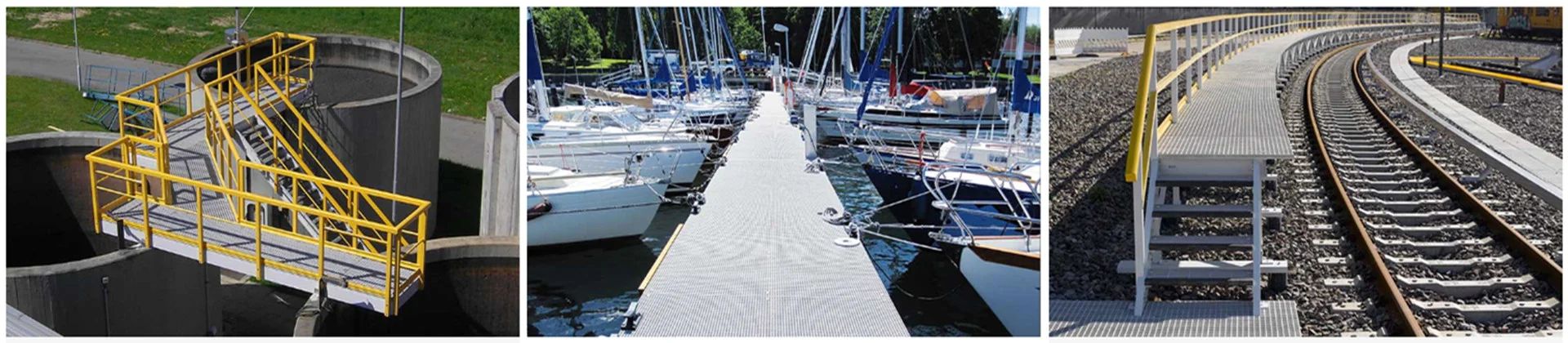
Introduction
Every year, corrosion-related downtime drains an estimated US $3.4 billion from North American industrial budgets, according to a 2024 market study by the National Association of Corrosion Engineers. Selecting the right walking-surface grating is one of the easiest ways to stem those losses while improving safety and uptime. Fiberglass and metal gratings dominate plant design because each offers a distinct blend of load capacity, chemical resistance, and lifecycle cost. Drawing on two decades of pultrusion experience at Unicomposite—an ISO-9001 manufacturer that collaborates with third-party labs for ASTM and ANSI testing—this guide delivers a data-driven comparison so you can specify with confidence.

fiberglass and metal gratings
Fiberglass and Metal Gratings at a Glance
What Is Fiberglass Grating?
Pultruded or molded FRP panels embed continuous glass fibers in a thermoset resin. The lattice is non-sparking, non-conductive, and up to 70 % lighter than steel while still meeting ANSI/NAAMM pedestrian load limits. Vinyl-ester resins excel in harsh chemical zones; isophthalic polyester covers general duty.
What Is Metal Grating?
Carbon-steel, stainless, and aluminum panels are welded or press-locked. Steel delivers the highest modulus; stainless adds chloride resistance; aluminum trades some strength for lighter weight. Protective coatings (galvanizing, powder) slow but do not stop oxidation.
Key Performance Factors Side-by-Side
Strength & Load Capacity
ANSI/NAAMM MBG-531 lists a ⅜ × 1 ¼ in. welded-steel panel at 720 lb/ft² for a 24 in. span. A 1 ½ in. deep pultruded FRP panel handles 560 lb/ft², easily clearing OSHA’s 50 lb/ft² walkway minimum but ceding extreme fork-truck duty to steel.
Mark Liu, P.E., structural engineer: “For pedestrian platforms under ten-foot spans, FRP meets deflection targets while cutting dead load roughly in half.”
Corrosion & Chemical Resistance
ASTM C581 immersion testing shows vinyl-ester FRP losing <0.2 % mass after 3 000 h in 20 % sulfuric acid, whereas uncoated carbon-steel pits within weeks. Even with galvanizing, steel can shed 0.1 in. thickness per year in coastal spray.
Safety & Ergonomics
-
Slip Resistance: OSHA records indicate floor-surface irregularities cause 15 % of workplace fatalities. Molded FRP with embedded quartz achieves a 0.8 wet CoF—about double smooth steel plate.
-
Weight: A 4 × 12 ft FRP panel weighs ~180 lb and can be positioned by two technicians; the steel equivalent tops 430 lb and needs hoisting gear.
-
Dielectric: FRP’s non-conductivity prevents stray-current arcs near substations—an advantage metal cannot match.
Safety Considerations
Always wear cut-resistant gloves and eye protection when trimming FRP. Steel removal requires hot-work permits, spark containment, and gas monitoring. Follow OSHA 1910 Subpart D for guardrail and opening sizes.
Cost of Ownership Analysis
Up-Front vs. Lifetime Cost
| Grating Type | Typical Purchase ($/ft²) | 20-Year Paint & Labor ($/ft²) | Expected Service Life |
|---|---|---|---|
| Carbon-Steel | 18 | 22 | 20 yrs |
| FRP (Vinyl Ester) | 28 | 0 | 25 yrs |
Steel starts ~35 % cheaper, but a single blast-and-recoat cycle closes the gap within seven years in corrosive environments. Plants surveyed in 2024 report saving 12 % on total lifecycle spend after switching to FRP in chemical zones.
Maintenance, Replacement & Downtime
-
Steel: Grinding and welding trigger 48-hour area shutdowns.
-
FRP: Carbide saws and bolted clips let crews replace a 4 × 12 ft panel in under an hour, cutting outage costs dramatically.
Real-World Applications & Case Study
Case Study: Wastewater Treatment Walkways
A Mid-Atlantic utility replaced 6 000 ft² of corroded steel over aeration basins with Unicomposite vinyl-ester grating. Field data show:
-
Install time 40 % faster thanks to lighter panels.
-
Zero repaint cycles after six years.
-
Payback reached in 3.8 years through reduced labor and coating spend.
First-person anecdote: “During the change-out, we expected a 36-hour basin shutdown,” recalls site engineer Dana Ng. “But once the crew realized each FRP panel could be hand-carried, we reopened in 22 hours—saving an entire shift of overtime.”
Industry-Specific Recommendations
-
Power Utilities: Deploy FRP along bus-bar corridors for dielectric safety.
-
Marine Docks: Aluminum fights salt but dents; FRP resists both corrosion and impact.
-
Food Processing: Stainless meets hygiene codes, yet FRP with FDA-approved resin offers similar sanitation with lower upkeep.
How to Specify the Right Grating
Critical Specs: Span, Load, Environment
-
Span & Load: Use MBG-531 or FRP span tables and limit deflection to L/200 for comfort.
-
Chemical Exposure: Match resin (polyester, vinyl ester, phenolic) or alloy (304 vs 316) to media.
-
Temperature: FRP softens above 150 °C; aluminum loses strength beyond 200 °C.
Partnering with a Manufacturer for Custom Profiles
Unicomposite’s engineering team provides FEA-verified load charts, custom I-beams, kick plates, and molded covers under one ISO-certified roof, ensuring every shipment meets spec on the first run.
Expert Insights & Standards Compliance
Interview Snippet with Structural Engineer
“Using fiberglass in chemical areas and steel where forklifts operate can shave 12 % off installed cost while meeting OSHA 1910 and ISO 14122 walkway criteria,” says Mark Liu, P.E.
Codes & Certifications
-
OSHA 1910 Subpart D: Walking-working surfaces.
-
ANSI/NAAMM MBG-531: Steel grating load tables.
-
ASTM C581: FRP chemical-resistance test.
-
ISO 9001: Quality management (Unicomposite certified).
-
DNV & ABS: Approvals available for offshore FRP.
Conclusion
Steel remains the go-to for extreme point loads, yet FRP conquers corrosion, slip hazards, and maintenance budgets. Blending both—backed by Unicomposite’s custom design support and third-party-verified testing—lets facility owners optimize safety and lifecycle value. Ready for project-specific load charts or samples? Talk with an Unicomposite engineer today.
Frequently Asked Questions
1. How long does fiberglass grating really last in a chemical plant?
Lab tests (ASTM C581) and field data show vinyl-ester FRP routinely exceeding 25 years without recoating in aggressive acids and chlorides.
2. Can FRP handle forklift traffic?
Standard pultruded panels suit pedestrian loads; for forklifts, specify heavier-duty FRP decks or stick with steel in high-impact zones.
3. Is stainless steel ever the better choice?
Yes—where hygiene and high-temperature wash-downs coincide, stainless remains unmatched, though FRP with FDA-approved resins is closing the gap.
4. Does fiberglass grating meet fire codes?
Class 1 flame-retardant resins limit flame spread to ≤25 (ASTM E84). Check local requirements for smoke density.
5. What customization options are available from Unicomposite?
Depth, mesh size, color, embedded grit, kick plates, and prefabricated stair treads—plus full FEA support for unique spans.


