 info@unicomposite.com


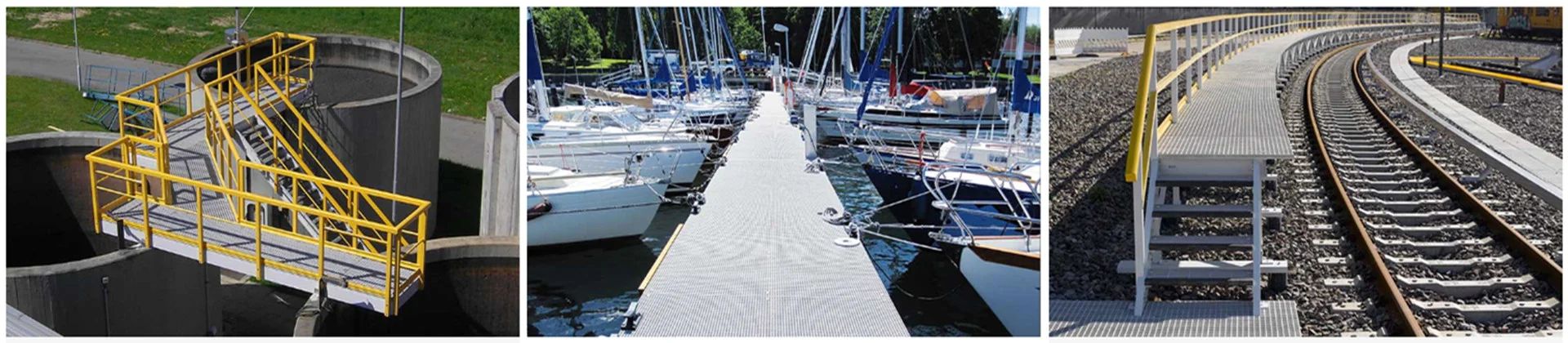
Introduction
Coastal docks live in a harsh cycle of salt, sun, wave splash, and bio-growth. Wood swells, checks, and rots; paint flakes; slip hazards rise after every tide. This guide explains why fiberglass grating for docks outperforms timber in saltwater on safety, longevity, and total cost—and how to specify and install it right.
Field note: On a June retrofit in a brackish marina, we swapped 1.5″ molded panels over 24″ timber stringers. After a stormy week, the gangway edge needed a quick re-torque of the J-clips. We standardized torque and added edge ties at 18″ intervals; movement stopped, and the surface stayed grippy after algae season.
As an ISO-certified pultrusion manufacturer, Unicomposite supports marine projects with span checks, kitted panels, and vinyl-ester systems—without turning this into a hard sell.

fiberglass grating for docks
Why Fiberglass Grating Wins in Saltwater
Corrosion & Rot Resistance
FRP’s glass fiber + thermoset resin matrix doesn’t rot and resists chloride attack. In brackish/coastal use, owners typically plan for 15–25+ years of service with light wash-down maintenance, whereas treated wood often needs major attention in 5–10 years under similar exposure. Where splash/spray is constant, choose vinyl ester for superior chemical resistance; isophthalic polyester can be suitable in milder conditions.
Slip Resistance & Safety
Gritted or meniscus FRP surfaces hold traction when wet, unlike smooth, algae-coated timber. Many operators set a wet DCOF target ≥ ~0.6 in consultation with insurers and local authorities. Note that accessibility rules don’t mandate a single number; specify the test method you’ll use (e.g., ASTM E303 pendulum or ANSI A326.3 for hard surfaces, as applicable) and document your maintenance plan.
UV, Thermal & Electrical Behavior
Marine pigments and UV inhibitors help FRP retain color and surface texture. Lower thermal conductivity yields a cooler underfoot feel in summer. FRP is non-conductive, a practical safety benefit near shore-power pedestals and lighting circuits.
Environmental & User Experience
Open-area meshes (40–70% void) drain quickly, shed debris, and can transmit light to the water below—useful near sensitive habitats. The surface is splinter-free and quiet, and no solvent-based sealers are needed.
Choosing the Right FRP Grating for Docks
Molded vs. Pultruded Grating
-
Molded (typ. 38 mm / 1.5″ pitch, 1–2″ thick): multi-directional strength, forgiving around curves, high open area; great for fingers and landings.
-
Pultruded (I/T-bar bearing bars + cross-rods): higher directional stiffness for longer spans and tight deflection control.
Resin Systems & Surface Finishes
-
Resin: Isophthalic polyester for general marine; vinyl ester for high chlorides/chemicals. Fire-retardant grades commonly meet ASTM E84 Class 1 (specify when required).
-
Tops: Coarse/medium/fine grit, meniscus, or solid-top plates (where drips below are undesirable). Lighter colors reflect heat; darker colors hide grime.
Panel Size, Span & Deflection Targets
-
Loads: Pedestrian docks often use 60–100 psf live load; add a point-load check for hand trucks or small carts.
-
Comfort: Target mid-span deflection around L/200–L/240.
-
Heel-proof: Use micro-mesh near public promenades to avoid heel/cane entrapment.
-
Illustrative span snippet: A 1.5″ molded VE panel at 60 psf typically spans ≈30″ at ~L/200. Manufacturer tables vary—confirm against your stringer spacing and desired feel.
Engineering & Hardware Details
Substructure & Fasteners
FRP grating mounts to FRP, timber, or steel stringers. Isolate dissimilar metals where needed and seal all cut edges. In saltwater, use 316 stainless clips and fasteners (e.g., per ASTM F593/F594):
-
M-clips to lock bearing bars to supports
-
C/J-clips for panel-to-panel ties
Rules of thumb: two clips per support minimum, more at corners/edges; edge clip spacing 18–24 in (450–600 mm). Typical torque falls around 6–10 N·m (50–90 in-lb)—follow the submittal.
Thermal Movement & Field Fabrication
Plan small expansion gaps at perimeters. FRP’s effective CTE is on the order of ~8–20 × 10⁻⁶ in/in/°F along bearing bars (higher across bars), far lower than many plastics but higher than timber longitudinally. Field cuts: carbide/diamond blades, dust control, respirator; reseal cuts with compatible resin.
Lifecycle Cost: FRP Grating vs. Wood on Docks
Maintenance & Replacement Cycles
Wood demands sanding, sealing, fastener resets, and periodic plank swaps; every hour requires over-water access and safety prep. FRP care is typically rinse + mild detergent, with seasonal inspections.
Transparent TCO Model (example, 10-year horizon; 600 sq ft finger)
Assumptions below are illustrative—replace with your local rates.
| Input (per sq ft unless noted) | Wood | FRP |
|---|---|---|
| Installed cost (year 0) | $18.00 | $27.00 |
| Annual maintenance (labor+materials) | $1.60 | $0.25 |
| Planned plank/panel replacement by year 8 | 20% | 0% (damage only) |
| Crew labor rate (for calc) | $70/hr | $70/hr |
Result (10 years):
-
Wood: $18 + (10×$1.60) + (0.20×$18) = $39.6/sf
-
FRP: $27 + (10×$0.25) + (0×$27) = $29.5/sf
Breakeven: typically year 5–7 depending on actual maintenance and downtime costs.
Mini Case Study (Anonymized, 2023–2024)
Scope: ~1,450 sq ft public pier (two 8-ft landings, three 3-ft fingers).
Action: Replaced timber with 1.5″ molded, vinyl-ester, medium-grit panels; edge clip spacing ≈24″, toe-kicks at gangway transitions.
Outcome (12 months): Seasonal maintenance hours dropped from ~120 → ~65; incident log noted fewer wet-day slip reports. Operators highlighted easier housekeeping and cooler underfoot feel on sunny days.
Standards, Documentation & Safety
-
Fire: Specify ASTM E84 Class 1 flame spread when required; note ASTM D635 self-extinguishing language as applicable.
-
Mechanical reference: Use ASTM D790 (flexural properties) for design values in submittals.
-
Slip testing: Reference a recognized method (e.g., ASTM E303 pendulum or ANSI A326.3 where appropriate) and name your wet COF target; align with AHJ and insurer.
-
Hardware: 316 SS per ASTM F593/F594; include torque in the install doc.
-
Submittals: Span/load tables, resin/surface datasheets, clip/fastener details, edge banding, installation guide, warranty, and an inspection/maintenance SOP.
Safety & Maintenance Checklist (owner SOP)
-
Quarterly visual: look for loose clips, lifted edges, damaged grit, or impact nicks.
-
Annual: re-torque perimeter clips; confirm edge tie spacing ≤ 24″; reseal any field cuts.
-
Cleaning: rinse + pH-neutral detergent; avoid aggressive solvents or steel brushes.
-
Recordkeeping: log inspections, cleaning dates, and any repairs for liability defense.
Limitations & When Wood Still Works
For very short-term installations, tight capital budgets, or freshwater boardwalks with low exposure, treated wood can still be pragmatic—especially where owner crews already handle annual sealing. Just document the higher maintenance cadence and slip-prevention plan.
How Unicomposite Supports Marine Projects
Unicomposite manufactures pultruded FRP profiles and supplies molded/pultruded grating for marine use. Support includes: span verification to your stringer layout and deflection targets, kitted panels with pre-drilled clip points, custom vinyl-ester or fire-retardant systems, color matching, and export-ready packaging. For municipalities, marinas, and contractors purchasing in bulk, this reduces install risk and schedule friction.
Conclusion
For saltwater facilities, fiberglass grating for docks delivers durable, slip-resistant walking surfaces without the repaint-and-replace cycle that plagues timber. Choose the right mesh and resin, confirm spans for comfort, detail clips and edges, and maintain with a simple SOP. Share your layout and load assumptions—Unicomposite can return a span check, kit list, and fabrication plan so your team installs once and keeps wrenches dry for years.
Frequently Asked Questions
Q1. Molded or pultruded—how do I choose?
Use molded for multi-directional strength, curves, and high open area on fingers/landings; choose pultruded when you need longer spans or tighter deflection.
Q2. Is vinyl ester always required near saltwater?
Not always. It’s preferred in heavy splash/spray and chemical cleaning regimes. Isophthalic polyester can be appropriate in milder brackish or coastal exposure—ask for a quick resin selection check.
Q3. What about thermal expansion on long runs?
Allow perimeter gaps and panel joints. FRP’s effective CTE is roughly ~8–20 × 10⁻⁶ in/in/°F along bearing bars; edge ties and proper clip torque manage movement at gangways.
Q4. How do I specify slip resistance correctly?
Set a wet COF target with your insurer/AHJ and name the test method (e.g., ASTM E303 or ANSI A326.3 as applicable). Pair it with a cleaning SOP for algae season.
Q5. Can Unicomposite pre-cut panels to fit odd shapes?
Yes. We provide kitted, cut-to-fit panels with pre-drilled clip points, toe-kicks, and edge banding to reduce over-water cutting and speed installation.


