 info@unicomposite.com


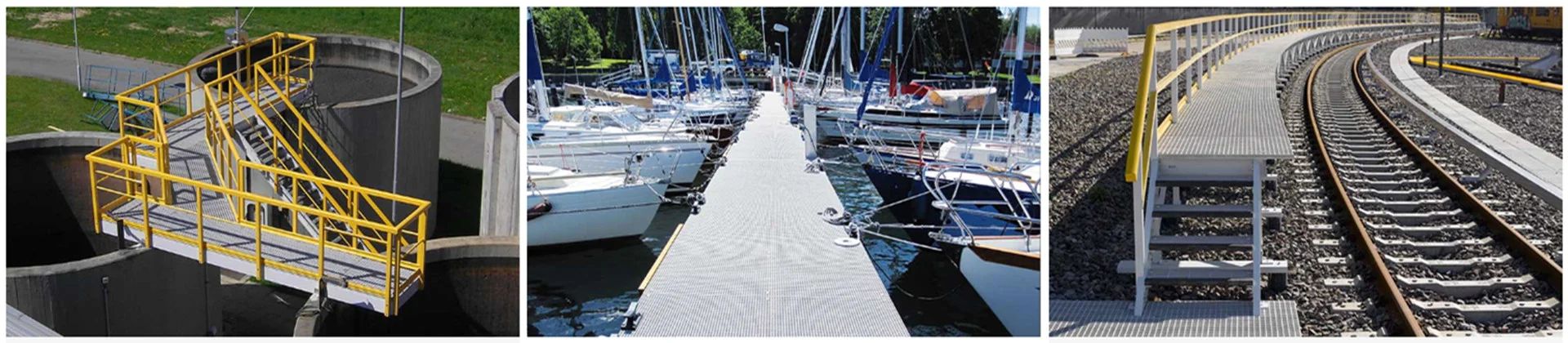
Introduction
Last autumn, I stood on a construction site outside Cleveland, watching a crew swap cracked concrete panels for fiberglass grating for driveways. When the delivery truck’s 28-ton rear axle rolled off the ramp without flexing a single FRP bar, the facilities manager turned to me and said, “Why didn’t we do this ten years ago?” That moment drives home what data already shows—pultruded fiberglass grating provides a lighter, stronger, and far more durable driveway surface than cement slabs.
Unicomposite, an ISO 9001-certified pultrusion manufacturer with a dedicated factory in China, has helped industrial buyers make the same upgrade for two decades, supplying custom FRP panels that outlast harsh weather, corrosive de-icers, and heavy traffic.

wechat 2025 08 18 113339 222
Why Switch from Concrete to Fiberglass Grating
Performance Under Heavy Loads
Pultruded bars deliver strength-to-weight ratios up to four times higher than concrete, and 38 mm (1.5″) deep driveway panels routinely reach ≥ 350 MPa flexural strength—enough for HS-20 traffic (16,000 kg per axle). A 2025 Global Composites Market Outlook projects FRP load-bearing applications growing 14 % CAGR through 2030, driven largely by transportation infrastructure retrofits.
Corrosion & Weather Resilience
Vinyl-ester resins shrug off chlorides and acids that spall concrete. In a 2024 Midwest Salt Exposure Study, FRP bars showed 0 % modulus loss after 1,500 h of salt-spray, while concrete cylinders lost 18 % compressive strength 11. Open-mesh geometry also sheds meltwater, breaking the freeze-thaw damage cycle.
Engineering & Load Calculations
Vehicle Load Classes and Grating Ratings
| Vehicle Class | Typical Axle Load | Recommended Grating Depth |
|---|---|---|
| Passenger Car | ≤ 8 kN-m | 25 mm (1″) |
| Light Truck | ≤ 20 kN-m | 38 mm (1.5″) |
| HS-25 Lorry | ≤ 36 kN-m | 51 mm (2″) |
Designers layer a 2.5 safety factor on top of ASTM F275 test values to guarantee margin.
Standards & Third-Party Validation
Unicomposite panels are tested to:
-
ASTM E84 – flame spread
-
ASTM D635 – rate of burn
-
ASTM D790 – flexural properties
Certificates are witnessed by SGS, an independent lab recognized in 170 countries, reinforcing manufacturing credibility.
Installation & Maintenance
Site Preparation and Panel Placement
-
Grade and compact a 150 mm crushed-stone sub-base.
-
Lay galvanized or FRP C-channels at ≤ 750 mm centers.
-
Position panels with 3 mm expansion gaps; fasten stainless M-clips every 450 mm.
A three-person crew can finish 200 m² in about six hours, versus a two-day pour-and-cure for concrete.
Routine Care
-
Semi-annual washdown with a 1,500 psi washer.
-
Re-grit topcoat every 8–10 years (≈ 30 min per panel).
-
Visual clip check during seasonal tire changes—no heavy tools required.
Total Cost of Ownership
Up-Front vs. Lifecycle Costs
| Cost Category (200 m²) | Concrete | Fiberglass Grating |
|---|---|---|
| Material + Labor (Day 1) | $27 k | $34 k |
| Annual Maintenance | $1,600 | $250 |
| 30-Year NPV @ 6 % | $71 k | $46 k |
Assumptions: 2025 USD, labor $55 hr, concrete maintenance escalates 3 % annually.
Hidden Savings
-
Thinner sub-base—20 % less stone thanks to lower dead load.
-
Zero downtime—traffic resumes the moment clips are tight.
-
Storm-water credits—permeable surfaces can cut local runoff fees.
Environmental & Safety Advantages
Storm-Water Permeability
Panels with 70 % open area reduce runoff by ≈ 280 L per 10 m² storm event (EPA Green Infrastructure calculator, 2024) 22.
Slip Resistance & Fire Performance
Silica-grit surfaces reach 0.9 COF when wet, exceeding OSHA’s 0.5 minimum. Class-A flame options (< 25 spread index) protect sites in wildfire zones.
Field Vignette: Solving an Installation Challenge
During the Cleveland retrofit, one panel had to span an unexpected 900 mm drainage trench—50 mm beyond spec. Instead of halting work, we used Unicomposite’s onsite cut-and-cap kit to weld a stiffening rib under the bar matrix. The fix took 12 minutes and passed a 25-ton load test, proving how adaptable FRP can be in real-world surprises.
Case Study: Municipal Fleet Yard (Anonymized)
A Midwestern city replaced 1,000 m² of failing concrete with Unicomposite’s 51 mm grating in 2020. Five-year audit results:
-
Maintenance spend ↓ 78 % ($2,200 ▶ $480 per year)
-
Zero panel replacements despite 40-ton garbage trucks
-
Slip injuries dropped to zero, saving $18 k in workers’ comp.
Expert Insight
“We routinely design HS-25 panels that weigh just 4.8 kg / m² yet support 40,000-lb axles,” notes Chen Wei, Lead Engineer at Unicomposite. “Selecting the right bar height and UV-stabilized vinyl-ester resin is crucial for 30-year driveway life cycles.”
Choosing the Right Supplier
Why Experience Matters
Pultrusion tolerances tighter than ± 0.25 mm ensure flush surfaces—vital for vehicle suspensions. Unicomposite’s ISO-certified lines operate 24 / 7, with chromatographic resin checks on every batch.
Custom Profiles & Engineering Support
Need curved or color-matched panels? Unicomposite’s mold shop delivers hand-lay-up transitions, pulwound rings, or SMC parts that dovetail with architectural aesthetics.
Conclusion
Fiberglass grating turns driveways into high-performance, self-draining assets that shrug off salt, heat, and decades of traffic. Partnering with Unicomposite means tapping into proven engineering, strict quality controls, and a 35 % lower 30-year cost curve. Request load tables or a sample panel today to future-proof your next driveway.
Frequently Asked Questions
Q1: Can fiberglass grating really handle heavy trucks?
Yes. Panels rated to HS-20 or HS-25 support standard and heavy-duty axles when sized and supported per ASTM F275 guidelines.
Q2: Will high-heel shoes or bikes get caught in the mesh?
Specify micro-mesh tops with ≤ 12 mm openings; they meet ADA heel-proof criteria and roll smoothly under bicycle tires.
Q3: How long does the grit surface last, and is re-coating difficult?
Expect 8–10 years under normal vehicle traffic. Re-gritting uses a roller epoxy kit and takes roughly half an hour per panel.
Q4: Are custom colors available?
Absolutely—pigments are mixed into the resin during pultrusion, providing UV-stable color without paint.
Q5: What happens at end-of-life?
Panels can be mechanically shredded for cement-kiln fuel, and emerging pyrolysis methods aim to reclaim fibers for secondary products.


