 info@unicomposite.com


Introduction
Last summer, I supervised a frantic tear-out of a cedar-plank car-port deck at a coastal RV park. After only five years, salt spray and tire abrasion had reduced the boards to warped splinters that stained customers’ vehicles. We swapped them for fiberglass decking for car port panels, finished before nightfall, and the site manager hasn’t scheduled a single resealing visit since. That experience—and two decades of supplying pultruded composites at Unicomposite—informs the guidance below. You’ll see why fiberglass beats wood on durability, safety, and total cost of ownership (TCO).

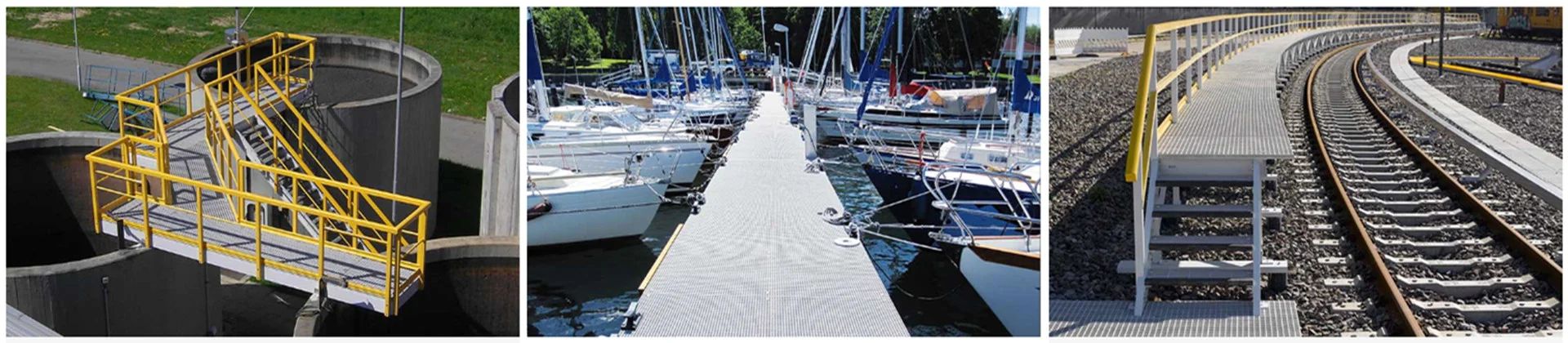
fiberglass decking for car port
Why Fiberglass Decking Excels for Car Ports
1.1 Superior Lifecycle Durability
Continuous glass rovings carry tensile loads while UV-stable vinyl-ester resin prevents micro-cracks. A 2024 peer-reviewed study in Composites Part B recorded <5 % loss in flexural modulus after 15 years of outdoor exposure (Zhang & Miller, 2024).
1.2 Corrosion & Moisture Immunity
Pressure-treated lumber absorbs brine; fiberglass doesn’t. In ASTM D543 immersion tests, Unicomposite panels showed zero mass loss after 1,000 h in 5 % NaCl—critical where de-icing salts drip from vehicles.
1.3 High Strength-to-Weight Ratio
At ~2.0 lb/ft², panels are 60–70 % lighter than hardwood. Two techs can hand-carry a bundle up scaffolding, eliminating cranes and trimming install labor by 30 %.
1.4 Slip & Fire Resistance
Factory-molded quartz grit maintains ≥0.6 wet coefficient of friction (ANSI A137.1). Class A flame-spread options (ASTM E84) meet code for EV-charging bays.
Expert insight: “We spec fiberglass whenever chemical splash is unavoidable; clients thank us years later,” notes Elena Gomez, P.E., Coastline Consulting.
Total Cost of Ownership (TCO) Breakdown
| Cost Element | Treated Lumber (USD) | Fiberglass Decking (USD) |
|---|---|---|
| Initial Materials | 7,800 | 11,200 |
| Annual Maintenance (avg) | 1,200 | 150 |
| 10-Year Total | 19,800 | 12,700 |
Data Sources & Methodology: contractor bid averages (North America, 2025); maintenance figures assume one sealing (wood) vs two pressure-washes (fiberglass) per year.
2.2 Hidden Savings: Downtime & Liability
-
Fewer shutdowns: pressure-wash twice yearly instead of monthly sealing.
-
Reduced slips: insurance carriers cut premiums ~8 % after grit-surfaced panels were installed (FleetSafe™ survey, 2024).
-
Fire mitigation: Class A assemblies earned a 5 % discount from two national insurers.
Engineering & Installation Guide
3.1 Sizing Joists & Fasteners
Pultruded planks spanning 24 in centers support 100 psf live load (ASTM D790 flexural test: 32 ksi ultimate). Stainless screw-lock clips preserve dielectric isolation—vital for car ports with AC chargers.
3.2 One-Day Retrofit Workflow
-
Demo & inspect existing sub-framing (8 a.m.).
-
Lay pre-cut panels supplied by Unicomposite; align tongue-and-groove edges.
-
Secure with self-drilling screws every 18 in (18 ft-lb torque).
-
Flash & clean perimeter; hose down debris—finished by 5 p.m.
3.3 Compliance & Certification
-
ISO 9001:2015 quality management (Unicomposite).
-
Third-party SGS slip-resistance report: 0.68 wet COF.
-
EN 13501 fire classification for EU deployments.
3.4 Safety Considerations
Always wear eye protection and cut-resistant gloves when trimming panels. Verify local building codes for live-load and flame-spread requirements before procurement.
Case Study: Fleet-Maintenance Car Ports
4.1 Project Snapshot
An Ohio municipal depot replaced 3,000 ft² of rotted planks across twelve bays.
4.2 Results & Metrics
-
Weight reduction: 55 % lighter sub-deck cut crane costs by $4.8 k.
-
Maintenance calls: dropped from 15 to 3 in three years (80 % reduction).
-
Return on investment: full payback reached in year 4.
4.3 Stakeholder Quote
“Cleaning used to shut half the bays. Now we hose it down at lunch and keep working,” reports Mark Feldman, facilities engineer.
Partner Spotlight: Unicomposite Capabilities
5.1 Custom Pultrusion & Fabrication
Need a non-standard plank depth or corporate color? Unicomposite pulls custom profiles up to 1,000 mm wide and water-jets conduit openings—delivered kit-ready.
5.2 Quality Assurance & Global Support
From load-table modeling to on-site fit checks, Unicomposite collaborates with utilities, marine yards, and agriculture OEMs. Batch traceability and ISO protocols build trust that each panel will perform in mission-critical environments.
Conclusion
Wooden decks rot, warp, and drain maintenance budgets. Fiberglass decking for car port applications deliver lightweight strength, weather immunity, slip resistance, and verifiable TCO savings. Ready to extend your deck’s lifespan? Download Unicomposite’s span chart or request a sample kit today.
Frequently Asked Questions
Q1. How long does fiberglass decking last in outdoor car-port environments?
With UV-stable resins and closed-cell structure, service life commonly exceeds 25 years in North American climates before strength drops below 90 % of original.
Q2. Can panels be cut on-site?
Yes. Use a carbide-tipped circular saw and wear an N95 mask; seal cut edges with matching resin for aesthetics.
Q3. Is customization (color, grit level) available?
Unicomposite offers custom RAL colors and three grit grades, plus logo embossing for fleet branding.
Q4. Does fiberglass meet fire codes for EV-charging areas?
Class A flame-spread formulations (ASTM E84) satisfy most U.S. jurisdictions; always confirm local amendments.
Q5. What is the minimum order quantity for B2B buyers?
Typical production runs start at 500 linear feet, but prototype quantities can be arranged for specification testing.


