 info@unicomposite.com


Introduction
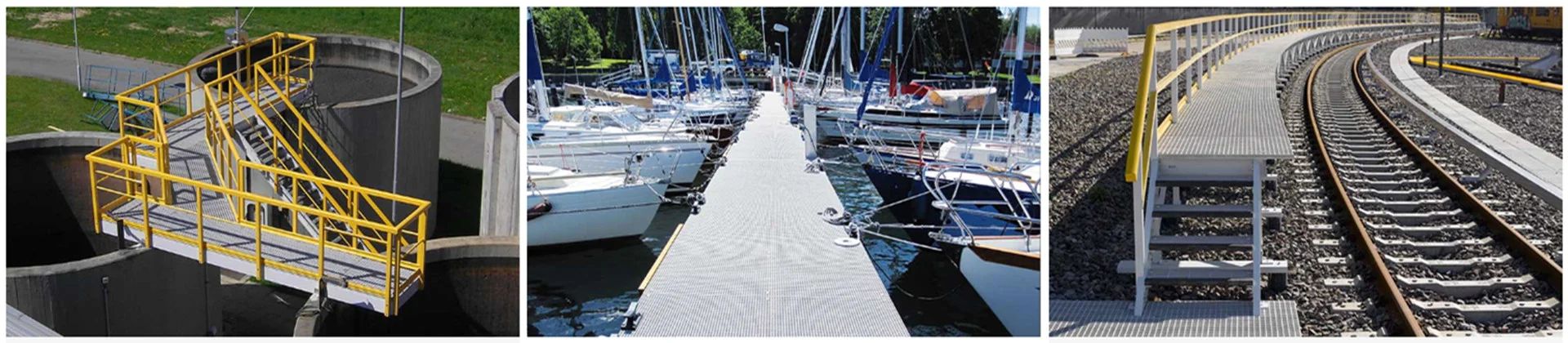
Fiberglass grating FRP is rapidly becoming the engineer’s first choice for safe, lightweight walkways that never rust. A 2025 Markets & Markets report pegs the sector at US $827 million by 2028 (5.9 % CAGR)—clear evidence that industry trusts the material’s lifecycle value (Markets & Markets, 2025). On countless projects, ISO-certified manufacturer Unicomposite has supplied custom pultruded profiles that outlast steel in power plants, chemical yards, and aquaculture docks. Below is an installation blueprint distilled from those real-world deployments.

fiberglass grating frp
Understanding Fiberglass Grating FRP
What Exactly Is Fiberglass Grating FRP?
Fiberglass grating FRP is made by embedding continuous glass rovings in a thermoset resin matrix (typically isophthalic polyester or vinyl ester) and curing them into rigid panels. The fibers carry tensile loads while the resin spreads shear, delivering a strength-to-weight ratio up to 7 : 1 vs. steel.
Core Advantages vs. Steel or Aluminum
-
70 % lighter than galvanized steel, cutting crane time and freight.
-
Chemical resistance: vinyl-ester FRP shows < 0.1 % weight change after 24 h sulfuric-acid immersion (ASTM C581 test, 2024).
-
Non-conductive & non-sparking for work near power lines or fuel storage.
“Switching to fiberglass grating FRP trimmed our maintenance spend by 30 % in year one,”
— Liang Zhou, P.E., wastewater-plant superintendent.
Industry Standards & Certifications to Know
Specify panels tested to ASTM E84 (flame spread ≤ 25), ASTM D638 (tensile), and EN 13501. Unicomposite ships third-party ISO 9001 load-test certificates to satisfy inspectors.
Pre-Installation Planning
Calculating Load Requirements & Consulting Span Tables
Start with service load plus a 1.5 safety factor. Worked example: desired uniform load = 4.0 kN/m²; target deflection ≤ L/200. Unicomposite’s span table shows that 38 mm-thick panels safely span 900 mm under that load, so choose supports at 850 mm centers for extra margin.
Selecting Resin Systems, Grit Surfaces, and Panel Sizes
-
Resin: isophthalic for general duty, vinyl ester for harsh chemicals, phenolic for fire-critical decks.
-
Surface: medium grit for pedestrian comfort; coarse quartz grit for oily areas.
-
Panel size: pre-cut 1220 × 4040 mm blanks reduce onsite waste by ~12 %.
Compliance Checklists: OSHA, ASTM, ISO
Edge-band unsupported ends, keep openings ≤ 19 mm where tools can fall, mark stair nosings yellow per OSHA 1910.29.
Site Preparation & Required Tools
Measuring, Marking, and Cutting Techniques for FRP Panels
Use a carbide-grit circular blade; mask the cut line to prevent chipping. Field anecdote: During a coastal jetty retrofit, our team dry-fit each panel first; this caught a 4 mm misalignment that would have cascaded into a 50 mm gap down the run—saving half-day rework.
Choosing the Right Fasteners, Clips, and Supports
-
316 SS saddle clips every fourth load bar (≈ 450 mm centers) resist chlorides.
-
Pedestals ≥ 50 mm wide distribute loads within span limits.
A 2024 independent ASTM D635 load test at Lloyd’s Register laboratory recorded only 3.2 mm deflection at design load—well below the 6 mm limit.
PPE and Job-Site Safety Protocols
N95 respirators, safety glasses, long sleeves, and HEPA vacuums keep airborne fiberglass < 0.5 mg/m³.
Step-by-Step Installation Procedure
Panel Placement, Alignment, and Thermal Expansion Gaps
Begin from one fixed corner, maintaining 6 mm gap per meter for thermal movement. Align load bars perpendicular to primary supports.
Securing Grating: Saddle Clips, M-Clamps, and Adhesive Pads
Torque saddle-clip bolts to 9 N·m; over-tightening can crush bearing bars. Where underside access is limited, use top-mount M-Clamps or structural adhesive pads (pull-off ≥ 12 kN).
Final Inspection: Deflection, Flushness, and Torque Checks
Walk the deck—deflection > L/200 calls for extra mid-span support. Re-check bolt torque after 24 h; relaxation can reach 10 %.
Case Study: Wastewater Walkway Retrofit with Unicomposite FRP
Project Scope, Challenges, and Unicomposite’s Role
A municipal wastewater plant replaced corroded steel over aeration tanks. Unicomposite delivered 750 m² of vinyl-ester panels plus stainless clip sets.
Results: 40 % Downtime Reduction and Zero Corrosion After 18 Months
Installation finished in two weekends, trimming outage days from five to three and saving US $14,800 in crane rental. Follow-up inspections show no blistering or rust streaks.
Maintenance & Lifecycle Cost Analysis
Routine Cleaning and Non-Destructive Testing Schedules
Pressure-wash quarterly with mild detergent; verify clip torque annually and ultrasound-scan for delamination.
Repair vs. Replacement: ROI Calculations Over 20 Years
A 2024 CompositesWorld study found fiberglass grating FRP costs 23 % less than galvanized steel after repaint cycles and shutdowns—ROI apparent by year 7.
Safety Considerations & Warranty
-
PPE: respirators, gloves, eye protection during cutting.
-
Warranty: Unicomposite offers a 20-year limited warranty covering structural integrity and corrosion.
-
Documentation: download MSDS and installation guide for full safety details.
Conclusion
When installed with proper planning, precise cutting, and disciplined fastening, fiberglass grating FRP delivers decades of corrosion-free service. Ready to design your next deck or catwalk? Download Unicomposite’s engineering spec sheet or request a custom quote—our pultrusion lines stand ready to mold panels to your exact needs.
Frequently Asked Questions
Q1. How long does fiberglass grating FRP last in a coastal environment?
Service life typically exceeds 30 years with minimal maintenance, thanks to UV-stable resins and corrosion-free glass fibers.
Q2. Can panels be customized for unusual shapes or cutouts?
Yes. Unicomposite offers factory-cut panels or ships blanks that can be trimmed onsite with carbide-grit blades.
Q3. What is the maximum operating temperature for standard vinyl-ester grating?
Most vinyl-ester formulations handle continuous service up to 105 °C; phenolic options push that higher for fire-critical applications.
Q4. How often should clip torque be re-checked?
Check torque during installation and again after 24 hours, then include it in annual inspections.
Q5. Is fiberglass grating FRP slip-resistant when wet or oily?
Coarse quartz-grit surfaces provide a coefficient of friction ≥ 0.65 even when wet, meeting OSHA recommendations for walking-working surfaces.


