 info@unicomposite.com


Introduction
In industrial facilities, the wrong grating material fails in a predictable sequence: surface rust at year two, structural thinning by year five, and unplanned replacement — with associated shutdown costs — somewhere between years six and eight. FRP grating breaks that cycle. The correct specification, matched to the actual operating environment, delivers the same load-bearing performance and surface condition at year 25 that it did at installation, with no recoating, no rust treatment, and no unplanned replacement events.
This guide covers FRP grating construction types, the technical characteristics that determine specification decisions, load rating data across standard panel configurations, and the application environments where FRP consistently outperforms steel, aluminum, and timber alternatives.
frp grating
What Is FRP Grating? Construction and Material Overview
FRP grating consists of glass fiber reinforcement embedded in a thermosetting polymer resin matrix, formed into a grid structure through either a molding or pultrusion process. The manufacturing method determines the panel’s structural behavior, load capacity, and dimensional flexibility — making construction type the first specification decision, not an afterthought.
What Is the Difference Between Molded and Pultruded FRP Grating?
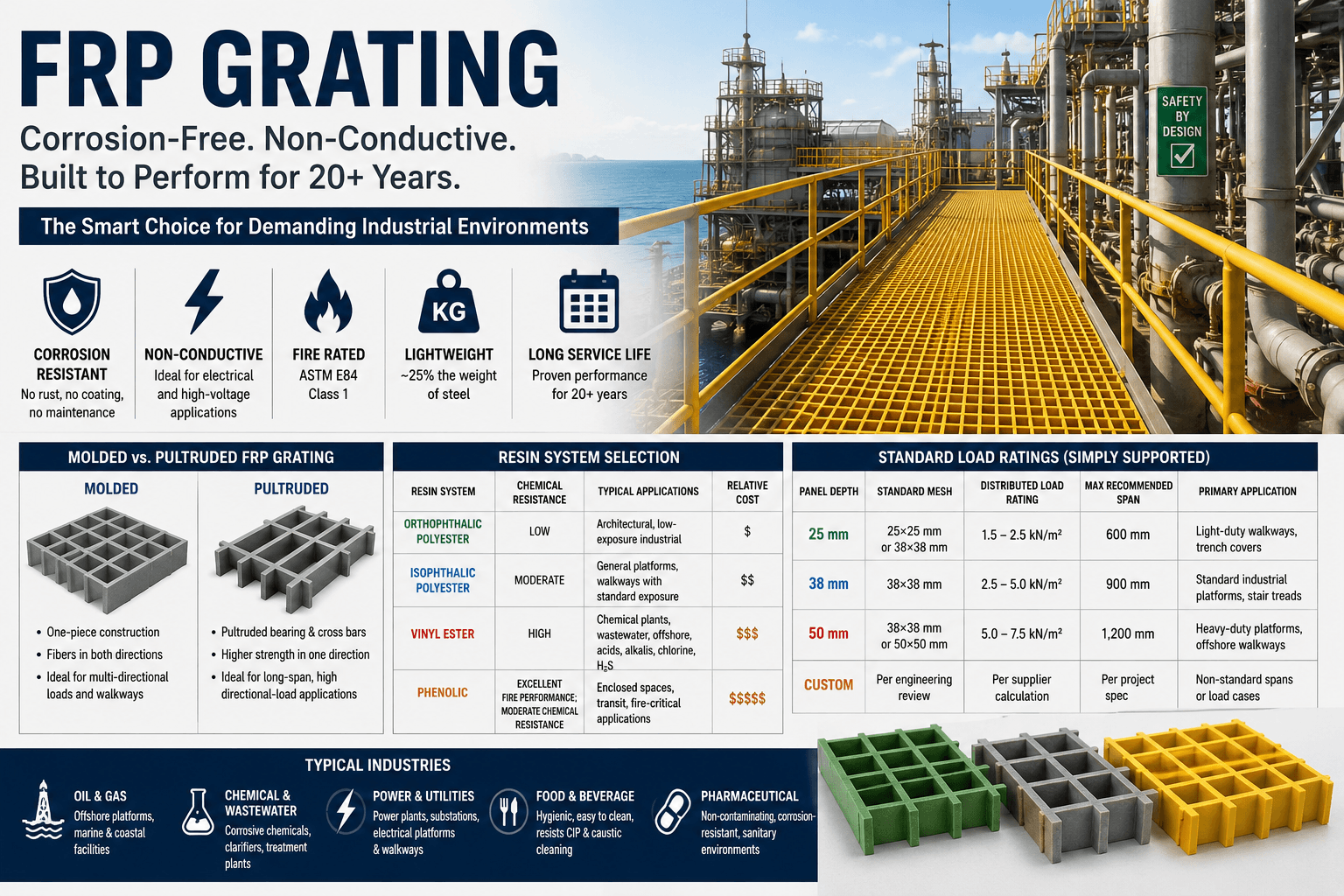
Molded FRP grating is produced by laying glass fiber roving in a mold and curing under heat and pressure, creating a one-piece panel with continuous fiber in both directions. Pultruded FRP grating is manufactured by pulling bearing bars and crossbars through resin and a heated die, producing a bonded assembly with higher one-directional load capacity. Molded grating suits multi-directional and walkway applications; pultruded grating suits long-span structural applications where loads run primarily along the bearing bar axis.
The choice between the two determines more than structural performance — it also governs lead time and cost. Molded grating panels in standard mesh sizes (25×25 mm, 38×38 mm) are widely stocked and typically available within 7–10 working days. Pultruded grating in non-catalog configurations carries a 15–25 day production lead time. Procurement teams who specify grating type without distinguishing between the two often receive products that perform correctly on paper but deliver structural behavior that doesn’t match the actual load case — a mismatch that rarely surfaces until installation testing or field failure.
Resin System Selection: The Chemistry That Governs Service Life
Three resin systems dominate FRP grating production, and selecting the wrong one for the site chemistry is the most common specification error in industrial procurement.
The following table summarizes the resin system options and the chemical environments each suits:
| Resin System | Chemical Resistance | Typical Applications | Relative Cost |
|---|---|---|---|
| Orthophthalic polyester | Low — general mild environments | Architectural, low-exposure industrial | Lowest |
| Isophthalic polyester | Moderate — standard industrial | General platforms, walkways with standard exposure | Low–Moderate |
| Vinyl ester | High — acids, alkalis, chlorine, H₂S | Chemical plants, wastewater clarifiers, offshore | Moderate–High |
| Phenolic | Excellent fire performance; moderate chemical resistance | Enclosed spaces, transit, fire-critical applications | High |
Isophthalic polyester covers the majority of general-industrial grating applications. Vinyl ester is the correct specification wherever the operating environment includes chlorinated water, acid or alkali cleaning chemicals, or hydrogen sulfide off-gassing — conditions common in wastewater treatment, offshore platforms, and chemical processing. Confirm resin compatibility in writing against ASTM C581 immersion data from the supplier before finalizing the specification.
Technical Characteristics That Define FRP Grating Performance
Beyond construction type and resin system, six technical characteristics govern whether a grating panel delivers its rated service life in a given industrial application. Each has a directly verifiable specification or standard associated with it.
Corrosion Resistance and Chemical Compatibility
FRP grating does not corrode. The glass fiber reinforcement and polymer resin matrix do not oxidize, do not develop crevice corrosion at fastener interfaces, and do not require protective coatings to maintain structural integrity across the panel’s service life. This is a property of the composite material itself — not of a surface treatment that can be damaged, depleted, or forgotten in a maintenance schedule.
The corrosion resistance of the specific resin system against specific chemicals at specific concentrations and temperatures is testable per ASTM C581 (Standard Practice for Determining Chemical Resistance of Thermosetting Resins Using a Tensile Test Specimen). Procurement teams should require ASTM C581 test data for the proposed resin system against the site chemical profile rather than relying on generic corrosion resistance tables that do not account for concentration or temperature variables.
What Fire Rating Do FRP Grating Panels Need for Industrial Platforms?
ASTM E84 Class 1 — flame spread index ≤ 25 and smoke developed index ≤ 450 — is the standard fire rating requirement for FRP grating used on occupied industrial platforms and walkways in North American projects. This certification must reference the specific grating panel series, depth, and mesh size being supplied — not the manufacturer’s broader product line. Request third-party laboratory test certificates, not self-certification.
Phenolic resin grating panels achieve the highest fire performance of any standard FRP system and are specified in applications where fire-code requirements exceed what vinyl ester can deliver — enclosed processing areas, transit infrastructure, and offshore accommodation platforms. For open-air industrial walkways and platforms, vinyl ester grating with ASTM E84 Class 1 certification typically satisfies both chemical and fire rating requirements simultaneously.
Load Ratings, Panel Depth, and Span Capabilities
FRP grating load capacity depends on three interdependent variables: panel depth (which determines section modulus), span length between supports, and the type of load (uniform distributed versus concentrated point load). The table below summarizes standard configurations and their rated load capacities under simply supported conditions:
The following specifications represent standard FRP grating panel configurations for industrial platform and walkway applications:
| Panel Depth | Standard Mesh | Distributed Load Rating | Max Recommended Span | Primary Application |
|---|---|---|---|---|
| 25 mm | 25×25 mm or 38×38 mm | 1.5–2.5 kN/m² | 600 mm | Light-duty walkways, trench covers |
| 38 mm | 38×38 mm | 2.5–5.0 kN/m² | 900 mm | Standard industrial platforms, stair treads |
| 50 mm | 38×38 mm or 50×50 mm | 5.0–7.5 kN/m² | 1,200 mm | Heavy-duty platforms, offshore walkways |
| Custom | Per engineering review | Per supplier calculation | Per project spec | Non-standard spans or load cases |
OSHA 1910.22(b)(1) requires walking-working surfaces to support “the maximum intended load” for the working surface, with industry-standard practice citing a 445 N (100 lbf) concentrated load or 2.4 kN/m² (50 psf) uniform live load as the minimum design baseline for general industrial platforms. Local building codes — IBC Table 1607.1 for the project’s occupancy classification — may impose higher loads. Load rating documentation from FRP grating suppliers commonly references NAAMM’s Metal Bar Grating Manual (MBG 531) format, which serves as the baseline procurement engineers compare against FRP suppliers’ equivalent load tables; confirming a supplier publishes load data in this format is a basic qualification signal.
Always request a supplier-issued span-and-load calculation for the specific installation geometry before finalizing panel depth selection.
Electrical Properties and Non-Conductivity
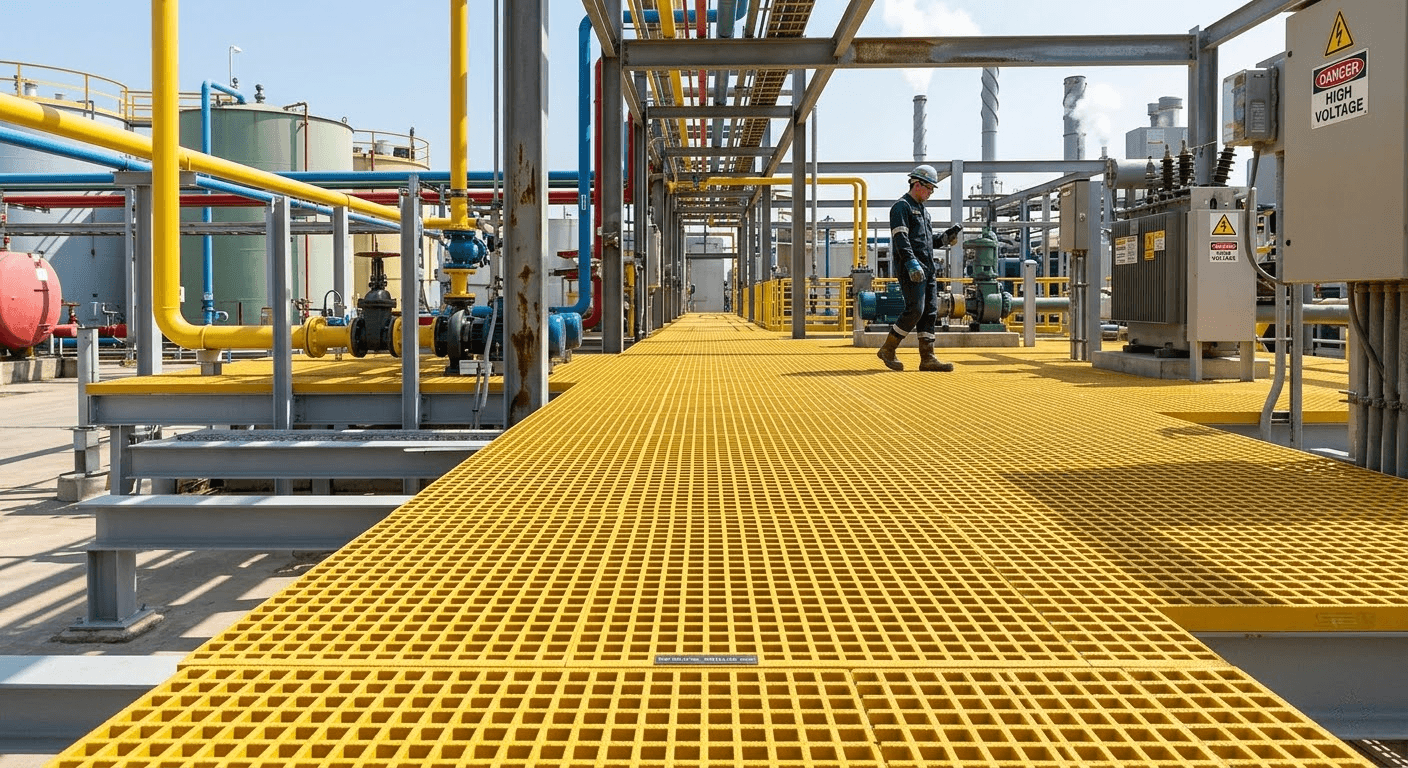
FRP grating does not conduct electricity. The dielectric strength of standard FRP grating — typically 10 kV/mm or greater — makes it the only appropriate material for walkways and platforms near energized equipment, high-voltage switchgear, or live bus bars in power substations. No metallic grating alternative achieves non-conductivity without additional insulating treatments that add cost and require periodic inspection.
The non-magnetic property of FRP is equally significant in applications where ferrous contamination is a concern — pharmaceutical manufacturing, certain food processing lines, and MRI suite construction all exclude metallic grating for this reason.
fiberglass grating
FRP Grating vs. Steel Bar Grating: A Material Comparison
Procurement decisions for industrial grating almost always begin with a unit cost comparison that favors carbon steel. The table below reframes that comparison across the dimensions that determine 20-year operational cost:
The following comparison covers the six dimensions most relevant to grating material selection in corrosive or electrically sensitive industrial environments:
| Evaluation Dimension | FRP Grating | Carbon Steel Bar Grating | Aluminum Grating |
|---|---|---|---|
| Weight relative to steel | ~25% | Baseline | ~35% |
| Corrosion resistance | Excellent — no coating required | Poor–Moderate — galvanizing fails in 3–8 yr in chemical environments | Moderate — pits in chlorinated or acidic conditions |
| Fire rating achievable | ASTM E84 Class 1 (standard resin formulations) | Non-combustible | Non-combustible |
| Electrical conductivity | Non-conductive | Conductive | Conductive |
| Maintenance requirement | Cleaning only — no painting, no recoating | Recoating every 3–5 yr; full replacement at 8–12 yr in aggressive environments | Periodic treatment in saline or acidic environments |
| Relative 20-yr lifecycle cost | Low | High (maintenance + replacement cycles) | Moderate |
For procurement teams comparing FRP against galvanized steel on first cost, the critical calculation is the number of replacement cycles steel requires within the FRP panel’s service period. In wastewater treatment and chemical processing environments, galvanized steel grating typically requires one full replacement every 8–12 years. An FRP panel installed in the same environment in the mid-2000s still operates without structural intervention today — a 20-year performance gap that the initial material premium rarely covers.
Industrial Applications Where FRP Grating Is Specified
FRP grating is not the correct specification for every application. In dry, low-chemical-exposure interior environments — warehouse mezzanines, light-duty office building access stairs — galvanized steel may remain appropriate on first cost. The environments below are where FRP’s performance advantages are quantifiably decisive.
Oil and Gas Platforms and Offshore Walkways
Offshore and coastal oil and gas facilities impose the most demanding combination of corrosion conditions on any structural grating: continuous salt spray, elevated humidity, hydrocarbon splash zones, and in some zones, intermittent submersion. FRP grating in vinyl ester resin handles all four simultaneously without degradation. For 38 mm depth panels at standard 38×38 mm mesh — the typical specification for offshore walkways — FRP weighs approximately 18–22 kg/m² versus 60–75 kg/m² for equivalent steel bar grating in the same depth and mesh class. That weight differential reduces crane requirements and structural deck loading, with cascading design benefits that partially offset the FRP material premium.
Bonded and grounded steel grating can manage static discharge risk in classified hydrocarbon areas under ATEX or NEC Class I Division 1 requirements, but the bonding installation itself becomes an ongoing maintenance item requiring inspection and remediation. FRP’s non-conductivity removes the failure mode at the material level; either approach can be code-compliant, but the FRP route eliminates one maintenance category from the operating budget.
Chemical Processing and Wastewater Treatment
Chemical processing plants and wastewater treatment facilities share the characteristic that the corrosive medium is not ambient — it is continuous, concentrated, and varied. Platform grating must resist the specific reagent cocktail present at each installation point: HCl pickling baths, NaOH cleaning circuits, chlorine disinfection systems, and H₂S off-gassing in anaerobic zones each require a distinct resin system selection.
An anonymized chlor-alkali processing facility evaluating grating replacement on a 1,200 m² access platform documented progressive corrosion damage on galvanized steel grating at year 7 of service in the chlorine concentrate handling zone, with full structural replacement required at year 9. The replacement specification standardized on 38 mm vinyl ester FRP grating; first inspection at year 12 documented no measurable surface or structural degradation, with the maintenance cost differential projecting to recover the initial FRP premium by year 14 of service.
Field observations across municipal wastewater facilities commissioned in the late 1990s and early 2000s — secondary clarifier access platforms with standard biocide dosing (typically 1–3 ppm free chlorine), ambient H₂S exposure, and operating temperatures below 40°C — document vinyl ester FRP grating service lives exceeding 20 years with no structural intervention. Performance in installations outside this typical envelope should be confirmed against supplier-specific test data rather than assumed.
Power Generation and Electrical Utilities
Power generation facilities — thermal plants, renewable energy installations, substations — specify FRP grating for platforms, cable tray walkways, and transformer access decks primarily for non-conductivity. Engineers working on live electrical infrastructure cannot use metallic grating on access platforms adjacent to energized equipment without additional grounding, shielding, and arc flash mitigation. FRP eliminates those secondary requirements at the material level.
Unicomposite Technology Co., Ltd. — ISO 9001-certified and operating from an 18,000 m² manufacturing facility in Nanjing — produces molded and pultruded FRP grating panels in standard depths (25 mm, 38 mm, 50 mm) and custom configurations under a single ISO 9001 quality system. This production scope supports OEM buyers comparing the two construction types without the supplier qualification overhead from sourcing across multiple manufacturers, and includes ASTM E84 fire rating documentation available for specific panel series.
Food, Beverage, and Pharmaceutical Facilities
Sanitary manufacturing environments add a hygiene dimension to the standard corrosion and load requirements. FRP grating in food-grade resin systems eliminates the metallic contamination risk that makes carbon steel grating inappropriate in direct-contact food processing areas, and provides the chemical resistance to survive caustic CIP cleaning cycles that attack standard polyester systems within months.
Beyond chemical exposure from the food contact medium, sanitary FRP grating must accommodate cleaning regimens — typically caustic clean-in-place (CIP) cycles at 60–80°C alternating with acid passivation steps — that destroy standard polyester systems within months. Food-grade vinyl ester or specialty epoxy resin formulations handle this thermal-chemical cycling profile; confirm the resin system’s documented performance against the specific CIP chemistry and temperature profile before specification.
Conclusion
FRP grating specification requires five decisions that cannot be corrected after installation without incurring replacement costs:
- Select the resin system by chemical exposure threshold, not application label. Vinyl ester for chlorine, H₂S, and aggressive chemical environments; isophthalic polyester for standard industrial conditions; phenolic for fire-critical applications. Require ASTM C581 compatibility documentation in writing — verbal supplier assurances do not constitute a specification.
- Match panel depth to the actual span and load case. 25 mm for light-duty; 38 mm for standard industrial walkways; 50 mm for heavy-duty or extended-span applications. Request supplier-issued span-and-load calculations referenced to the OSHA 1910.22 baseline or the applicable IBC occupancy load class.
- Specify construction type by load directionality. Molded grating for multi-directional loads and standard platform applications; pultruded grating for long-span or high-directional-load installations. The wrong construction choice produces panels that perform correctly on paper but mismatch the actual load case at installation.
- Require ASTM E84 Class 1 certification for the specific product series. General product-line fire ratings do not cover specific panel configurations. The certificate must match the exact grating depth and mesh shipping to site.
- Model 20-year total cost of ownership, not unit price. In any environment with active chemical exposure, FRP’s lifecycle economics outperform galvanized steel within the first replacement cycle steel requires — typically year 8–12 in active chemical service.
[Contact Unicomposite for FRP grating specifications, ASTM E84 documentation, and a project-specific quote →]


