 info@unicomposite.com


Introduction
Balustrades are critical safety barriers on platforms, walkways and staircases in industrial plants, marine facilities and infrastructure projects. For decades, painted carbon steel has been the default, but many owners now battle rust, peeling coatings and repeated shutdowns just to keep guardrails safe and compliant.
An FRP balustrade, built from fiberglass-reinforced plastic profiles, offers a different path. It combines corrosion resistance, low weight and electrical insulation in a way traditional metals struggle to match. Manufacturers such as Unicomposite, an ISO-certified pultrusion specialist with its own factory in China, supply FRP balustrade systems to wastewater treatment, cooling towers, power utilities, agriculture and more. This guide compares FRP balustrade and steel in lifespan, cost and safety so you can choose the right system for your next project.

FRP balustrade
What Is an FRP Balustrade and Where Is It Used?
FRP Balustrade Basics and Core Material Properties
An FRP balustrade is a safety barrier assembled from fiberglass-reinforced plastic posts, rails and infill. Structural parts are most often made by pultrusion: glass fibers are pulled through resin and a heated die to form constant profiles such as square posts or round rails.
Compared with steel, pultruded profiles are much lighter – typically around half the weight of an equivalent steel section – while still being designed to meet common handrail load requirements. They offer high corrosion resistance and good dimensional stability under continuous outdoor exposure. As one maintenance manager put it after a retrofit, “We kept the strength and lost the rust.”
Typical Applications Across Industries
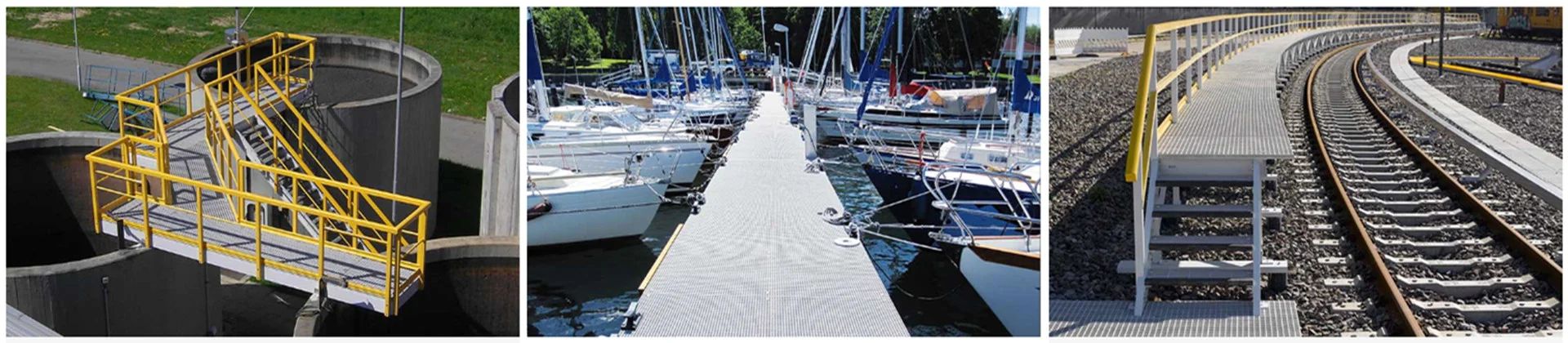
Because of these properties, FRP balustrade is chosen wherever personnel need safe access in aggressive environments, for example:
-
Walkways and platforms in wastewater treatment and chemical plants
-
Cooling tower structures and marine docks exposed to spray and moisture
-
Power substations and transformer yards that require non-conductive guardrails
Many operators now standardize FRP for new walkways in corrosive zones to cut repainting work orders over the life of the plant.
FRP Balustrade vs Steel: Lifespan and Durability
Corrosion, Weathering and Service Life
The biggest practical difference between FRP balustrade and painted steel appears after only a few years in service. Steel begins to rust at coating damage, especially in coastal or chemical atmospheres, and often needs blasting and repainting every 5–7 years to maintain appearance and safety.
FRP is inherently corrosion resistant because the glass and resin are not attacked by most industrial chemicals or salt spray. Color is built into the profile, so there is no external coating to flake off. With UV-resistant resins and proper design, FRP guardrails are commonly specified for 20–25 years of service with only basic cleaning, which is why many owners now describe them as a “fit and forget” solution in harsh environments.
Structural Performance and Long-Term Safety
Both steel and FRP balustrades can be engineered to meet the guardrail load requirements found in typical building codes and industrial safety standards. Designers check deflection and ultimate strength under horizontal loads on the top rail and infill, and FRP profiles are tested to confirm that they meet these criteria.
Because FRP does not lose cross-section to rust in corrosive environments, its load-bearing capacity remains more stable over time. Safety factors are preserved without worrying about hidden corrosion under paint, and high-traffic areas avoid the sharp, rusted edges that sometimes appear on damaged steel rails.
Cost Comparison Over the Full Lifecycle
Upfront Material and Installation Costs
On a per-meter material basis, painted carbon steel balustrades often look cheaper than FRP options, sometimes by 10–20%. However, installation closes much of this gap.
FRP components are light enough to be carried by two people and cut on site with simple tools, so crews can install long runs quickly without cranes or heavy lifting gear. On retrofit projects in congested pipe racks or elevated platforms, contractors regularly report installation time reductions of 15–30% when switching from steel rails to modular FRP systems.
Maintenance, Downtime and Total Cost of Ownership
The larger cost difference appears over 10–20 years of operation. Every time a steel balustrade needs repainting, you pay for coatings, labor, scaffolding, safety supervision and, often, lost production or restricted access.
A simple example helps. Imagine 100 m of balustrade on a coastal wastewater platform. Steel might cost 100 units initially and require two full repaint cycles over 20 years, each costing 40 units, for a total of 180 units. An FRP balustrade might cost 130 units initially but only need inspection and washing, bringing the same 20-year period in at around 130–140 units. Many owners report lifecycle savings in the range of 20–40% when they account for maintenance. In one anonymized coastal wastewater plant, replacing 120 m of steel rails with FRP eliminated two planned repaint cycles in 10 years and cut guardrail maintenance costs by roughly one-third.
Safety, Compliance and Worker Comfort
Safety Around Electricity and Hazardous Environments
In power and electrical environments, the non-conductive nature of FRP is a major safety advantage. A steel handrail that becomes energized through a fault or induction can present a serious shock hazard. FRP balustrades, by contrast, have excellent dielectric properties and can be tested to withstand specified voltage levels in accordance with common electrical insulation methods.
Many utilities now specify non-conductive composite guardrails around switchgear, transformers and overhead lines as part of their internal safety standards. Workers often comment that they feel more comfortable around non-conductive rails, especially in cramped substations and cable trenches where accidental contact with metal is hard to avoid.
Fire, Slip and Visibility Considerations
Fire performance is another key design point. Modern FRP systems can be formulated with fire-retardant resins and smoke-suppressant additives to meet typical flame spread and smoke index requirements in building and industrial codes. Working with a supplier who can provide tested fire performance data helps ensure compliance.
Day-to-day safety also matters. FRP stairways and platforms can integrate molded or bonded anti-slip surfaces to reduce incidents in wet or oily conditions. High-visibility colors such as safety yellow are integral to the profile, so the balustrade remains easy to see even after years of weathering.
Design and Safety Notes
Like any structural system, FRP balustrades must be properly engineered and installed. Very high-temperature zones, impact-intensive areas or locations with unusual loads may still favor steel or hybrid designs. It is good practice to review local building codes and industrial safety standards, and to work with qualified engineers and manufacturers so that load, fire and electrical requirements are clearly defined and verified by testing.
Design Flexibility and Custom Engineering Support
Standard Pultruded Profiles and Modular Systems
FRP balustrade systems are built from a toolkit of standard pultruded profiles: posts, top and mid rails, toe boards, infill panels and brackets. Because the profiles are consistent in shape, engineers can design modular spans and standardize details across multiple sites.
This modularity simplifies adapting the same balustrade concept to different platform heights, stair pitches or changes in direction. When platforms also use FRP grating, ladders and cable trays, an FRP balustrade helps create a coherent, all-composite system.
Custom Colors, Shapes and Composite Solutions with Unicomposite
Some projects need more than a standard kit of parts. That is where a specialist manufacturer like Unicomposite adds value. Because Unicomposite operates its own pultrusion lines and complementary processes such as pulwound, SMC/BMC and hand lay-up, the team can design custom posts, infill or connection parts tailored to your loads, clearances or branding.
Engineering support typically includes reviewing layouts, recommending wall thicknesses and fiber directions, selecting resin systems for specific chemicals or temperatures, and providing test data where needed. Combined with ISO-certified quality control, this gives owners and EPCs confidence that the FRP balustrade system will perform as intended in sectors such as electricity transmission, wastewater treatment, cooling tower construction, agriculture, aquaculture and marine structures.
How to Decide if FRP Balustrade Is Right for Your Project
Environment and Performance Checklist
A quick checklist helps you decide between steel and FRP:
-
Will the balustrade be exposed to salt spray, chemicals, constant humidity or wash-down?
-
Are there electrical hazards nearby that make non-conductive materials attractive?
-
Is the owner targeting at least 15–20 years of service life before major refurbishment?
-
How easy is maintenance access, and what will downtime cost during repairs?
If you answer “yes” to multiple exposure or access challenges, an FRP balustrade will usually score higher in a long-term performance comparison than a conventional steel system.
When Steel Still Makes Sense vs When FRP Wins
There are still situations where steel is the right choice, such as indoor, climate-controlled spaces with low corrosion risk, very high-temperature zones or projects with tight upfront budgets and simple future access. In those cases, galvanized or stainless steel may deliver adequate performance at a lower initial cost.
However, in coastal plants, chemical facilities, wastewater treatment works, cooling towers and live electrical environments, FRP balustrades typically offer a stronger value proposition. As a rule of thumb, if you expect to repaint steel more than twice over a 20-year period, it is worth running a lifecycle cost comparison with FRP.
Conclusion
Choosing between steel and FRP balustrade systems is ultimately about balancing risk, safety and total cost over the life of your asset. In benign, easily accessible locations, traditional steel still has a place. In aggressive or hard-to-reach environments, however, FRP’s corrosion resistance, electrical insulation, low weight and reduced maintenance provide a compelling alternative.
Manufacturers like Unicomposite, with ISO-certified production and a track record across electricity, landscaping, wastewater, cooling towers, agriculture, aquaculture and marine projects, can help turn these principles into a practical specification. By engaging early, you can review drawings, confirm load and fire performance, and receive a realistic cost comparison between steel and FRP options so your next balustrade project becomes a deliberate, data-backed choice.
Frequently Asked Questions
Yes. Properly designed FRP handrail and balustrade systems are engineered and tested to meet the same guardrail load requirements that apply to steel.
In many wastewater, chemical and coastal applications, FRP balustrades are specified for 20–25 years of service life with only periodic inspection and cleaning.
Yes. FRP posts and rails can usually be fixed to steel or concrete using stainless steel anchors and brackets, and the low weight of the system is an advantage during retrofit work.


