 info@unicomposite.com


Introduction
The first time I inspected the retrofitted wastewater bridge on a typhoon-gray morning, I ran a dry-film gauge across an FRP beam web that had been battling salt spray for five years. No blistering, no chalking—just a crisp clack as the probe bounced off the glossy resin. Moments like that drive home how costly corrosion really is: AMPP’s 2025 global estimate pegs annual losses at US $2.8 trillion1. Facilities in marine, chemical, and wastewater zones must decide whether to keep recoating steel or invest in pultruded fiberglass that doesn’t rust. Drawing on Unicomposite’s ISO 9001 and ISO 14001–audited pultrusion plant and collaboration with the Hohai University Composites Lab, this guide compares the two materials so engineers can design smarter—and spend fewer weekends fighting rust.

frp beams
Understanding Corrosion in Harsh Sites
Common corrosive environments
-
Marine structures face relentless chloride ions that pit metals.
-
Wastewater plants generate hydrogen sulfide and sulfuric acid.
-
Chemical facilities expose members to aggressive acids, alkalis, and solvents.
How corrosion erodes performance
A 2024 field study showed unprotected carbon-steel I-beams in splash zones thinning 1 mm every 18 months, reducing moment capacity by 8-10 % within a decade2. Each recoating outage costs tens of thousands in lost throughput and scaffolding.
Material Showdown: FRP Beams vs. Steel
Mechanical properties head-to-head
| Property | Pultruded FRP (E-glass/vinyl-ester) | Carbon Steel |
|---|---|---|
| Tensile strength | 500–700 MPa | 400–550 MPa |
| Modulus | 40 GPa | 200 GPa |
| Strength-to-weight | ≈3× steel | Baseline |
A 2025 ASTM D7957 round-robin found FRP retained 97 % of its modulus after 1,000 thermal cycles (-40 °C ↔ 80 °C), while coated steel lost 6 % due to micro-crack initiation3.
Corrosion-resistance mechanisms
Steel depends on barrier paints; once breached, oxidation is inevitable. FRP uses inert glass fibers in hydrophobic resins—no electrochemical pathway means no rust, even after 10,000-hour ASTM B117 salt-fog exposure.
Service temperature & fire performance
Standard polyester FRP works to 80 °C. Unicomposite’s vinyl-ester beams push continuous service to 110 °C and achieve ASTM E84 flame-spread ≤ 25 with halogen-free additives.
“When a client doubts stiffness, we show how a 15 % deeper web balances deflection while trimming 60 % of the lift load,” says Chen Wei, Senior Design Engineer, Unicomposite.
Real-World Case Study & Expert Insight
Coastal wastewater bridge retrofit
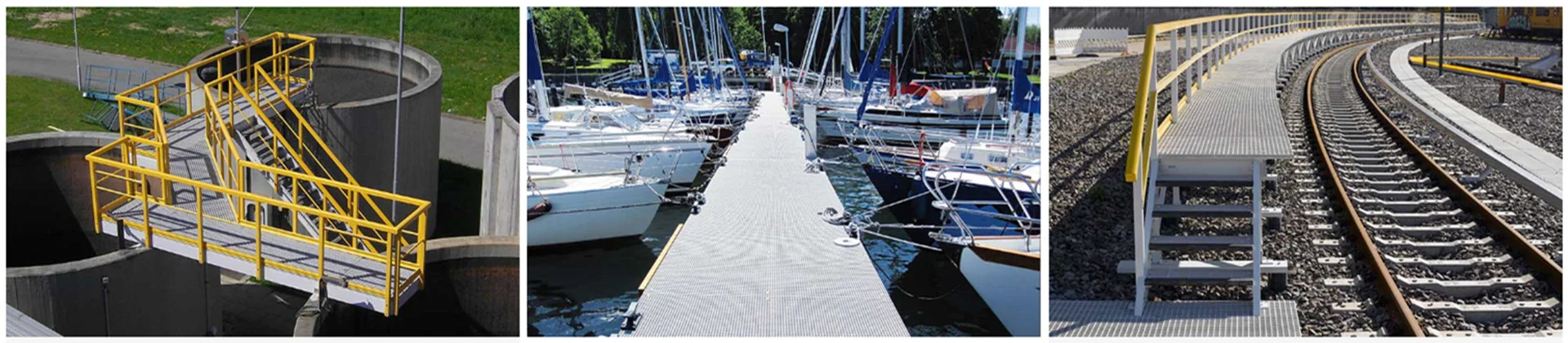
In 2019 a Southeast-Asian utility swapped corroded steel stringers for Unicomposite FRP beams and grating. Lightweight sections allowed crane-free installation, keeping foot traffic open.
Five-year performance snapshot
| Metric | Year 0 | Year 5 | Δ |
|---|---|---|---|
| Mid-span deflection (mm) | 8.3 | 9.4 | +13 % (within L/360) |
| Coating repairs | 0 | 0 | –100 % vs. steel baseline |
| Annual inspection cost | US $12 k | US $2 k | –83 % |
“Eliminating the annual sand-blast shutdown paid back the material premium in three seasons,” notes project manager Liu Rong.
Engineering & Installation Considerations
Design codes & standards
-
ACI 440.1R-23 for FRP-reinforced concrete.
-
ASTM D7290 & D7957 for statistical material properties.
-
ISO 14001 audit verifies Unicomposite’s environmental management.
Handling & on-site fabrication
At one-quarter the weight of steel, FRP beams can be man-handled or lifted with telehandlers. Their dielectric nature (tested to 100 kV/ft) enhances crew safety near live conductors.
Hybrid solutions
Designers often pair FRP beams with galvanized steel columns or connectors, merging composite corrosion resistance with localized steel stiffness—ideal for crane rails or seismic joints.
Cost & Lifecycle Analysis
Upfront costs
FRP beams run 15-25 % higher per kilogram than carbon steel. Yet smaller foundations, no hot-works permits, and reduced lifting gear narrow the installed gap.
Maintenance savings
Steel splash-zone recoating averages US $70/m² every 4 years. FRP needs only wash-downs and visual checks.
Total cost of ownership
A 30-year model for a 50-m wharf girder line showed 27 % lower TCO with FRP—including downtime and labor—before accounting for carbon-pricing incentives.
Regulatory & Safety Compliance
Environmental impact & recyclability
Steel is endlessly recyclable; FRP can be shredded into filler or repultruded sheets, meeting EU End-of-Life Vehicle Directive thresholds. VOC-free resin systems lower permitting hurdles.
Worker safety advantages
Non-sparking, non-conductive FRP minimizes fire and shock hazards in petrochemical zones.
Safety disclaimer: Always verify load calculations and code compliance with a licensed structural engineer.
Conclusion
For structures relentlessly attacked by salt, sewage, or chemicals, steel’s protective coatings amount to a temporary cease-fire. FRP beams deliver a lasting peace treaty—lightweight, corrosion-proof, and engineered for decades-long service. Backed by Unicomposite’s ISO-certified pultrusion, ISO 14001 environmental stewardship, and university-lab-verified testing, they let owners re-allocate maintenance budgets to growth projects instead of rust patrols. Download our FRP beam MSDS or request a design consultation today—see how much “rust tax” you can save this fiscal year.
Frequently Asked Questions
Q1. How long do FRP beams last in coastal environments?
Laboratory aging and 20-year field data indicate design lives of 50 years or more, provided UV-stabilized resins are specified and basic inspections are performed.
Q2. Can FRP beams be customized for unusual load paths?
Yes. Unicomposite pultrudes bespoke geometries and hybrid lay-ups, and our engineers run FEA to validate non-standard profiles before production.
Q3. What fire ratings can FRP beams achieve?
With Class 1 flame-retardant additives, beams reach ASTM E84 flame-spread ≤ 25 and meet many building-code egress requirements.
Q4. How does thermal expansion of FRP compare to steel?
FRP’s coefficient (≈ 8–12 × 10⁻⁶/°C) is closer to concrete, reducing differential movement in composite decks relative to steel.
Q5. Are FRP beams compatible with standard steel connectors?
Absolutely—hybrid framing uses stainless or galvanized bolts and special bearing pads to distribute local stresses without galvanic corrosion.


