 info@unicomposite.com


Introduction
If your guardrails live in salt spray, chemical mist, frequent washdowns, or UV-heavy rooftops, corrosion isn’t a “maybe”—it’s a maintenance line item. The NACE/AMPP IMPACT study estimated the global cost of corrosion at US$2.5 trillion (3.4% of global GDP), which is why many facilities look for materials that don’t depend on paint to survive.
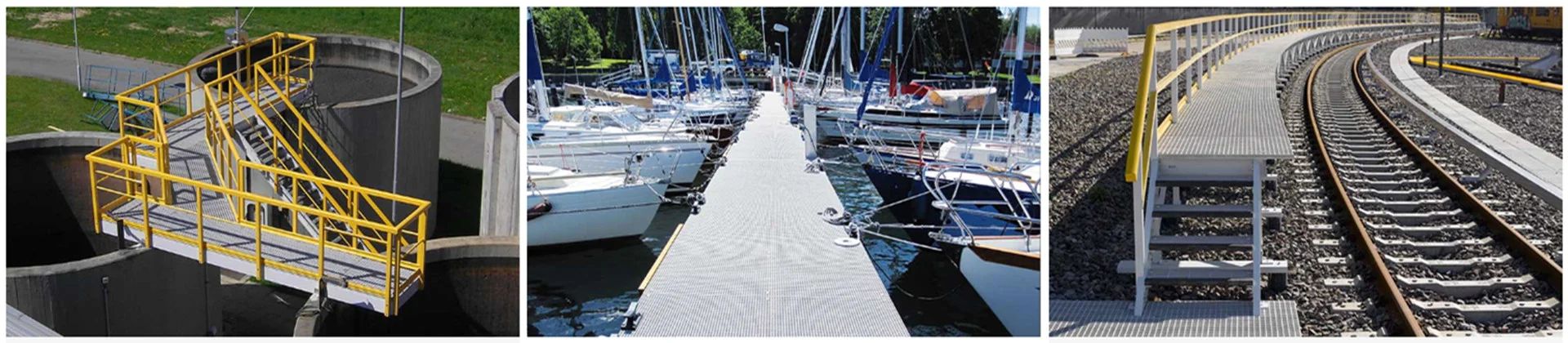
An FRP guardrail (fiberglass-reinforced plastic; sometimes called GRP) is often chosen for industrial walkways, platforms, cooling towers, wastewater, marine/coastal structures, and utilities—especially when downtime is expensive.
What you’ll get here: a buyer-friendly spec and selection guide that ties performance to standards, environment, and connection details—so your RFQs come back comparable and your installs stay compliant.

frp guardrail
FRP Guardrail Basics: Materials, Profiles, and Why It Matters
Most industrial fiberglass guardrail components (top rail, midrail, posts, toe boards) are produced by pultrusion for consistent straight profiles. That matters because guardrails are a system: repeatable geometry + repeatable joints is how you avoid “one bay feels wobbly.”
Pultruded FRP vs Other Composite Methods (and when each fits)
- Pultrusion: best for long, straight, consistent profiles (rails/posts/toe plates).
- Pulwound / filament-wound: useful for tubular elements or special stiffness needs.
- SMC/BMC: molded parts when geometry is complex.
- Hand lay-up: one-offs or unusual retrofits.
What makes FRP different in guardrail applications
Two performance drivers dominate:
- Resin system (chemical resistance + weathering)
- Connection design (how loads transfer to posts and anchors)
A quick reality check from OSHA’s language: guardrails aren’t decorative—OSHA requires they be “capable of withstanding… at least 200 pounds” near the top rail.
That load path goes through your brackets, base plates, and anchors—so those details can’t be an afterthought.
Resin choice, simplified:
- Vinyl ester: typically selected for harsher chemical exposure and higher corrosion resistance.
- Polyester (incl. corrosion-resistant grades): often fits lighter exposure and cost targets.
UV strategy: For outdoor exposure, specify UV inhibitors/surface veil/topcoat appropriate to your site’s sun exposure—otherwise you may see chalking and cosmetic fade long before structural issues.
Specs & Standards: What buyers should ask for
Start with the governing rules for your site, then write specs so quotes are apples-to-apples.
OSHA baseline (common for industrial walking-working surfaces)
OSHA 1910.29 requires top rails at “42 inches… plus or minus 3 inches”.
It also requires a 200-lb load near the top rail without failure and limits downward deflection so the top rail does not drop below 39 inches under that test load.
If your project is in the construction context, OSHA 1926.502 contains parallel guardrail criteria (including the 42-inch ±3-inch top-rail height).
Building-code style guard loads (common when IBC/ASCE governs)
In many building-code contexts, guards/handrails are designed for 50 lb/ft (plf) linear load along the rail.
And for concentrated load, code language commonly specifies 200 pounds (0.89 kN).
Fire performance (when required)
If fire/smoke criteria apply, ASTM E84 is often referenced. ASTM explains the purpose as determining relative burning behavior by observing flame spread and reporting flame spread/smoke developed indices—while also noting this is comparative and doesn’t, by itself, define noncombustible materials.
Buyer spec checklist (use this to prevent vague “meets code” claims)
Ask for these in writing:
- Governing standard: OSHA 1910.29 vs 1926.502; IBC/ASCE where applicable (and local amendments)
- Geometry: height, midrail/infill method, toe board, gates, maximum openings
- Loads + deflection: point/line loads + allowable movement
- Materials: resin system, UV strategy, tolerances, finish/color
- Hardware: fastener alloy, isolation strategy, anchors/base plates
- Documentation: drawings, calculations (if needed), QA/QC, traceability, test reports (fire, etc.)
Engineering selection: Match FRP guardrail to real conditions
Here’s a fast workflow that reduces back-and-forth:
Step-by-step selection workflow
- Map exposure: chemical names + concentrations, temperature range, UV, splash vs immersion vs washdown.
- Confirm layout intent: top rail height, intermediate protection, toe boards, gates, openings (OSHA gives intermediate member spacing limits like 19 inches max for certain configurations).
- Lock load cases: OSHA’s 200-lb near top rail is a frequent baseline; code projects may also require 50 plf linear load.
- Choose resin + surface protection: select for chemical compatibility first; UV protection for outdoor.
- Engineer the connections: brackets, splice locations, base plates, anchors, and isolation to prevent galvanic/corrosion issues in hardware.
Environment → resin/finish “starter table” (confirm with your exposure list)
| Environment | Common selection emphasis | Why |
|---|---|---|
| Wastewater (H₂S/chemicals, constant humidity) | Vinyl ester + corrosion-focused hardware | Chemical + moisture exposure stack |
| Marine/coastal | UV + salt-spray resistant hardware + stable finish | Hardware often fails before FRP |
| Cooling towers | Moisture + chemical drift + UV | Mixed exposure, frequent maintenance access |
| Utilities / electrical areas | Dielectric-friendly design + compliant geometry | Safety + site-specific electrical requirements |
Anonymized scenario pattern (what often drives success): sites that standardize (a) resin system, (b) post spacing, and (c) base-plate anchorage details tend to stop the “loose bay” problem—because the load path stays consistent under the 200-lb test expectation.
Installation & maintenance: Avoid the common failure modes
A lot of fiberglass railing complaints trace back to install details, not the material.
Installation checklist (field-usable)
- Anchor alignment: misaligned base plates create constant side-load and loosening.
- Torque control: under-torque loosens; over-torque can crush/damage composite around holes.
- Clean drilling & edge distances: use proper bits, avoid splintering; don’t crowd holes near edges.
- Seal cut ends: field cuts should be sealed per supplier guidance to protect the laminate.
- Isolate dissimilar metals: if you’re using stainless/galvanized anchors, specify isolation sleeves/washers as needed.
A compliance-minded gut-check: OSHA specifies that under the 200-lb downward test load, the top rail must not deflect below 39 inches above the walking-working surface.
If your system feels “springy,” it’s usually a post spacing / connection stiffness issue—not something you fix with thicker paint.
Maintenance plan (what “low maintenance” actually means)
- Quarterly/biannual walkdown: check fasteners, anchors, splices, gates (frequency depends on traffic and exposure).
- Impact damage protocol: replace cracked/compromised sections; don’t “patch-and-forget” safety hardware.
- Outdoor appearance checks: monitor UV chalking/fade as a surface indicator; treat as a trigger to review finish specs next cycle.
Procurement: Documentation, testing, and supplier qualification
This is where B2B buyers win: the right docs prevent surprise change orders.
What to request before issuing a PO
- Shop drawings: post spacing, base plates, splices, gate details, toe boards
- Design basis: confirm the governing requirement set (e.g., OSHA 1910.29 criteria and/or code loads like 50 plf and 200 lb where applicable).
- Material spec: resin system, UV strategy, finish/color, profile tolerances
- QA/QC: dimensional inspection plan + batch traceability
- Fire documentation (if required): E84 reporting context and what the indices represent
Supplier capability (what “good” looks like, with a concrete example)
When you’re buying in bulk, look for suppliers that can show process control, traceability, and engineering support for connection details (not just “we sell rails”). For example, Unicomposite is an ISO-certificated pultrusion manufacturer with in-house production for standard pultruded fiberglass profiles and custom composite parts, and can support other composite forming methods (Pulwound, SMC/BMC, hand lay-up) when geometry or performance needs go beyond standard profiles. In practical terms, that breadth helps when your project needs custom brackets, unique post spacing, or integration with existing steel/concrete structures.
Conclusion
A reliable FRP guardrail spec is usually built in this order:
- environment (chemicals/UV/temp)
- governing standard (OSHA vs code context)
- loads/deflection and post spacing
- resin + UV/finish strategy
- connection + hardware engineering
- documentation + QC/traceability
If you want faster quotes and fewer RFIs, send a one-page “inputs sheet” with: exposure list, required standard, target rail layout/post spacing, hardware constraints, and any fire/smoke requirements (E84 or similar).
Frequently Asked Questions
How long does an FRP guardrail last in corrosive environments?
Service life depends on resin selection, exposure severity, UV protection, and—most often—hardware/connection choices. In harsh sites, the right resin system plus corrosion-smart hardware can dramatically reduce maintenance compared with painted metal.
Do FRP guardrails meet OSHA requirements?
They can, as long as the system is designed and installed to meet OSHA criteria like 42-inch ±3-inch top rail height and the 200-lb load/deflection requirements.
What should I include in an RFQ for custom FRP guardrail?
List chemicals and concentrations, temperature range, UV exposure, required standard (OSHA/code), target post spacing, mounting substrate (steel/concrete), hardware preferences, and any fire/smoke targets (e.g., ASTM E84 reporting needs).
Is ASTM E84 a “fireproof” certification?
No—ASTM describes E84 as a comparative surface burning test that reports flame spread and smoke developed indices; it doesn’t, by itself, define a material as noncombustible or guarantee performance in all real-fire scenarios.
When might FRP not be the best choice?
If your application involves sustained high temperatures beyond the chosen resin system, severe abrasion/impact risk without protection, or jurisdiction-specific requirements that demand engineered approvals you can’t document, another solution may fit better—or you may need additional design controls.


