 info@unicomposite.com


Introduction
Steel has been the default material for reinforcing grids and support structures for decades, but in many aggressive environments it has become a liability: corrosion, heavy weight, hot work permits, and constant repainting or replacement. That’s why more engineers and asset owners are now asking whether FRP lattice systems can do a better job than steel.
This article compares the two from a practical standpoint—lifespan, cost, and performance—with examples drawn from real industrial settings. The goal is not to “sell composites” but to help you see where they make sense, what trade-offs exist, and how to specify them correctly.
Unicomposite, an ISO-certificated pultrusion manufacturer in China, has long supplied fiberglass-reinforced profiles and custom composite parts into power utilities, wastewater plants, cooling towers, agriculture, aquaculture, marine projects, and more. Experience from these sectors provides a useful lens for understanding when FRP lattice becomes a better long-term choice than steel.

FRP lattice
FRP Lattice Basics: What It Is and Where It Fits
1.1 – What Do We Mean by “FRP Lattice”?
In an industrial context, FRP lattice usually refers to a grid or network made from fiberglass-reinforced polymer profiles. Typical examples include:
- Reinforcement meshes for concrete slabs, decks, or walls
- Lattice-type girders or truss webs
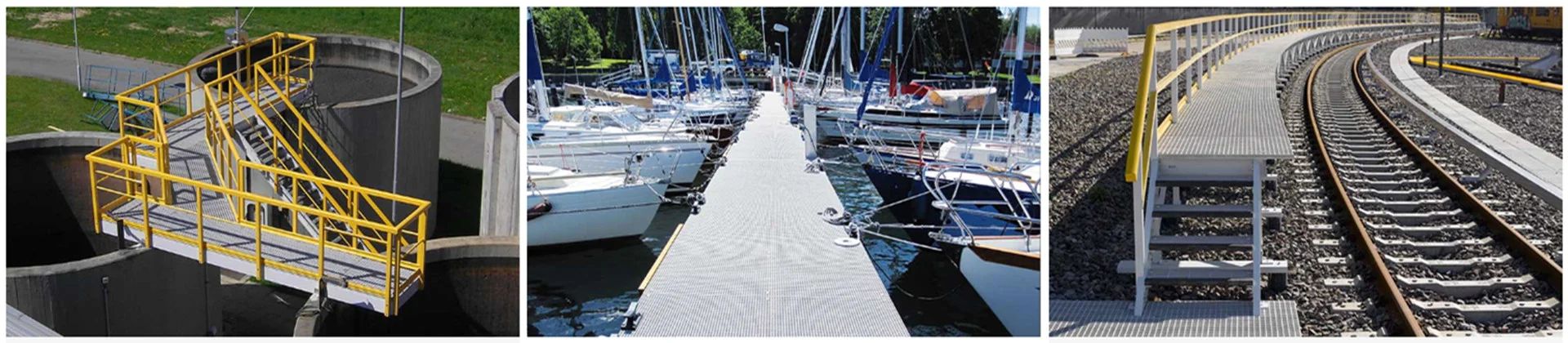
- Grating-style panels used as walkways, platforms, or covers
These products combine continuous glass fibers (for strength and stiffness) with a polymer resin (for geometry and environmental resistance). Pultrusion is a core process: fibers are pulled through resin and a heated die to produce profiles with consistent dimensions and mechanical properties. Other processes—pulwound, SMC/BMC, hand lay-up—are used when cylindrical, thick, or highly customized shapes are required.
Because the material is engineered, the lattice can be tuned for directional stiffness, opening size, and integration with handrails, curbs, or embeds, giving designers more options than standard welded steel meshes.
1.2 – Typical Applications Across Industries
FRP lattice systems are most attractive where corrosion, weight, or electrical safety are critical:
- Power utilities & substations – non-conductive platforms and support grids around high-voltage equipment
- Wastewater & cooling towers – covers, walkways, and supports exposed to constant moisture and chemicals
- Marine & aquaculture – docks, cages, and access ways in saltwater and splash zones
- Industrial slabs and platforms – reinforcement and decking in chemical plants or facilities with de-icing salts
- Agriculture and landscaping – frames, screens, and supports in fertilizer-rich or permanently damp environments
Unicomposite’s portfolio spans these same sectors, supplying standard pultruded profiles and custom lattice assemblies. That breadth of application is a strong indicator that composites are now a mainstream option rather than a niche experiment.
Performance Comparison: FRP Lattice vs Steel
2.1 – Corrosion Resistance and Environmental Durability
Corrosion is where steel struggles most. In chloride-rich or acidic environments, coatings, galvanizing, and extra thickness only slow the loss of section; eventually rust appears at welds, cut edges, and connections.
FRP, by contrast, is non-corrosive: the glass fibers are locked inside a resin matrix, so there is no electrochemical reaction like rust. With appropriate resins (for example, vinyl ester for harsh chemical exposure) and UV stabilizers, FRP lattice maintains strength and stiffness over long service lives in environments that rapidly degrade steel. In wastewater and marine projects, owners often see the difference directly as fewer rust repairs, fewer coating campaigns, and more stable condition ratings in inspections.
2.2 – Mechanical Performance and Structural Behavior
Mechanically, FRP and steel behave differently:
- Strength: well-designed FRP profiles can reach tensile strengths comparable to or higher than mild steel.
- Stiffness: the elastic modulus of FRP is lower—roughly a quarter that of steel—so the same geometry will deflect more under load.
- Weight: FRP density is typically 1.8–2.0 g/cm³ vs ~7.8 g/cm³ for steel, which translates to 60–75% weight reduction for comparable sections.
The main design implication is deflection. Engineers moving from steel to FRP lattice may need deeper sections, closer supports, or different grid patterns to keep serviceability within limits. Coordination with local concrete and FRP design standards—plus manufacturer data and partial safety factors—is essential to ensure a safe, efficient design.
Expert insight: Many teams start with a familiar steel design, then collaborate with the composite manufacturer to adjust profile shape and spacing. Iterating with real test data often produces a solution that meets both strength and deflection criteria without over-building.
2.3 – Weight, Handling, and Safety on Site
On site, the lighter weight of FRP lattice is one of the first benefits crews notice. Panels that once needed a crane can often be carried by two people; meshes can be trimmed with simple tools rather than hot work. This can shorten installation windows and reduce lifting-related injuries.
Non-conductivity is equally important around high-voltage assets. FRP grids and platforms help control step and touch potentials and reduce the need for complex bonding and grounding of metallic components. Maintenance teams in substations and power plants frequently report that the combination of light weight and electrical safety makes FRP a better fit for outage-sensitive work.
Lifespan and Lifecycle Cost: FRP Lattice as a Long-Term Investment
3.1 – Service Life in Aggressive Environments
In dry indoor spaces, both materials can last a long time. In coastal, chemical, or wastewater environments, steel’s service life is often limited by corrosion at connections and details. FRP lattice, if specified with the right resin and protective additives, is designed to withstand that same environment without rusting.
For owners, the pay-off is fewer unplanned shutdowns for structural repairs, fewer emergency replacements, and a smoother inspection record over the asset’s design life.
3.2 – Capex vs Opex: How Costs Really Compare
At bid time, FRP lattice may be more expensive per meter than steel. However, looking only at initial material price ignores other cost drivers:
- Material & fabrication: FRP may cost more at purchase, but usually doesn’t need galvanizing or complex coatings.
- Transport & installation: weight reductions of 60–75% can cut freight and simplify site handling.
- Inspection & maintenance: non-corrosive performance greatly reduces repainting, patch repairs, and unplanned outages.
When lifecycle costs are modeled honestly for harsh environments, FRP often comes out ahead even though the first invoice is higher.
3.3 – Mini Case Study: Upgrading from Steel to FRP Lattice
A municipal wastewater plant used painted steel lattice covers over open channels. After less than a decade, corrosion at supports and welds demanded frequent patching and forced partial lane closures several times a year. Maintenance crews described the work as “never-ending.”
During a refurbishment, the plant switched to FRP lattice panels designed for the same loads. The lighter panels were installed by small teams without cranes, and no hot works were required for trimming. Over the next 7–10 years, inspections found discoloration but no structural loss; staff reported that routine cleaning replaced the cycle of grit blasting and patch repairs.
Design and Specification Checklist for FRP Lattice
4.1 – Key Design Parameters Engineers Must Clarify
Successful FRP lattice projects start with clear design inputs. Engineers should define:
- Load combinations (dead, live, dynamic, impact, environmental)
- Span, support conditions, and allowable deflection or vibration limits
- Temperature range, chemical exposure, and required design life
- Interfaces with concrete, steel, or other materials
These parameters drive profile selection and grid configuration, and they must be checked against applicable codes, owner standards, and manufacturer recommendations.
Design & safety note: Examples in this article are illustrative only. Final designs should always be validated by qualified engineers using local codes, project specifications, and tested material properties supplied by the manufacturer.
4.2 – Material and Manufacturing Choices that Matter
Performance depends heavily on materials and processes:
- Resins: polyester for general structures, vinyl ester for aggressive chemicals, epoxy where high mechanical performance or bonding is critical.
- Fibers: E-glass is common; fiber orientation and volume fraction are tuned to match primary load directions.
- Processes: pultrusion for straight, consistent profiles; pulwound for cylindrical parts; SMC/BMC and hand lay-up where complex shapes, local thickening, or integrated features are needed.
Unicomposite illustrates the type of partner specifiers should seek: an ISO-certificated pultrusion manufacturer with its own factory, multiple FRP processes under one quality system, and the ability to create both standard and custom lattice components.
4.3 – Practical Specification Tips for Purchasers
Purchasing and engineering teams can avoid many headaches by:
- Describing the environment and design life along with geometry
- Specifying performance requirements—strength, stiffness, chemical and UV resistance—rather than only dimensions
- Requesting QA/QC documentation, including mechanical test data and material traceability
- Clarifying packaging, labeling, and handling expectations for site logistics
Engaging the manufacturer early, especially when replacing steel in an existing design, often leads to better-optimized lattices and fewer surprises during installation.
Choosing an FRP Lattice Supplier and Engineering Partner
5.1 – What to Look For in a Supplier
Choosing the right supplier is as important as choosing the right material. Good signs include:
- ISO-certificated quality management and documented process control
- In-house manufacturing rather than purely trading activity
- Engineers on staff who can support design checks and detailing
- A track record in sectors like utilities, wastewater, cooling towers, agriculture, aquaculture, and marine
Unicomposite fits this profile, supplying FRP profiles and lattice solutions across industries that demand long service life and consistent quality. Working with such a specialist helps buyers move beyond “catalog only” choices to systems tailored to their loading and environment.
5.2 – Collaboration Workflow: From Concept to Delivery
A typical B2B collaboration for FRP lattice looks like this:
- Concept & inquiry – the owner shares drawings, load cases, and environmental data.
- Engineering review – the supplier proposes profile types, grid patterns, and resin systems.
- Sampling & testing – trial panels or sections are produced for fit-up and verification.
- Pilot installation – a limited deployment validates installation methods and performance.
- Full rollout – production ramps up with agreed QA/QC, packaging, and delivery schedules.
Treating the supplier as an engineering partner rather than a commodity vendor usually results in safer, more economical systems and clearer accountability throughout the asset’s life.
Conclusion
Steel lattices remain familiar and effective in many environments, but their vulnerability to corrosion, weight, and electrical hazards can drive high lifecycle costs in challenging conditions. Well-designed FRP lattice systems offer a different balance: lighter weight, non-corrosive performance, electrical insulation, and often lower total cost of ownership when the environment is harsh.
For project owners and engineers, the key is not to replace steel everywhere, but to recognize where composites make strategic sense. Reviewing existing specifications, running honest lifecycle cost comparisons, and engaging experienced manufacturers such as Unicomposite can help you decide where FRP lattice is the right tool for the job—and where steel remains the best fit.
Frequently Asked Questions
Q1: Is FRP lattice strong enough to replace steel in structural applications?
Yes, when it is properly designed, FRP lattice can achieve comparable or higher tensile strength than mild steel. The main design difference is its lower stiffness, so profiles and spans must be chosen carefully. Working with manufacturer data and qualified engineers is essential to ensure safety and performance.
Q2: How much lighter is FRP lattice compared with steel?
FRP typically weighs only about 25–40% as much as steel for comparable sections. This weight reduction can cut freight costs, reduce lifting requirements, and make installation faster and safer for crews.
Q3: What are the main limitations of FRP lattice?
Key considerations include lower stiffness (which affects deflection), fire performance, and long-term behavior at elevated temperatures. These issues are manageable through proper design, resin selection, fire protection strategies, and adherence to relevant standards, but they must not be ignored.
Q4: How can I be sure FRP lattice will last in my chemical or coastal environment?
Start by clearly describing your environment—chemicals, temperatures, moisture, and design life—and ask the manufacturer to recommend resin systems and formulations that match. Request durability test data, previous project references in similar conditions, and clear QA/QC documentation to support your decision.
Q5: When does it make most sense to choose FRP lattice over steel?
FRP is especially compelling where corrosion, electrical safety, or frequent access for maintenance is a concern—such as wastewater plants, cooling towers, coastal facilities, and substations. In these cases, reduced maintenance, fewer shutdowns, and safer working conditions often outweigh higher initial material cost.


