 info@unicomposite.com


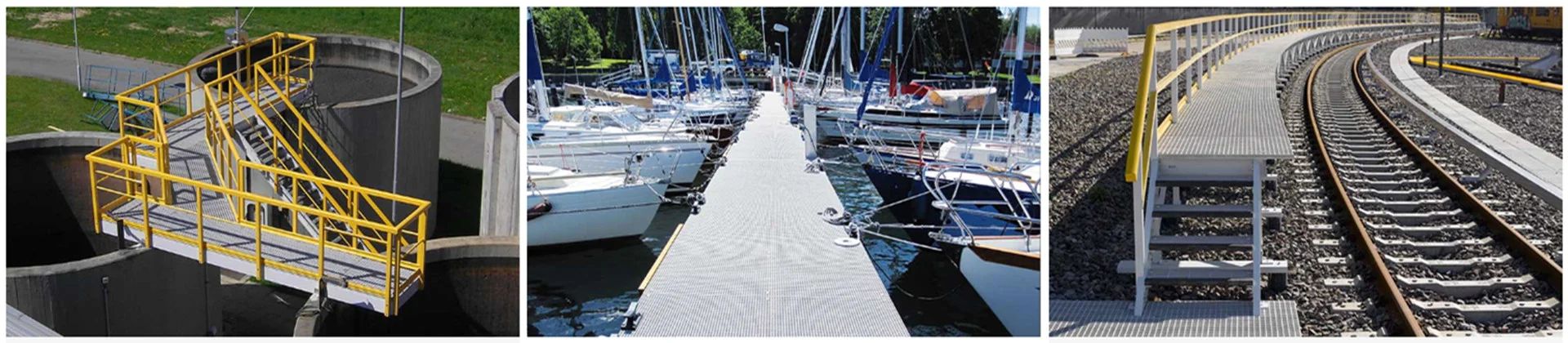
Introduction
For facility managers and civil engineers, few things are as frustrating as watching expensive infrastructure slowly disintegrate. You invest heavily in a new platform or catwalk, only to find that within a few years, the harsh industrial environment has turned your investment into a rust bucket requiring constant maintenance.
This brings us to the classic industrial dilemma: Do you stick with the traditional standard—Galvanized Steel—or do you switch to the modern challenger, the FRP walkway (Fiberglass Reinforced Plastic)?
While steel has been the go-to material for decades due to its familiarity, it comes with “hidden” costs that often blow maintenance budgets out of the water. On the other hand, FRP offers a composite solution designed specifically to handle the environments that destroy metals.
As an ISO-certified professional pultrusion manufacturer, Unicomposite has seen this transition firsthand. We produce various fiberglass extrusion products and custom composite parts for clients who are tired of the endless cycle of scraping and repainting. In this guide, we’ll break down the technical differences to help you decide which material is right for your next project.

FRP Walkway vs. Steel
1. Corrosion Resistance: The Deal Breaker
If your facility deals with chemicals, saltwater, or high humidity, corrosion is your enemy. This is where the battle between steel and FRP is usually decided.
The Steel Reality
Carbon steel, even when galvanized, relies entirely on a surface coating. Once that coating is scratched—whether during installation or by daily foot traffic—oxidation begins. In acidic or saline environments (like wastewater treatment plants or marine docks), steel gratings can lose significant structural integrity in just a few years.
The FRP Advantage
An FRP walkway is fundamentally different. It is not coated; it is a composite material where the resin matrix provides inherent chemical resistance throughout the entire part.
-
Standard Protection: Standard Isophthalic polyester resins offer excellent weatherability for outdoor use.
-
High-Level Protection: For aggressive chemical plants, we often use Vinylester resins. These can withstand acidic and alkaline environments that would rapidly degrade steel.
2. Safety Profile: Slip Resistance and Conductivity
Safety isn’t just a checkbox; it’s a daily operational requirement. The material you choose for your walkways directly impacts your worker safety metrics.
Slip Hazards (Standard Compliance)
Steel plate becomes notoriously slippery when wet or oily. While diamond plating offers some initial traction, the “teeth” wear down over time. In contrast, high-quality FRP profiles are typically manufactured with a grit-embedded surface. At Unicomposite, we bond hard grit (silica or aluminum oxide) to the surface, creating a permanent texture. This often achieves an R13 slip resistance rating (per DIN 51130) or exceeds ASTM D2047 standards, ensuring safety even in oily conditions.
Electrical Safety
In power utilities and substations, conductivity is a major risk. Steel conducts electricity; FRP does not. Fiberglass is an excellent dielectric insulator. Installing an FRP walkway around transformers or switchgear adds a passive layer of safety, reducing the risk of electrical shock to personnel. Additionally, it has low thermal conductivity, meaning railings and gratings won’t freeze skin in winter or burn hands in summer, unlike metal.
3. Strength-to-Weight Ratio and Installation
One of the most common misconceptions is that “lighter” means “weaker.” In the world of composites, that rule simply doesn’t apply.
The Weight Advantage
FRP is approximately 70% lighter than steel (Density: ~1800 kg/m³ vs. ~7850 kg/m³). This drastic weight reduction changes the logistics of installation entirely.
Field Note: The Retrofit Reality We recently supported a client replacing a corroded steel catwalk in a water treatment plant. The old steel had to be cut out with torches, creating fire hazards, and required a crane to lift the heavy, rusted sections.
When the new FRP walkway arrived, the difference was night and day. Two workers could manually carry the grating panels into position. There was no heavy machinery, no welding, and no “hot work” permits required. The installation was finished in half the time, purely because the material was easy to handle.
Custom Fabrication
Because Unicomposite has its own factory, we support custom fiberglass fabrication. We can pre-cut, drill, and trial-assemble your walkway system before it leaves our facility. This means your team receives a “kit” that fits together perfectly, rather than raw materials that need extensive field fabrication.
4. Total Cost of Ownership (TCO) Analysis
This is where the savvy procurement officer needs to look beyond the initial quote.
If you only look at the material cost on Day 1, Carbon Steel is usually cheaper. However, industrial infrastructure is built for decades. When you factor in Total Cost of Ownership (TCO), the math flips.
A 10-Year Comparison:
-
Steel Walkway: Low initial cost, but high installation cost (cranes/welding). Requires spot maintenance by Year 3 and full sandblasting/repainting by Year 7.
-
FRP Walkway: Higher initial material cost, but significantly lower installation cost. Requires zero maintenance for corrosion in Year 3, Year 7, and beyond.
By eliminating the maintenance budget, FRP often pays for itself within the first 3 to 5 years of service.
5. Engineering Considerations: Stiffness vs. Strength
To maintain trust and engineering integrity, we must address the one area where steel holds an advantage: Modulus of Elasticity (Stiffness).
While FRP is incredibly strong (high tensile strength), it is more flexible than steel. Steel is stiffer.
-
The Implication: If you simply swap a steel grate for an FRP grate of the exact same thickness on a wide span, the FRP may feel “bouncy” to walk on.
-
The Solution: This is easily engineered around. We simply use a deeper profile height (e.g., moving from 1-inch to 1.5-inch grating) or decrease the distance between support beams. As long as the support span is calculated correctly, FRP provides a rock-solid walking surface.
6. Choosing the Right FRP Specification
Not all fiberglass is created equal. To ensure your project succeeds, you must specify the right parameters.
-
Molded vs. Pultruded: For long walkways, Unicomposite generally recommends pultruded profiles. The pultrusion process aligns glass fibers linearly, providing superior stiffness for longer spans compared to molded grating.
-
Fire Safety: Always check for fire retardancy. Our industrial-grade profiles can be formulated to meet ASTM E84 Class 1 flame spread ratings (typically <25), which is a critical requirement for indoor industrial, marine, and offshore applications.
Conclusion
So, is an FRP walkway better than steel?
If you are building a temporary structure in a dry environment with a tight initial budget, steel remains a viable option. However, for modern industrial facilities—especially those in water treatment, marine, chemical, or electrical sectors—FRP is the superior choice. It offers a “install it and forget it” solution that improves worker safety while drastically cutting long-term maintenance costs.
Ready to upgrade your infrastructure? Unicomposite serves customers globally with standard pultruded profiles and custom fabrication solutions. Whether you need to replace a single platform or design a complex walkway system, our engineering team is ready to support you. Contact us today for a quote or to request a material sample kit.
Frequently Asked Questions
Q: How long does an FRP walkway last? A: In most industrial environments, a high-quality FRP walkway can last 20+ years with little to no maintenance. The resin matrix protects the fibers from UV and chemical degradation, ensuring a service life that often exceeds that of galvanized steel.
Q: Can FRP walkways support forklift traffic? A: Standard pedestrian grating is designed for foot traffic (typically 50-100 psf live load). However, as a manufacturer, Unicomposite can produce “High Load Capacity” (HLC) grating specifically designed to support forklifts and heavy trucks. Always specify your load requirements during the design phase.
Q: Is it difficult to cut FRP on-site? A: No. Unlike steel which requires torches or plasma cutters, FRP can be cut easily using standard circular saws or jigsaws equipped with a diamond or masonry blade. However, we recommend wearing a dust mask and long sleeves to protect against fiberglass dust.
Q: Does the color fade over time? A: All organic materials are affected by strong UV radiation eventually. However, we add UV inhibitors directly into the resin mix and often apply a synthetic surfacing veil. While a slight color shift might occur over many years in direct desert sun, the structural integrity remains unaffected.


