 info@unicomposite.com


Introduction
Unsightly rust, slick surfaces, and costly shutdowns — aging metal or timber walkways can sabotage budgets and safety records. Five years ago I supervised an emergency weekend replacement after a corroded steel catwalk collapsed at a wastewater plant, costing the owner three days of downtime and $110 k in rental pumps. That nightmare pushed our team to ask a crucial question: Is fiberglass grating for walkway projects worth the investment?
Fiberglass-reinforced plastic (FRP) grating promises corrosion immunity, high slip resistance, and non-conductivity. Backed by Unicomposite, an ISO 9001:2015-certified pultrusion specialist that designs and fabricates custom profiles in-house, the material’s value proposition is no longer theoretical. This article weighs the evidence so you can decide with confidence.

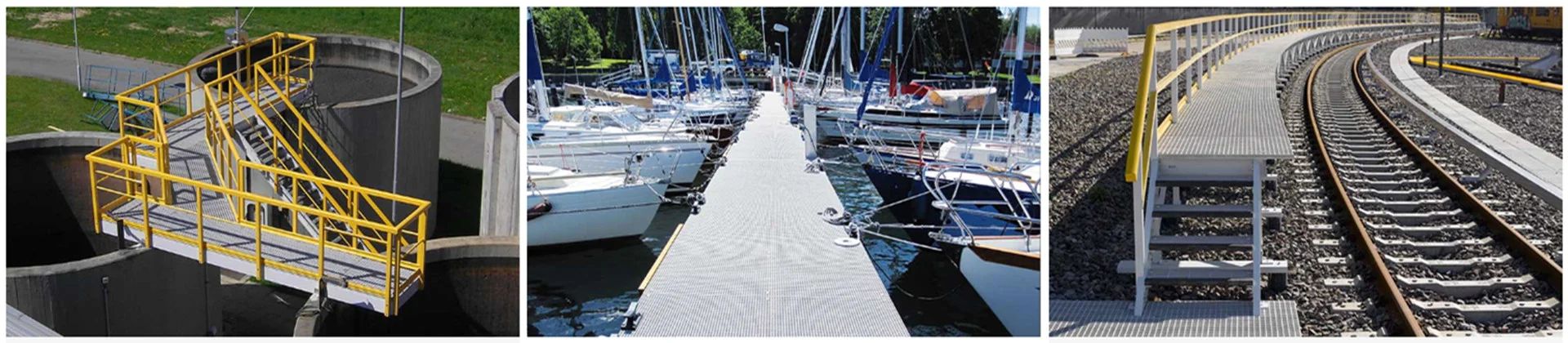
fiberglass grating for walkway
What Exactly Is Fiberglass Grating for Walkway Use?
How Pultruded FRP Grating Is Made
“Pultrusion aligns continuous glass strands under tension, saturates them with thermosetting resin, then cures the profile in a heated die — creating a structural ‘I-beam’ every inch,” explains Wei Zhang, Senior Process Engineer at Unicomposite.
The result delivers tensile strengths up to 35 000 psi, rivaling mild steel with none of its oxidation woes.
Key Physical & Safety Properties
-
Slip resistance: Embedded silica grit achieves a ≥ 0.6 static coefficient of friction, even when oily.
-
Dielectric performance: Non-conductive to 100 kV per inch, protecting electrical crews.
-
Fire behavior: ASTM E-84 Class 1 flame-spread (< 25) formulations are available.
Safety considerations: Always wear gloves, eye protection, and a respirator when cutting FRP panels to avoid glass-fiber dust exposure.
Fiberglass vs. Traditional Materials
Weight, Strength & Installation Time
| Metric | FRP Grating | Galvanized Steel | Benefit |
|---|---|---|---|
| Weight (kg / m²) | ≈ 12 | ≈ 40 | 70 % lighter |
| Span @ 25 mm depth (mm) | 900 | 600 | Fewer supports |
| Install labor (2024 Georgia pulp-mill retrofit) | -30 % | Baseline | Faster, lower cranage |
Light weight slashes crane size and foundation loads, letting crews man-handle panels into tight pipe racks.
Corrosion Resistance, Maintenance & Longevity
A 2023 Materials Performance salt-spray test recorded 0 % mass loss after 3 000 h, while carbon steel lost 15 %. Eliminating repainting (≈ $4 / ft² every three years) pays back the premium within five years in most coastal or chemical environments.
Real-World Performance Proof
Industrial Cooling-Tower Walkway — 5-Year Case Study
Anonymized utility records show FRP panels maintained < 2 mm deflection under a 500 kg point load after 60 months of 100 % humidity. Incident logs list zero walkway-related slips since installation.
Coastal Marina Boardwalk — Salt-Spray Endurance Example
Installed in 2020, a 400 m pedestrian span exposed to 18 ppt salinity and typhoon debris remains structurally sound; neighboring timber decking requires replacement every 18 months.
Cost–Benefit Analysis Over the Project Lifecycle
Up-Front Pricing vs. Total Cost of Ownership
Initial purchase runs $95–$120 / m² (≈ 2× galvanized). Yet a 2024 ABS Consulting model shows FRP saving 38 % over 20 years once repainting, unplanned outages, and injury claims are counted.
Productivity & Safety ROI
The 2024 U.S. Bureau of Labor Statistics pegs the average lost-time injury at $44 000. After switching to fiberglass grating for walkway catwalks, a Midwestern chemical plant cut slip incidents from four per year to one in five years, freeing 160 productive hours and avoiding ~$176 k in indirect costs.
Engineering & Compliance Checklist
Load Ratings, Deflection Limits & Span Tables
-
Uniform load charts: 25 mm-deep FRP spans 900 mm at L/200 deflection; 38 mm panels span 1 200 mm under 4.8 kN / m².
-
Deflection control is critical for worker comfort; specify L/200 or tighter for sensitive equipment areas.
Meeting OSHA 1910 & ASTM F3059 Standards
OSHA requires walking-working surfaces to be “designed, constructed, and maintained free of hazards.” ASTM F3059 sets FRP test protocols. Unicomposite supplies third-party SGS test reports and full material traceability within compliance folders.
Selecting a Trusted Supplier
Unicomposite’s Custom Profiles, Design Support & ISO Credentials
With an R&D lab in Nanjing, Unicomposite tailors resin systems for chemical exposure or flame-spread limits. ISO 9001:2015 procedures govern everything from fiber wet-out to post-cure, guaranteeing repeatable quality.
Quality Control, Documentation & Global Logistics
-
100 % bar-coded dimensional checks feed a digital SPC dashboard.
-
Mill certs, MSDS, and span tables arrive in one PDF packet.
-
Container consolidation via Shanghai or inland intermodal hubs delivers to the U.S. West Coast in as little as 18 days.
Conclusion
When corrosion immunity, lifecycle savings, and proven safety gains are tallied, fiberglass grating for walkway applications is unequivocally worth it. Partnering with experienced FRP manufacturers like Unicomposite secures engineering support, rigorous QC, and global logistics that ensure every panel performs as specified. Ready to future-proof your walkways? Request a span calculation or sample kit today.
Frequently Asked Questions
Q1: How long does fiberglass grating last in harsh chemical environments?
Properly specified FRP walkways routinely exceed 20 years of service with minimal maintenance, even in pH-extreme or salt-spray settings.
Q2: Can fiberglass grating handle forklift traffic?
Yes — choose heavy-duty 51 mm or hybrid-plate designs rated for axle loads; consult span tables for maximum unsupported distance.
Q3: Is FRP grating fire-safe?
Class 1 fire-retardant resins comply with ASTM E-84 (< 25 flame-spread) and meet most industrial codes; always confirm specific site requirements.
Q4: What customization options are available?
Unicomposite can adjust resin type, surface grit, color, and panel size, and can embed identification tags for asset management.
Q5: How do I fasten FRP panels to existing steel supports?
Stainless or galvanized M-clip sets secure panels without drilling; torques of 9–11 N·m prevent movement while allowing later removal for cleaning.


