 info@unicomposite.com


Corrosion Challenges in Marine and Dock Construction
Marine and dock structures are exposed to one of the harshest environments on earth. Saltwater, constant wetting and drying, UV radiation, waves and spray all attack traditional materials such as carbon steel, reinforced concrete and timber. The most aggressive corrosion usually occurs in the splash and tidal zones, where components are alternately submerged and exposed to air. In these areas, steel may lose several tenths of a millimeter of thickness every year, leading to section loss, cracking of concrete, spalling and eventually structural failure or costly emergency repairs.
For port authorities, marina owners and engineering designers, this means higher inspection frequency, frequent recoating, shutdowns for repair and higher lifetime costs. Even when high grade stainless steels or complex coating systems are used, mechanical damage and under-film corrosion remain difficult to avoid in the long term. As a result, more and more marine projects are turning to corrosion-resistant FRP (fiber reinforced polymer) profiles and gratings as a durable alternative to traditional materials.

Corrosion Resistant FRP
Key Advantages of Corrosion-Resistant FRP in Marine Construction
Outstanding Resistance to Corrosion and Chemicals
FRP profiles are manufactured with glass fibers embedded in a thermosetting resin matrix. By choosing high performance resin systems such as vinyl ester or isophthalic polyester, FRP components offer excellent resistance to saltwater, chloride ions, many acids, alkalis and industrial chemicals. Unlike steel, FRP does not rust or suffer from pitting in the presence of seawater, and it is not subject to galvanic corrosion when combined with other metals in a structure. This makes FRP especially suitable for splash zones, tidal areas and fully immersed conditions where coatings on steel are frequently damaged.
Light Weight with High Strength and Stiffness
Although FRP has a much lower density than steel, properly designed profiles provide high tensile and flexural strength. The combination of light weight and strength is particularly valuable on piers, floating docks, catwalks and access platforms, where reducing self weight can help lower the load on piles and supporting structures. Light weight components are also easier and safer to lift, transport and install, especially in remote coastal areas or on offshore platforms where crane capacity is limited.
Non-Conductive and Thermally Insulating
FRP is inherently non-conductive and has excellent dielectric properties. This is a strong advantage where electrical equipment or power cables are present, such as in shipyards, container terminals or waterfront substations. FRP ladders, handrails and walkways reduce the risk of electric shock to maintenance workers. At the same time, the low thermal conductivity of FRP improves comfort for personnel because grating and handrail surfaces do not become as hot or as cold as metal under extreme temperatures.
Slip-Resistant and Safe Walking Surfaces
Marine structures are constantly wet, and algae growth can make walking surfaces very slippery. Molded and pultruded FRP gratings can be supplied with grit-top or meniscus surfaces that provide excellent slip resistance, even in oily, wet or icy conditions. The high-friction surface, combined with bright safety colors, helps minimize slip and fall accidents on docks, ramps and gangways, supporting the safety objectives of port operators and shipowners.
Long Service Life and Reduced Maintenance
Because FRP structures do not rust or rot, the need for repainting, recoating and replacement is greatly reduced compared with steel or wood. In many cases, FRP can operate for decades in marine conditions with only basic cleaning and inspection. This longer service life directly improves lifecycle cost and reduces downtime for maintenance. For ports handling high traffic volumes, the ability to keep facilities in service without frequent shutdowns is often more valuable than the initial savings from lower cost materials.
Typical Marine and Dock Applications of FRP
FRP Grating for Piers, Walkways and Platforms
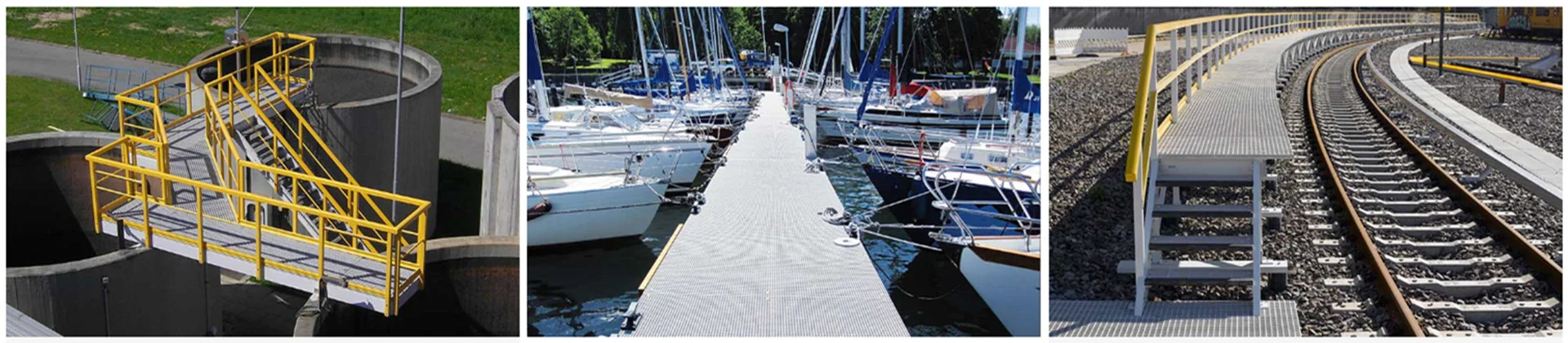
Molded and pultruded fiberglass grating is one of the most widely used FRP products in marine environments. Open mesh grating allows water and debris to pass through while providing a strong and slip-resistant walking surface. On docks and jetties, FRP grating panels are commonly used for access platforms, catwalks, fishery facilities and maintenance walkways, replacing steel grating that corrodes quickly in salt spray. Unicomposite supplies molded and pultruded gratings in a range of mesh sizes, panel thicknesses and resins to match different load and corrosion requirements.
FRP Profiles for Structural Members and Framing
Pultruded FRP I-beams, channels, square tubes and angles can be used as primary or secondary structural members in marine projects. Typical applications include framing for docks and marinas, pipe racks in desalination plants, ladders and support structures on offshore platforms, and reinforcement of seawalls and revetments. These profiles combine corrosion resistance with high strength to weight ratio, and they are easy to cut, drill and assemble on site with standard tools.
FRP Rebar in Marine Concrete Structures
In reinforced concrete structures exposed to seawater, corrosion of steel rebar is often the main cause of deterioration. FRP rebar provides a non-corroding alternative reinforcement for components such as sea walls, pile caps, splash zone beams and deck slabs. Using FRP rebar eliminates the risk of rust-induced cracking and spalling and allows designers to reduce concrete cover in some cases. For engineering teams interested in this solution, Unicomposite offers a full range of FRP rebar diameters and surface configurations suitable for marine applications.
Handrails, Ladders and Safety Barriers
FRP handrail and ladder systems are widely used on waterfront facilities, wastewater treatment plants and chemical docks. These systems are light enough to install without heavy lifting equipment, yet strong enough to meet typical industrial loading codes. They provide a corrosion-resistant, non-conductive and low maintenance safety solution around open water, chemical tanks and elevated platforms.
To explore these solutions in more detail, you can refer to our marine application page for FRP dock and marine systems at Dock & Marine, our fiberglass grating range at Molded / Pultruded Grating, our FRP rebar at FRP Rebar and our handrail and fencing systems at Handrail & Fencing System.
Design and Material Selection Considerations
Choosing the Right Resin System
The corrosion resistance of FRP is strongly influenced by the resin used. For demanding marine environments, vinyl ester resin is often recommended because it provides excellent resistance to seawater, chlorides and many solvents. Isophthalic polyester may be suitable for less severe exposures or above-water components. When selecting FRP materials for a project, designers should first define the chemical environment, expected temperature range and required service life, then choose a resin grade that meets the relevant corrosion resistance charts.
Mechanical Loads and Deflection Criteria
Although FRP has high strength, its modulus of elasticity is lower than that of steel, which means deflections under load will be greater for the same section size. For gratings, beams and decks, it is important to verify not only the ultimate load capacity but also deflection limits for comfortable walking or vehicle operation. Manufacturers provide load tables for standard grating panels and profiles, and custom structural design can be carried out using appropriate safety factors and design standards.
Fire Performance and UV Protection
Marine regulations or project specifications may require defined fire performance for structural components. FRP products can be formulated with fire-retardant resins and additives to achieve ratings such as ASTM E84 Class 1 or equivalent. In outdoor applications, UV stabilizers and surface veils are used to improve color retention and weathering resistance. Where long term aesthetics are important, applying a suitable topcoat or gelcoat can help maintain appearance over many years of exposure.
Fastening and Connection Details
FRP components are typically connected using stainless steel or galvanized steel fasteners, adhesive bonding or FRP-to-FRP bolted joints. Because FRP is anisotropic, bolt hole locations and edge distances should follow the manufacturer’s recommendations to avoid stress concentrations. For gratings on steel or FRP support frames, clip systems are used to ensure secure fixing while allowing for thermal expansion.
Cost, Maintenance and Lifecycle ROI
When comparing FRP with traditional materials, it is important to evaluate the full lifecycle cost rather than only the initial purchase price. Steel may appear cheaper at first, but frequent repainting, replacement of corroded grating and unscheduled shutdowns quickly increase total expenditure. FRP, on the other hand, may require a slightly higher initial investment but can significantly reduce maintenance and replacement costs over the service life of the structure.
| Parameter | Carbon Steel | Stainless Steel | Corrosion-Resistant FRP |
|---|---|---|---|
| Initial Material Cost | Low | High | Medium |
| Corrosion Resistance in Seawater | Poor without heavy coatings | Good but may suffer pitting | Excellent with proper resin |
| Typical Maintenance Frequency | High | Medium | Low |
| Weight Compared with Steel | 100% | About 100% | Approximately 25% to 30% |
| Expected Service Life | Often limited by corrosion | Good but dependent on environment | Very good with minimal degradation |
This comparison shows why many owners find that FRP delivers a lower total cost of ownership, especially when access for maintenance is difficult or disruption to operations is expensive.
How Unicomposite Supports Your Dock and Marine Projects
Unicomposite has been focusing on FRP pultrusion technology and composite solutions for many years. For dock and marine projects, we provide a complete package of corrosion-resistant FRP products, including structural profiles, molded and pultruded gratings, rebar, handrail systems and custom components tailored to your drawings. Our engineering team can help you select suitable resins, grating types and profile sizes, and propose practical solutions that match your loading, durability and budget requirements.
From early concept design to final delivery, we work closely with contractors, designers and end users to ensure that each project benefits from the full potential of FRP technology. Whether you are upgrading an existing steel dock or designing a new marine facility from scratch, we can help you evaluate how FRP can improve safety, durability and lifecycle performance.
FAQ: FRP for Marine and Dock Structures
Yes, when the correct resin system and corrosion barrier are selected, FRP performs very well in seawater, splash zones and tidal environments. Many components have been in service for decades with minimal loss of properties. It is important to discuss the exact exposure conditions with the manufacturer so that the right resin and laminate design can be recommended.
Pultruded FRP gratings and structural profiles can be designed for heavy duty loads, including light vehicles and forklifts, provided that the correct panel thickness, support spacing and profile sizes are used. Load tables and engineering calculations should be reviewed during design to verify both strength and deflection limits for the specific application.
To receive a suitable proposal, it is helpful to share drawings or sketches, expected loads, exposure conditions, required service life, local standards to be followed and any specific requirements regarding fire performance, color or surface finish. Based on this information, Unicomposite can suggest optimized FRP products and provide quotations for a complete dock or marine solution.


